
Section 1: Sulfuryl Fluoride — The Primary Structural Fumigant
The landscape of structural fumigation in the United States changed dramatically between 2005 and 2015. Methyl bromide — the dominant fumigant for decades — was phased out for structural pest control use under the Montreal Protocol on Substances that Deplete the Ozone Layer. Methyl bromide is an ozone-depleting substance, and its use in non-critical applications was eliminated through an international agreement that the United States signed and implemented through EPA regulations. By 2015, methyl bromide was no longer available for structural fumigation by licensed pest control operators in the United States.
The primary fumigant in use for structural pest control today is sulfuryl fluoride, sold under the trade names Vikane (manufactured by Corteva Agriscience, formerly Dow AgroSciences) and Zythor (manufactured by Ensystex). Both products share the same active ingredient — sulfuryl fluoride — and are used at similar dosage rates for the same target pests. The information in this lesson applies to both products; references to "Vikane" should be understood to encompass both registered formulations unless otherwise noted.
Chemical Properties of Sulfuryl Fluoride
Sulfuryl fluoride (chemical formula SO₂F₂) is a colorless, odorless, non-flammable gas at room temperature. These properties have important practical implications for fumigation operations:
- Colorless: Fumigant gas cannot be seen inside the structure. This is one reason that concentration monitoring with instruments is not optional — there is no visual indicator of gas presence or concentration.
- Odorless: Sulfuryl fluoride has no warning smell at dangerous concentrations. This is why chloropicrin (a lachrymatory agent — a substance that causes intense eye and nose irritation at very low concentrations) is required to be applied as a warning agent before the fumigant is introduced. If a person were to inadvertently enter a structure containing sulfuryl fluoride, they would have no sensory warning — they would simply be overcome by the gas. Chloropicrin provides that warning.
- Non-flammable: Unlike some older fumigants, sulfuryl fluoride does not pose a fire or explosion hazard. This simplifies the pre-fumigation shutoff procedures for open flames but does not eliminate all precautions (gas meter shutoff is still required).
- Density: Sulfuryl fluoride is approximately 3.5 times heavier than air. At room temperature in a static environment, it tends to settle toward lower portions of the structure. This is one reason that gas introduction points, monitoring locations, and aeration procedures are designed to account for vertical stratification within the structure.
- Vapor pressure: Sulfuryl fluoride has a vapor pressure of approximately 272 psi at 70°F. It is stored and transported as a liquefied gas under pressure in steel cylinders. When released, it rapidly volatilizes to gas phase.
The odorlessness of sulfuryl fluoride is not merely a chemical curiosity — it is the primary reason that chloropicrin must be applied before every fumigation. If a person enters a structure during fumigation and there is no chloropicrin, they will receive no sensory warning before reaching dangerous or lethal concentrations. The application of chloropicrin at the correct rate before introducing Vikane is a safety requirement, not an optional step. A fumigation conducted without chloropicrin is a violation of the product label and Florida law.
Mode of Action
Sulfuryl fluoride kills insects — and other organisms — through a multi-pathway mechanism that ultimately disrupts cellular respiration and ion transport. At the cellular level, sulfuryl fluoride is believed to act primarily as an inhibitor of cytochrome c oxidase, the terminal enzyme in the mitochondrial electron transport chain. Cytochrome c oxidase is responsible for reducing oxygen to water as part of aerobic metabolism. When this enzyme is inhibited, cells cannot generate ATP through aerobic respiration — essentially, the insect's cells cannot use the oxygen that is present in the air.
Secondary mechanisms include inhibition of acetylcholinesterase (the enzyme that breaks down acetylcholine at nerve synapses) and disruption of chloride ion channels in nerve membranes. The combined effect produces rapid neuromuscular dysfunction followed by death.
Critically, sulfuryl fluoride kills pests at all life stages: egg, larva/nymph, pupa, and adult. This is a major advantage over contact pesticides that may not effectively penetrate eggs or pupae. When dosed correctly, a complete structural fumigation achieves 100% mortality across all life stages of the target pest within the treated structure.
Penetration Characteristics
One of the key advantages of sulfuryl fluoride as a fumigant is its ability to penetrate into wood, foam, and other materials where target pests reside. Drywood termites spend their entire lives inside structural wood — they do not forage through soil or travel outside the timber they are infesting. Reaching them with contact or systemic pesticides applied to surfaces is difficult or impossible. Sulfuryl fluoride gas, being a small molecule, diffuses through wood grain and into wood galleries where termite colonies are established.
The rate of gas penetration into wood depends on several factors:
- Wood moisture content: Dry wood (less than 10% moisture content) allows faster gas penetration than wet or high-moisture wood. Green lumber, wet crawlspace wood, or wood damaged by water intrusion may require longer exposure times to achieve lethal concentrations throughout the wood mass.
- Wood species and density: Dense hardwoods (oak, mahogany) penetrate more slowly than softwoods (pine, fir). Most structural lumber in Florida homes is Southern yellow pine or spruce-pine-fir, which penetrate at predictable rates that the Vikane dosage tables account for.
- Temperature: Gas penetration into wood increases with temperature. At higher temperatures, wood fibers expand slightly, molecular diffusion rates increase, and the target pest's metabolism is faster — requiring less exposure time for lethality. The Vikane label includes temperature-adjustment factors that are applied to the base dosage rate.
- Concentration gradient: Gas penetrates wood from high-concentration areas (the air space within the tent) to lower-concentration areas (inside the wood). Maintaining the required minimum concentration in the air space throughout the exposure period is essential for achieving adequate penetration.
No Residual Activity
After a fumigation is complete and the structure is aerated, sulfuryl fluoride does not remain in the structure in biologically active concentrations. It does not bind to surfaces, wood, or furnishings in a way that continues to kill insects. Once the gas dissipates, there is no protection against new infestations. A drywood termite alate that lands on the structure and begins a new colony the week after fumigation will establish and grow just as if the fumigation had never occurred.
This characteristic requires that customers be clearly informed before fumigation, and that the written contract include the no-residual disclosure. Customers who expect ongoing protection from a one-time fumigation will be disappointed — and may file complaints or litigation — if this limitation is not explained upfront.
🪲 Section 2: Target Pests — Drywood Termites and Wood-Destroying Beetles
Whole-structure fumigation is most commonly used in Florida for drywood termites — termites that do not require soil contact, live entirely within the wood they infest, and are difficult or impossible to treat with soil-applied liquid termiticides or bait systems. Understanding the biology and identification of the target species drives the treatment selection decision.
West Indian Drywood Termite (Cryptotermes brevis)
The West Indian Drywood Termite is the most common and economically significant drywood termite in Florida and is considered the most widely distributed drywood termite species in the world. It was almost certainly introduced to Florida through the importation of infested wood products and furniture from the Caribbean, and is now established throughout all of peninsular Florida.
Identification
Cryptotermes brevis soldiers are unmistakable: they have a roughened, pitted (phragmotic) head that resembles a corncob or a plug when viewed from the front. This distinctive head shape — technically a phragmosis — serves as a physical plug to block tunnel entrances against ant attack. The head is dark brown to black, and much of the body is pale to yellowish. The combination of a dark, rough, strongly flattened head with a pale body is diagnostic for the genus Cryptotermes in Florida.
Swarmers of Cryptotermes brevis are small (approximately 7–8 mm including wings), dark brown to black, and emerge primarily in late summer and fall — a timing distinct from subterranean termite swarm seasons. Swarming typically occurs in the evening, and swarmers are strongly attracted to light. Finding small, dark-winged termites on windowsills or near light fixtures in late summer is a typical homeowner alert for this species.
Biology and Colony Structure
West Indian Drywood Termite colonies are small by termite standards — typically a few hundred to a few thousand individuals at maturity. Unlike subterranean colonies, which can extend their foraging galleries hundreds of feet through soil, drywood termite colonies are entirely contained within the wood they infest. Colony expansion occurs only as workers excavate additional galleries within the wood, and to new pieces of wood through direct contact.
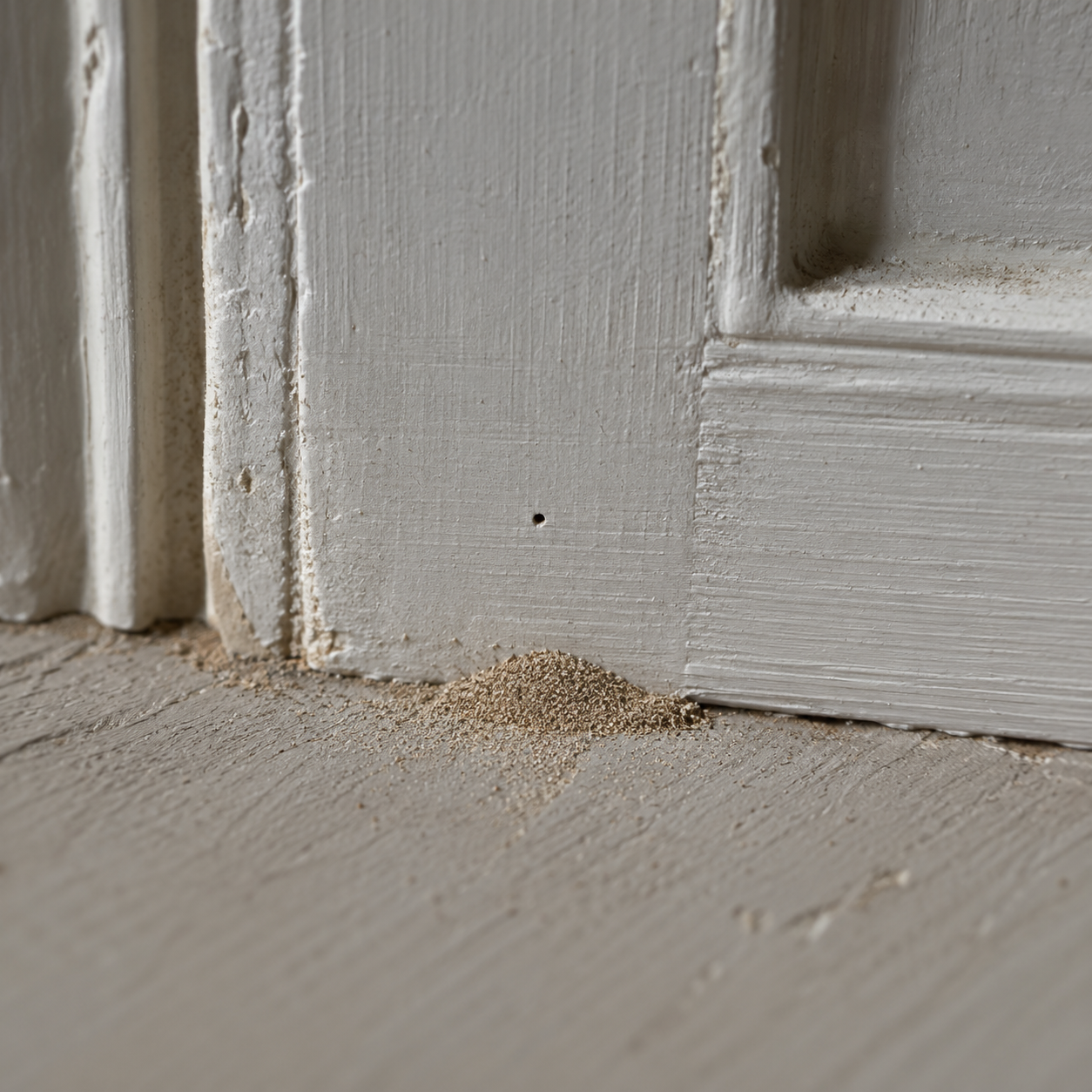
The most reliable sign of an active West Indian Drywood Termite infestation is the presence of fecal pellets (frass) — tiny, six-sided (hexagonal) pellets with flattened or concave sides, approximately 0.9–1.0 mm long, hard and dry, and variable in color from pale tan to dark brown depending on the wood being consumed. Workers eject pellets through "kick holes" in the gallery walls, and accumulations of pellets on surfaces below infested wood are the primary field indicator of an active colony. Finding pellets does not immediately reveal the extent of infestation — the colony may be small or it may have spread to multiple structural members.
The six-sided, dry, hard fecal pellet of the West Indian Drywood Termite is the most important field sign for identifying and locating drywood termite infestations. Learn to recognize them. A small pile of pellets on a windowsill, door frame, or floor below a wooden member is a strong indicator of an active colony in the wood above. Fresh pellets are lightly covered with a slight powdery material; older pellets are free and clean. A flashlight and a white card placed below suspected kick holes can make pellets easier to spot during inspections.
Southeastern Drywood Termite (Incisitermes snyderi)
The Southeastern Drywood Termite is the native drywood termite species of Florida and is found throughout the state, from the Panhandle to the Keys. While it is less commonly cited than the West Indian Drywood Termite in structural infestations, it is an important pest of structural lumber, furniture, and dead wood in Florida and along the Gulf Coast.
Identification
Incisitermes snyderi soldiers have a more typical termite head profile compared to the phragmotic Cryptotermes — the head is roughly rectangular with relatively large mandibles, and the entire body is pale yellowish-white to light tan. Soldiers are larger than Cryptotermes soldiers. Swarmers are pale yellow to brownish, with pale wings, and swarm from late spring through summer — earlier in the season than Cryptotermes brevis.
Biology
Like other drywood termites, Incisitermes snyderi colonies are small (a few hundred to a few thousand individuals), produce distinctive hexagonal fecal pellets, and are entirely contained within the wood they infest. Colonies develop slowly and may take five to ten years to reach maturity. The species shows a preference for dead wood, fence posts, wood in direct weathering exposure, and older structural lumber. In Florida, it is frequently found in crawlspace structural members, sill plates, and exposed porch or carport timbers.
Western Drywood Termite (Incisitermes minor)
The Western Drywood Termite is not native to Florida but is occasionally introduced through the importation of infested wood furniture and building components from the western United States, where it is the dominant drywood termite pest. It has been found in isolated infestations in Florida, most commonly in pieces of furniture or decorative wood that were imported from California, Arizona, or other western states.
Management is the same as for other drywood termite species. If a confirmed Western Drywood Termite infestation is localized to a single piece of furniture, targeted treatment (heat, cold, or localized fumigation) may be appropriate rather than whole-structure fumigation. However, if the infestation has spread to structural wood, whole-structure fumigation is the recommended approach.
Wood-Destroying Beetles
Whole-structure fumigation is also effective against several wood-destroying beetle species that are managed in structural settings in Florida. These include:
Powderpost Beetles (Family Lyctidae and Bostrichidae)
True powderpost beetles (Lyctus spp.) and false powderpost beetles (Bostrichidae) infest the sapwood of hardwoods and some softwoods. Adult beetles emerge through small, round exit holes and leave behind fine, flour-like frass (hence "powderpost"). Infestations are often introduced through infested hardwood flooring, hardwood furniture, or woodcraft materials imported from outside the region. Active infestations are identified by the presence of fine, powdery frass and fresh emergence holes with clean edges (older holes have weathered edges).
Old House Borer (Hylotrupes bajulus)
The Old House Borer is one of the most economically damaging wood-boring beetles in North America and is established throughout the eastern United States, including Florida. Despite its name, it most commonly attacks relatively recently seasoned softwood lumber — particularly pine — within the first 10 to 20 years after construction. Larvae tunnel within structural wood for three to twelve years before pupating and emerging as adults. The emergence holes are oval, approximately 6–10 mm wide, and the characteristic sign of infestation is a rasping or gnawing sound audible from within infested walls or structural members — the sound of feeding larvae. Frass is coarse and granular, packed in galleries.
Whole-structure fumigation is highly effective against Old House Borer at all life stages, including the long-lived larvae that are otherwise inaccessible within structural wood.
Deathwatch Beetle (Anobium punctatum)
The Deathwatch Beetle is less commonly encountered in Florida than the Old House Borer but is occasionally found in older structures, particularly in hardwood furniture and structural hardwoods. It produces small round emergence holes and fine, bun-shaped fecal pellets. Whole-structure fumigation is effective when infestations are widespread within a structure; isolated furniture infestations may be treated with targeted methods.
Section 3: Treatment Selection — When to Fumigate vs. Alternatives
Whole-structure fumigation is not always the appropriate or necessary response to a drywood termite infestation. The treatment selection decision requires an assessment of the extent of the infestation, the accessibility of the infested wood, the type of structure, and the customer's goals and circumstances. Understanding when fumigation is and is not the best choice is part of the certified operator's professional responsibility.
Indications for Whole-Structure Fumigation
Whole-structure tent fumigation is the indicated treatment when:
- Multiple infestations are present — evidence of drywood termite activity in two or more separate locations within the structure, particularly if the infestations are in inaccessible areas
- The extent of infestation is unknown — when a visual inspection cannot determine the full scope of the infestation and localized treatment would leave unknown active colonies untreated
- Infestation is in inaccessible structural wood — wall cavities, under flooring, within attic framing that cannot be spot-treated
- The infestation is confirmed or probable in the roof structure — attic framing and roof sheathing are particularly difficult to treat with localized methods and are well-penetrated by fumigant gas
- The customer requests complete protection — when the customer understands the alternatives but prefers the thoroughness of whole-structure treatment for a home sale, historic preservation, or peace of mind
Localized Alternatives to Whole-Structure Fumigation
When an infestation is small, localized, and fully accessible, alternatives to whole-structure fumigation may be appropriate. Certified operators must be familiar with these options so they can give customers accurate comparisons:
Orange Oil (d-limonene)
Orange oil products (primarily d-limonene derived from citrus peel) can be injected directly into drywood termite galleries through small drilled holes. D-limonene kills termites on direct contact and has some fumigant-like activity within the immediate gallery. Its limitations are significant: it does not penetrate wood the way sulfuryl fluoride does, it cannot reach colonies in inaccessible locations, and its effectiveness is entirely dependent on the ability to locate and treat all active galleries. Studies have shown highly variable efficacy ranging from complete control of accessible colonies to minimal control of colonies in dense or deep wood. Orange oil is not an appropriate alternative when the full extent of an infestation is unknown.
Heat Treatment
Structural heat treatment involves placing industrial heaters and fans throughout a structure to raise all interior surfaces — including the core of structural wood — to a minimum of 120°F (49°C) and holding that temperature for a specified time. Heat penetrates wood and kills drywood termites and other insects at all life stages. Heat treatment has the advantage of being a "natural" process with no chemical residue. Its disadvantages include: significant time and equipment requirements; risk of heat damage to electronics, waxed wood furniture, musical instruments, vinyl records, wine, candles, medications, and other heat-sensitive items; difficulty achieving uniform lethal temperatures in very large or compartmentalized structures; and the inability to document internal wood temperatures with the same precision as gas concentration monitoring.
Electrocution (Electro-Gun)
Electrocution devices deliver a high-voltage, low-current electrical charge through the surface of infested wood, killing termites and other insects in their galleries. This method is limited to accessible, exposed wood surfaces and is unsuitable for large-scale infestations or infestations in inaccessible areas. It is rarely used as a primary treatment method and is generally appropriate only for very localized, confirmed infestations in exposed wood.
Microwave Treatment
Handheld microwave devices can deliver microwave energy into infested wood, heating the galleries to lethal temperatures. Like electrocution, this method is limited to accessible surfaces and small treatment areas. It is most useful for localized spot treatment in confirmed, accessible infestations.
Borate Wood Treatment
Borate products (sodium borate decahydrate, disodium octaborate tetrahydrate) in glycol carriers (Boracare, Tim-bor) penetrate deep into dry structural wood and deposit boron salts throughout the wood matrix. Borates are toxic to termites, wood-decaying fungi, and beetles. They provide long-term residual protection. However, borate treatment requires access to bare or previously untreated wood surfaces — painted or finished wood does not allow adequate borate penetration. Borate treatment is most effective as a preventive treatment on new construction or as a follow-up treatment after fumigation or remediation of water-damaged wood. It is not generally adequate as a standalone treatment for an active, ongoing drywood termite infestation in an established structure.
- Multiple colonies or unknown extent: Whole-structure fumigation is the only method that reliably treats the entire structure simultaneously
- Single accessible colony in small, exposed wood: Localized treatment (injection, heat spot treatment) may be appropriate
- Preventive treatment of new wood or post-remediation wood: Borate treatment provides excellent long-term residual protection
- Customer wants no-chemical option: Heat treatment is an alternative for accessible structures, with proper item removal and temperature documentation
- Customer wants maximum certainty in whole structure: Whole-structure fumigation provides the most thorough, documented, verifiable treatment
Section 4: Chloropicrin — The Required Warning Agent
Chloropicrin (trichloronitromethane, CCl₃NO₂) is a colorless to slightly yellow, oily liquid that produces a potent gas with intense lachrymatory (tear-producing) and irritating properties. At concentrations as low as 1–2 ppm, chloropicrin causes severe eye and respiratory irritation, involuntary tearing, coughing, and a burning sensation in the nose and throat. These properties make it ideal as a warning agent in situations where the primary fumigant (sulfuryl fluoride) is odorless and does not provide sensory warning.
Required Use Before Fumigant Introduction
The Vikane and Zythor product labels — which have the force of federal law — require that chloropicrin be applied at the labeled rate to the structure before sulfuryl fluoride is introduced. The chloropicrin must be placed in the structure in a manner that distributes the warning gas throughout all areas before the fumigant is added. Typical placement involves setting chloropicrin applicators in the structure, allowing the gas to distribute for a specified period, and then introducing the sulfuryl fluoride.
The required chloropicrin application rate is specified directly on the Vikane label (EPA Reg. No. 1015-78, current specimen revised 07/08/2024). Applicators must calculate the correct chloropicrin quantity and document it on the application record alongside the sulfuryl fluoride dosage.
Chloropicrin Dosing per the Current Vikane Label
- Application rate: 1 fl oz of chloropicrin per 10,000–15,000 cubic feet of space being fumigated (30 ml per 283–425 cubic meters). Alternatively, follow the dosage rate calculated by the Vikane Fumiguide® Calculator for the specific job.
- Per-container maximum: dispense no more than 3 fl oz of chloropicrin into any single evaporation container. Heavy single-container placement does not volatilize efficiently and leaves residual liquid that complicates clearance.
- Introduction sites: establish at least one chloropicrin introduction site for every 45,000 cubic feet of fumigated space. Multiple sites distribute the warning gas throughout the structure so an unauthorized entrant receives sensory warning anywhere they could enter.
- Container preparation: place a handful of wicking agent (e.g., cotton) inside the evaporation container, then pour chloropicrin over the wicking agent. The wick increases the surface area available for evaporation and accelerates the warning gas's distribution.
- Container material: do not use chloropicrin evaporation containers or application equipment made of magnesium, aluminum, or their alloys — chloropicrin is severely corrosive to these metals and will react with them. Glass, ceramic, plastic, or appropriate stainless-steel containers are acceptable.
- Fan placement: place the chloropicrin evaporation container(s) in the air stream of a fan to enhance distribution of the warning agent throughout the structure.
- Multi-point application sequence: when applying chloropicrin at multiple introduction sites within a structure, start at the point farthest from the exit and work toward the exit. This ensures the applicator is not walking through a chloropicrin-saturated atmosphere on the way out.
- Pre-release timing: chloropicrin must be released within the structure at least 5 to 10 minutes prior to introduction of sulfuryl fluoride, so the warning gas distributes throughout the structure before the odorless fumigant arrives.
- During aeration: removal of all chloropicrin evaporation containers from the fumigated space during the initial phase of aeration (Step 1 of Aeration Procedure 1 or 2) aids dissipation of the warning agent from the structure.
Chloropicrin Safety
While chloropicrin is used as a warning agent at relatively low concentrations, it is itself a toxic material at higher exposures. The OSHA Permissible Exposure Limit (PEL) for chloropicrin is 0.1 ppm as an 8-hour time-weighted average. At the concentrations present inside a tented structure after chloropicrin application, it is immediately dangerous to life and health — no person may enter the structure without a self-contained breathing apparatus (SCBA) after chloropicrin has been applied. The warning properties of chloropicrin that protect unauthorized entrants from fumigant exposure also mean that a properly equipped fumigation crew must treat chloropicrin introduction as a full respiratory protection event.
Section 5: Environmental Fate and Regulatory Status of Sulfuryl Fluoride
Unlike methyl bromide, which was phased out primarily because of ozone depletion, sulfuryl fluoride does not deplete the ozone layer. However, it is a potent greenhouse gas — its global warming potential (GWP) is estimated at approximately 4,800 times that of carbon dioxide over a 100-year period. This has led to ongoing regulatory scrutiny at both the federal and international levels.
EPA approved sulfuryl fluoride as the replacement for methyl bromide in structural fumigation, but has also noted its greenhouse gas profile in regulatory assessments. Certified operators should be aware that the regulatory status of sulfuryl fluoride may continue to evolve, and that industry best practices around dosage accuracy — using the minimum effective dosage rather than excess fumigant — are both legally and environmentally important.
After aeration of a fumigated structure, sulfuryl fluoride dissipates into the atmosphere where it is eventually broken down through photolytic and atmospheric chemical processes. It does not accumulate in soil, water, or food products at residual levels after a properly conducted fumigation.
| Property | Sulfuryl Fluoride (Vikane/Zythor) |
|---|---|
| Chemical formula | SO₂F₂ |
| Appearance | Colorless, odorless gas |
| Density relative to air | ~3.5× heavier than air |
| Flammability | Non-flammable |
| Primary mode of action | Inhibits cytochrome c oxidase; disrupts cellular respiration |
| Life stages killed | All stages: egg, larva/nymph, pupa, adult |
| Residual activity | None after aeration |
| Regulatory status | Restricted Use Pesticide (EPA-FIFRA) |
| Required warning agent | Chloropicrin (required before gas introduction per label) |
| Primary structural use | Drywood termite whole-structure fumigation; wood-destroying beetles |