
Section 1: Customer Preparation Requirements
The pre-fumigation preparation process begins well before the fumigation crew arrives at the property. Customers must be fully briefed on what they are responsible for removing, sealing, or relocating before the tent goes on — and the certified operator's company is responsible for ensuring that preparation is complete before gas is introduced. An incomplete preparation is not a minor administrative matter; it is a safety and legal hazard. Fumigant exposure to improperly stored food, medications, or — most critically — a person or animal who was not evacuated, can result in injury, death, and criminal liability.
Evacuation of All Occupants
All persons must vacate the structure before fumigation preparation begins. This includes:
- All residents and family members
- Domestic employees, housekeepers, and caregivers who may have regular access to the home
- All pets, including fish, birds, reptiles, amphibians, and any other animals
- All plants — both indoor plants and plants in attached structures such as enclosed sunrooms or atriums
Fish and other aquatic animals require special attention. Aquariums connected to external aerators or water features that draw outside air from the fumigated space must be moved or disconnected during fumigation. The fumigant entering an aquarium aerator pump can kill fish even if the tank is in an adjacent non-fumigated space, if air is drawn from the fumigated structure.
The certified operator should confirm evacuation in writing through the pre-fumigation preparation checklist. The checklist should include a signed statement from the responsible adult occupant (or property owner) confirming that the structure has been fully vacated and that all items on the preparation list have been addressed.
The most common overlooked occupant in structural fumigations is a pet — particularly a cat or dog that hides in a confined space and cannot be found at evacuation time. Before the tent goes on, require the customer to certify that all pets have been removed and transported to a boarding facility or other safe location. Some companies require that a pet boarding confirmation be presented before fumigation proceeds. A pet left inside a tented structure will not survive. The liability exposure for a pest control company that fumigates a structure with a living animal inside is severe.
Food, Beverages, and Medications
All food and beverages — including items in opened or unsealed containers — must be removed from the structure or double-bagged in approved fumigation bags (commonly called "NodaFume bags" or equivalent airtight fumigant barrier bags) before fumigation. This requirement comes directly from the Vikane product label and applies to:
- All open food containers, including items in open pantries or cupboards
- Fresh produce left on counters
- All items in the refrigerator and freezer (if the power will be off during fumigation) or items in open containers in the refrigerator
- Opened bottles of beverages (wine, spirits, juice, condiments)
- All medications and vitamins — including items that appear tightly sealed in their original containers
- Baby formula and infant food
- Pet food — especially if in an open bag or bowl
The Vikane label specifies that food items may remain in the structure if they are placed in intact, undamaged, sealed fumigant barrier bags meeting the ASTM D3985 standard for oxygen transmission rate. Double-bagging with nylon-polyethylene composite fumigation bags is the industry standard. Regular plastic grocery bags, zip-lock bags, and most household plastic bags do not provide adequate fumigant barrier protection and cannot be substituted.
Sealed Factory Packages
Factory-sealed, unopened, commercially packaged food products in metal cans with sealed lids, glass jars with sealed lids, and similarly sealed containers may remain in the structure without bagging under the Vikane label — because the factory seal provides a fumigant barrier. However, the safest practice is to remove or bag everything, since container seals that appear intact may have microscopic defects. FDACS inspection history shows that disputes over whether food was "adequately sealed" are among the most common post-fumigation consumer complaints. Removing everything avoids the argument entirely.
Medications and Controlled Substances
All medications — prescription and over-the-counter — must be removed from the structure or placed in approved fumigation bags. Many prescription medications, including controlled substances (opioids, benzodiazepines, stimulants), must be transported from the structure by the patient or their caregiver. Advise customers to arrange this well before the fumigation date, as transportation requirements for controlled substances may require advance planning (a patient cannot simply leave their prescription medications in a bag on the porch).
Mattresses and Bedding
Mattresses, pillows, and bedding do not need to be removed from the structure during fumigation. Sulfuryl fluoride does not leave a biologically active residue in fabric, foam, or wood after proper aeration. Customers may leave bedding in place.
Section 2: Structural Preparation — Sealing, Tarping, and Utilities
Proper structural preparation is the physical foundation of an effective and safe fumigation. If the tent does not achieve a reasonable gas seal around the structure, gas will escape faster than it is introduced — and it will be impossible to maintain the minimum fumigant concentrations required for complete pest mortality. The structural preparation phase is where experienced crews make the difference between a fumigation that works and one that fails.
Structural Tenting (Tarping)
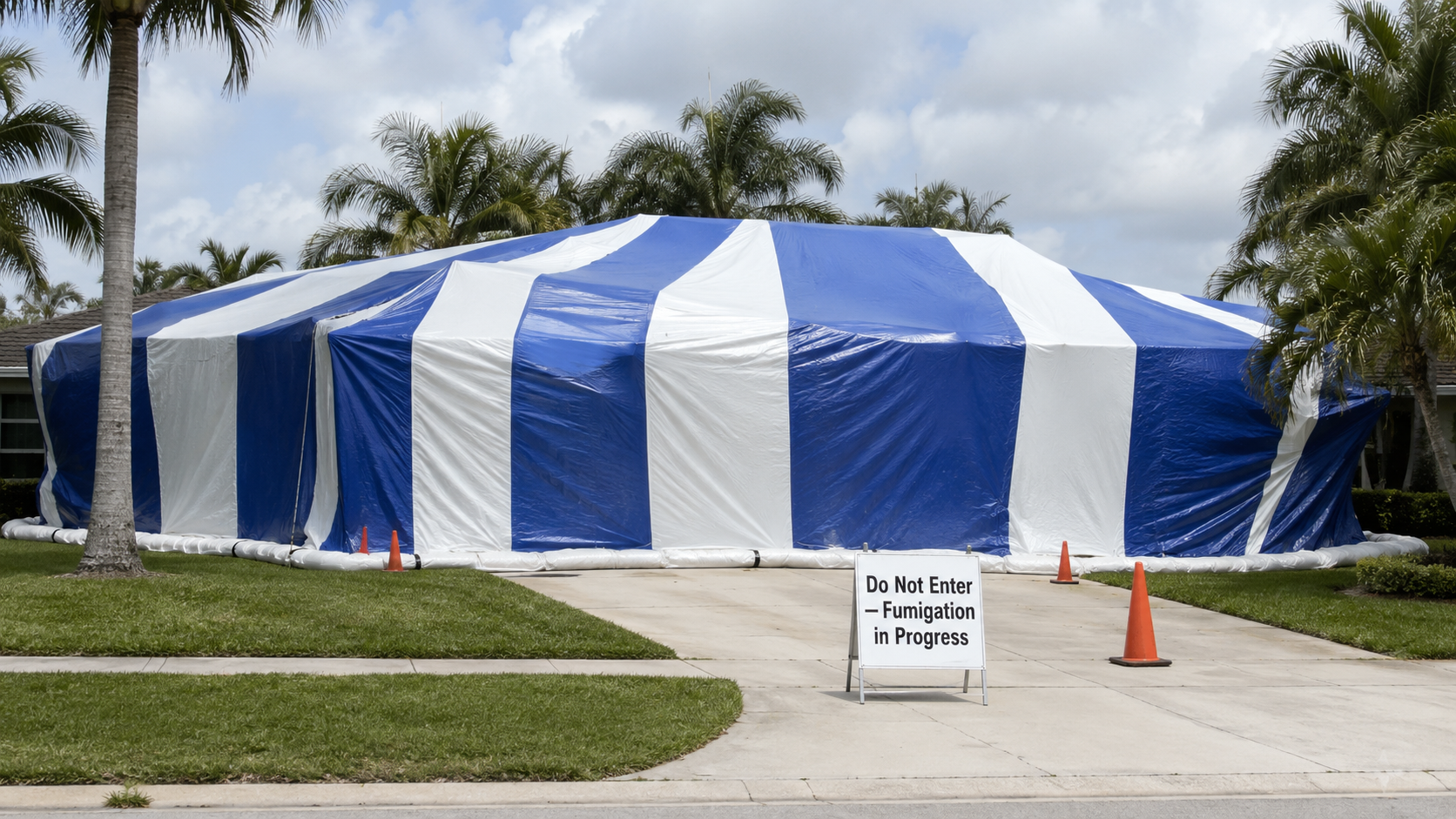
Whole-structure fumigation requires enclosing the structure in a gas-tight tent made from heavy-duty fumigation tarps. Fumigation tarps are typically constructed from woven polyethylene or similar materials with low gas permeability. They are available in a range of sizes and are connected at the edges with clamps or "fumigation tape" to form a continuous enclosure around the structure. The tent must extend to ground level and be sealed along the ground perimeter with "sand snakes" (sandbags or flexible weighted tubes) or other ground-sealing devices that prevent gas from escaping under the tent skirt at grade level.
Tarp Preparation and Inspection
Before installation, all fumigation tarps must be inspected for holes, tears, worn areas, and damaged seams. A small hole in a fumigation tarp can result in significant gas loss, elevated gas concentrations in adjacent areas, and failure to achieve the minimum concentration-time (CT) factor required for pest mortality. Tarps that cannot be fully patched must be replaced. Most fumigation companies use a tarp inspection log that records the condition of each tarp section before and after each use.
Tent Installation Sequence
Typical tent installation proceeds as follows:
- Crew performs pre-fumigation structure walk-through to confirm evacuation and preparation compliance
- All interior doors, cabinets, closets, and drawers are opened to allow free gas circulation through the structure
- Attic access panels and attic vents are left open or adjusted per the label to allow gas penetration into the attic space
- Tarps are draped over the roof peak and down the sides of the structure, with additional tarps connected at the eaves and down to ground level
- Ground snakes are placed along the perimeter at the base of the tent to seal the tent-to-ground interface
- Any gaps around protruding pipes, meter boxes, air conditioning units, or structural irregularities are sealed with tarp patches and fumigation tape
- The structure is visually inspected from all sides for obvious tent gaps before proceeding to the warning agent application step
Attached Structures
Attached garages, enclosed patios, sunrooms, and other structures that are connected to the main structure must either be included in the fumigation tent or adequately sealed off at the point of connection. Including attached structures in the tent is generally preferable because gaps at the connection point between the fumigated and un-fumigated portions of a structure are a common source of gas leakage and uneven concentration distribution.
Interior Preparation
Before the tent is installed, the structure interior must be prepared to allow free gas circulation and to prevent gas accumulation in unintended areas:
- Open all interior doors — including closet doors, pantry doors, cabinet doors, and interior room doors — to allow free circulation of fumigant gas throughout the structure
- Open all drawers — fumigant needs to penetrate drawer contents; opened drawers allow gas circulation inside furniture
- Open attic access panels — attics must be penetrated by the fumigant; sealed attic hatches prevent adequate gas penetration to roofline wood
- Remove or open safe doors where possible — safes that are sealed may prevent adequate fumigant penetration to materials stored inside
- Plastic tarps or drop cloths should not be left covering furniture or floors — plastic sheeting under or around objects can prevent fumigant from reaching surfaces below
Gas and Electrical Utilities
Natural Gas Shutoff
All gas service to the structure must be shut off at the meter before fumigation. This includes the main natural gas supply and any propane tanks connected to the structure. The Vikane label requires extinguishing all pilot lights and open flames, and shutting off gas service at the meter ensures that gas appliances — water heaters, furnaces, pool heaters, gas stoves — are completely shut down and cannot attempt to ignite during the fumigation period. Gas shutoff must be coordinated with the utility company if it requires operating the curb stop valve; a fumigation crew should not unilaterally shut off city gas service at the street without authorization.
Electrical Considerations
Electrical service does not need to be shut off for sulfuryl fluoride fumigation, but the following electrical precautions are required:
- Turn off all HVAC systems (air handlers, heat pumps, exhaust fans). HVAC systems must not operate during fumigation as they can redistribute gas in uneven patterns and may pull gas into return air ducts where it concentrates
- Disable all smoke detectors and carbon monoxide detectors in the structure — these will alarm when exposed to fumigant gas. Note that disabling smoke detectors means the structure has no fire detection during the fumigation period; this is one reason why fire department notification is a professional best practice
- Disconnect any automatic irrigation systems that could flood the tent perimeter and displace ground seals
- Turn off all automatic lights, appliances, and devices that might operate on a timer during fumigation and draw attention to the structure
Swimming Pools and Hot Tubs
Pool and spa pumps should be turned off during fumigation if the pool or spa is enclosed within the tent. Exposed pool or spa water within the tent should be covered or the pool equipment isolated to prevent gas absorption into the water — sulfuryl fluoride has limited solubility in water, but pool covers prevent any potential issue and protect tarp ground seals from water splashing.
- All occupants and pets evacuated — confirmed in writing
- All food, beverages, and medications removed or double-bagged in approved fumigation bags
- All interior doors, cabinets, closets, and drawers opened
- All attic access panels opened
- Gas service shut off at meter — pilot lights extinguished
- All HVAC systems off — thermostats off or set to prevent operation
- Smoke detectors and CO detectors disabled
- Automatic irrigation turned off
- Refrigerator and freezer — open containers removed or bagged; refrigerator/freezer can remain operating
- Plastic drop cloths and furniture covers removed from furniture and floors
Section 3: Warning Signs and Lock Boxes
Warning signs and lock boxes are not optional equipment — they are federally and state-mandated safety devices that must be in place before any fumigant is introduced into the structure. Their purpose is to prevent unauthorized entry by neighbors, first responders, utility workers, or occupants who return during the fumigation.
Warning Sign Requirements
The EPA Fumigant Risk Mitigation Measures (RMMs) established requirements for the minimum content, size, and placement of warning signs for sulfuryl fluoride fumigations. These requirements are incorporated into the Vikane product label and into Florida law by reference. Warning signs must:
- Be posted at every entrance to the structure, including all exterior doors, gate entrances to fenced yards, and entrances to attached garages
- Bear the words "DANGER — POISON GAS" in large, legible lettering
- Include the skull-and-crossbones (or equivalent danger pictogram)
- Identify the fumigant being used (e.g., "SULFURYL FLUORIDE — VIKANE")
- Include the name and 24-hour emergency telephone number of the fumigation company
- State that the structure is being fumigated and that re-entry before clearance is forbidden
- Meet minimum size requirements (at least 8.5 inches × 11 inches, large enough to be easily read from the entry point)
Warning signs must be posted before chloropicrin is applied and must remain posted until the certified operator has completed clearance testing and formally declared the structure safe for re-entry. Removing warning signs before clearance is complete — even temporarily — is a violation.
Lock Box Requirements
Lock boxes (also called fumigation lock boxes or entry control devices) are installed over all entry door lock cylinders to prevent the use of the occupant's key to open doors during fumigation. Lock boxes are available in various designs but must have two key requirements:
- They cannot be bypassed without the fumigation company's key — the occupant's key must be physically blocked from engaging the lock cylinder
- They must be installed on all lockable entrances — all exterior doors, and any door that an occupant or emergency responder might attempt to open
The fumigation company holds one set of keys to the lock boxes and — in some jurisdictions or for large commercial fumigations — provides a second set to the local fire department for emergency access.
Windows must be secured from the inside or from outside access. Ground-floor windows that could be opened from outside must not be accessible. If a window cannot be secured from inside before the structure is vacated, it must be locked from outside or secured with a tamper-evident seal.
Every fumigation that proceeds without lock boxes installed on all entry points is a federal label violation, regardless of other precautions taken. Lock boxes exist because people return to their homes during fumigation — sometimes within hours. A customer who says "I'll just stay with family" may decide to retrieve forgotten medications or a child's school project that evening. Without a lock box, their key will open the door. With a lock box installed correctly, the door cannot be opened even with the correct key. Install lock boxes on every lockable entry before chloropicrin is applied. No exceptions.
Secondary Locks and Emergency Responder Access
Beyond the primary lock box, the Vikane and Zythor labels require a secondary lock on every entrance that prevents the door from being opened by normal means — even by someone holding a valid key. A "secondary lock" is any demonstrably effective device that defeats the existing door hardware: an interior barricade on a sliding glass door, a deadbolt brace on a front door, a track-blocker on a garage door, or a chain that physically prevents the door from opening past a few inches. A garage door must additionally have its automatic opener disabled (unplug the unit) and the door secured against being manually lifted from the outside. If an interior-only locking mechanism (such as a sliding glass door's interior latch) is already engaged and the door cannot be opened from outside even with a key, that interior lock can serve as the secondary lock and no additional device is required for that door.
The purpose of secondary locks is layered defense: if a customer or unauthorized person somehow defeats the primary lock box (by picking, by using their original key in a way that bypasses the box, or by removing the box improperly), the secondary lock prevents the door from opening anyway. Each entry point gets both a lock box AND a secondary lock. There is no acceptable substitute for either layer.
Equally important is the certified operator's continuous access to the structure during the fumigation. The certified operator must hold the keys (and any combination codes, electronic fobs, or other access credentials) required to enter the structure at any moment from gas introduction through clearance. If a customer refuses to provide keys or refuses to make their keys available to the fumigator for the duration of the fumigation, the fumigation must not proceed. This is not a customer preference issue — it is a label and Chapter 482 compliance issue. The certified operator must be able to respond to an emergency, perform interim monitoring, and conduct aeration without delay or third-party coordination.
Emergency contact information posted on the warning signs must be a phone number that connects to a live human trained on the fumigation, not a voicemail box or generic answering service. Many jurisdictions require — and professional fumigators always perform — a courtesy notification to the local fire department before fumigation begins. A printed copy of the site plan, the fumigant being used, the emergency contact, and a key access plan should be coordinated with the fire department's non-emergency line in advance. In a structural fire response or false-alarm dispatch, fire department personnel must know which structures are under fumigation in their response area so they can respond appropriately if an alarm is received from an adjacent address.
Section 4: Personal Protective Equipment for Fumigation Crews
Fumigation crew members face acute inhalation hazards during multiple phases of a fumigation job. The appropriate respiratory protection depends on the activity being performed and the expected fumigant concentration in the breathing zone. Selecting and using the correct respiratory protection is a life safety matter — inadequate respiratory protection during fumigation operations has resulted in applicator fatalities.
Respiratory Protection Hierarchy
Respiratory protective devices are classified by their Assigned Protection Factor (APF) — the maximum ratio of workplace concentration to the maximum use concentration for which the respirator provides adequate protection. For fumigation work, three types of respirators are relevant:
Air-Purifying Respirator (APR) with Organic Vapor Cartridges
Air-purifying half-face or full-face respirators with combination organic vapor / acid gas cartridges can be used for some fumigation-related tasks at low fumigant concentrations. However, air-purifying respirators have critical limitations for fumigation work:
- APRs do not supply oxygen — they only filter the ambient air. If oxygen levels are depleted (possible in a sealed structure at high fumigant concentrations), an APR provides no protection
- APRs do not protect against immediately dangerous to life or health (IDLH) concentrations (200 ppm sulfuryl fluoride)
- The cartridges must be appropriate for the specific fumigant — standard organic vapor cartridges offer limited protection against sulfuryl fluoride and must be replaced frequently
- APRs may be used only when concentrations are known to be below the maximum use concentration for the respirator, which requires prior atmospheric testing
Supplied-Air Respirator (SAR)
A supplied-air respirator provides clean, breathable air from a remote compressed air source through a hose to the wearer. SARs are appropriate for extended-duration tasks inside the fumigated structure when concentrations do not exceed 2,000 ppm (the maximum concentration for SAR use without SCBA backup). SARs are sometimes used by fumigation crews during gas introduction and early monitoring phases when the crew needs to be inside the structure but concentrations are not yet at IDLH levels.
Self-Contained Breathing Apparatus (SCBA)
A self-contained breathing apparatus — the same type used by firefighters — provides the highest level of respiratory protection and is the required respiratory protection for entry into a structure after chloropicrin has been applied or after sulfuryl fluoride has been introduced at any concentration. SCBA supplies the wearer's breathing air from a pressurized cylinder carried on the back, independent of ambient air. It provides protection at any fumigant concentration, including IDLH levels.
SCBA must be used — without exception — by any person entering a structure after chloropicrin has been applied or after sulfuryl fluoride introduction has begun. There is no safe shortcut here. A person who enters a tented structure with only an air-purifying respirator after chloropicrin has been applied is at immediate risk. If the SCBA is not available or not functioning, the entry does not happen. Every fumigation crew must have properly maintained, air-cylinder-charged SCBA available on-site at all times after preparation begins.
SCBA Maintenance and Training
Fumigation crews must be trained in the proper use of SCBA — donning and doffing, seal check procedures, air supply monitoring, and emergency procedures (low-air alarm response, buddy system requirements). SCBA cylinders must be inspected before every fumigation job to confirm they are fully charged. A partially charged SCBA cylinder represents a serious hazard — if a crew member needs to enter the structure during fumigation for a monitoring or emergency task and discovers the cylinder is low on air inside the structure, they are in immediate danger.
OSHA 29 CFR 1910.134 (Respiratory Protection Standard) requires that employers provide a written respiratory protection program covering selection, fit testing, training, inspection, and maintenance of respiratory protective equipment. The fumigation certified operator must ensure that the company's respiratory protection program addresses all fumigation-specific requirements.
Other PPE for Fumigation Operations
In addition to respiratory protection, fumigation crew members should use:
- Chemical-resistant gloves when handling chloropicrin applicators or fumigant cylinders — chloropicrin is a severe skin and mucous membrane irritant
- Eye protection (safety glasses or goggles) during chloropicrin handling — chloropicrin causes intense eye irritation on contact
- Appropriate footwear — closed-toe shoes with non-slip soles for working on roofs and in confined spaces during tent installation
- Fall protection equipment when working on roofs of structures taller than 4 feet, per OSHA requirements
Section 5: Crew Safety Protocols and the Buddy System
Fumigation operations require a minimum of two trained crew members to be present at all times during gas introduction, concentration monitoring inside the structure, and clearance testing. This is the "buddy system" — no crew member may enter a fumigated structure alone. The reasons are straightforward: if a crew member becomes incapacitated inside the structure due to equipment failure, unexpected fumigant exposure, or a medical emergency, a second person must be available to assist with an emergency rescue.
Daily Safety Briefing
Before every fumigation job, the certified operator or lead applicator must conduct a crew safety briefing that covers:
- The specific fumigant and chloropicrin being used that day and their hazards
- The structure layout — where all entry points are, where the monitoring points will be, and where the gas cylinders will be placed
- SCBA inspection results — confirmation that all SCBA units are fully charged and functioning
- Emergency procedures — the location of the nearest emergency medical facility, the fumigation company's emergency contact number, and the procedure for a crew member incapacitation event
- Communication plan — how the crew will maintain contact during the job, including what to do if a crew member cannot be reached
Adjacent Property Safety
Fumigant gas does not recognize property lines. During tent installation and gas introduction, the fumigation company must take measures to prevent fumigant from migrating to adjacent structures, particularly in attached multi-unit buildings. At minimum:
- Adjacent occupants must have been notified and, for attached units, must have left their unit or sealed shared walls prior to gas introduction
- Concentration monitoring in adjacent units may be required for attached townhomes, condominiums, or multi-unit structures where shared walls may allow gas permeation
- Ambient air monitoring at the perimeter of the tent during gas introduction confirms that fumigant is not escaping at dangerous levels
- Structure fully evacuated — all persons, pets, and plants confirmed out, in writing
- All food, beverages, medications bagged or removed per label
- All interior doors, drawers, and cabinets opened
- Gas service shut off at meter; pilot lights extinguished
- HVAC off; smoke/CO detectors disabled
- Structure tented — tarps inspected, gaps patched, ground snakes sealed
- Warning signs posted at every entrance — before chloropicrin application
- Lock boxes installed on all lockable entry points
- Adjacent property notification complete
- All crew SCBA cylinders checked — fully charged, functioning
- Daily safety briefing completed
- Emergency procedures reviewed — nearest emergency facility location confirmed
- Dosage calculation completed and signed before gas introduction