
This course covers cockroach control for Florida certified operators across four lessons. By the end of the course you will be able to:
- Describe cockroach biology, anatomy, and the egg-nymph-adult life cycle, and explain why it drives control decisions.
- Identify the cockroach species found in Florida and distinguish domestic from peridomestic species and habits.
- Conduct a professional inspection using monitoring traps and sanitation within an Integrated Pest Management (IPM) program.
- Select and place gel baits, insect growth regulators, and dusts correctly, and apply resistance-management and bait-rotation practices.
These objectives are reviewed at the end of the final lesson.
Cockroaches are among the oldest and most successful insects on Earth. The fossil record places their lineage at over 320 million years — they predate dinosaurs and have survived every major extinction event since the late Carboniferous period. That deep evolutionary history is not a trivia point: it explains why cockroaches are exceptionally hard to kill, why they tolerate environments that would destroy most insects, and why effective cockroach management demands a working knowledge of their biology rather than just a product label.
Florida's warm, humid, year-round climate makes the state one of the most cockroach-rich environments in the United States. A Florida certified operator will encounter cockroaches in nearly every account type — single-family homes, apartments, restaurants, food processing plants, hospitals, schools, warehouses, marinas, and public infrastructure. Understanding the biology covered in this lesson is the foundation that makes the species identification, inspection, and product selection in later lessons make sense.
Taxonomic Position — Order Blattodea
Cockroaches belong to the order Blattodea, which now also includes the termites. Genetic and morphological work in the 2000s established that termites are essentially highly social, wood-feeding cockroaches descended from a wood-roach ancestor — a biological fact with practical implications for understanding both groups. Worldwide there are roughly 4,500 described cockroach species, but fewer than 30 are considered structural pests, and only seven species account for virtually all professional pest management work in Florida:
- German cockroach — Blattella germanica
- American cockroach — Periplaneta americana
- Smoky-Brown cockroach — Periplaneta fuliginosa
- Australian cockroach — Periplaneta australasiae
- Brown-banded cockroach — Supella longipalpa
- Asian cockroach — Blattella asahinai
- Florida woods cockroach ("palmetto bug") — Eurycotis floridana
These seven are covered in detail in Lesson 2. The remainder of this lesson covers the general biology that applies to all of them.
External Anatomy
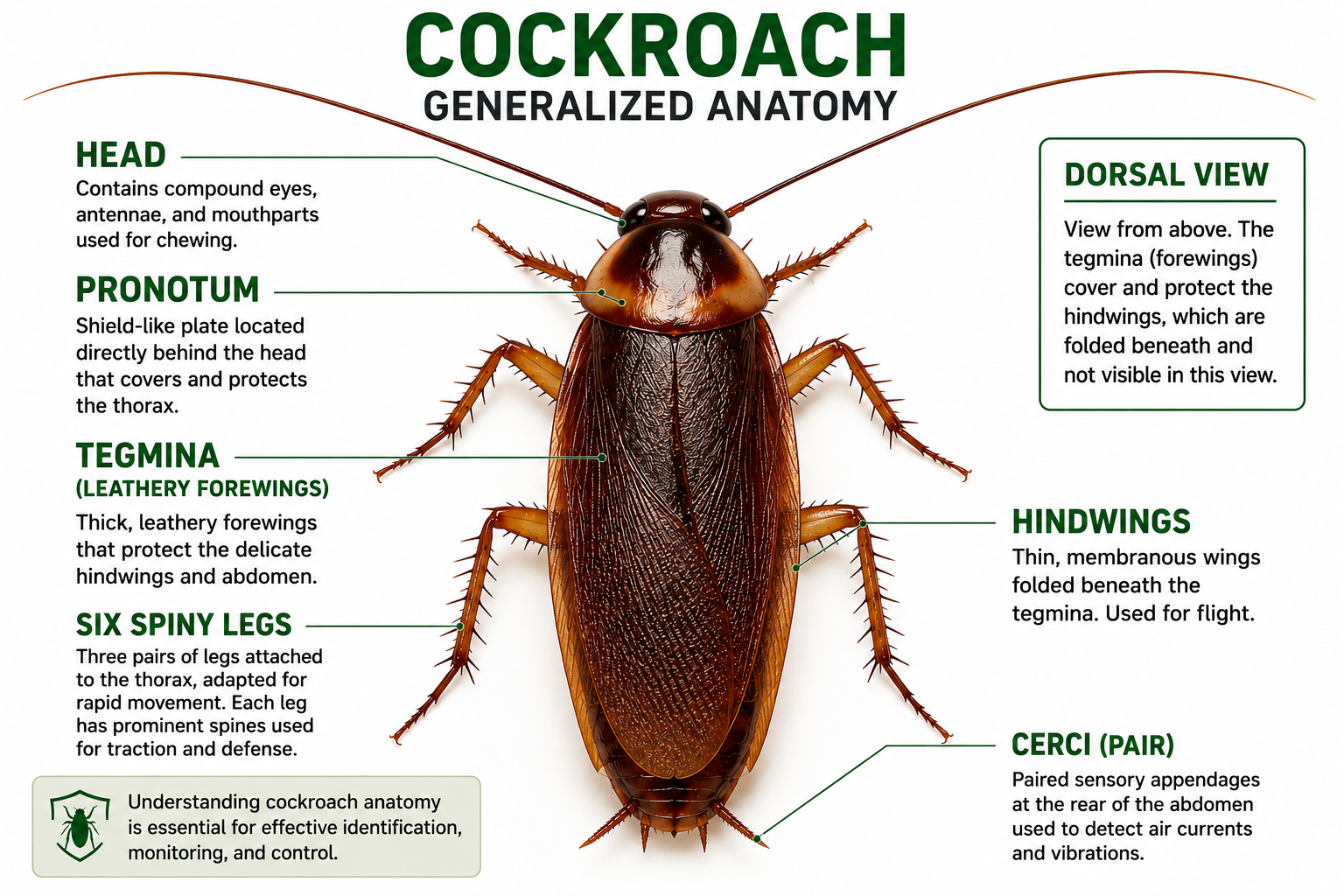
A cockroach body is divided into the standard insect three regions: head, thorax, and abdomen. Several anatomical features have direct field-identification or control significance.
Head and Mouthparts
The head is held downward beneath the body and bears a pair of long, threadlike antennae that exceed body length in most species. The antennae are the cockroach's primary sensory organ — they constantly sweep the surrounding environment, detecting odors, air currents, humidity, and physical contact. Mouthparts are mandibulate (chewing) — cockroaches grind solid food. This matters because cockroaches will eat almost any organic material — including paper, glue, hair, soap, leather, and other cockroaches — but it also explains why gel baits work: the cockroach physically chews and ingests the bait matrix.
Pronotum
The pronotum is the large shield-shaped plate covering the first thoracic segment, immediately behind the head. The color, pattern, and shape of the pronotum is the single most useful field-identification feature for adult cockroaches. The German cockroach's two parallel dark longitudinal stripes, the American cockroach's pale figure-eight pattern, and the Australian cockroach's bright yellow front edge are all pronotal features. Train your eye to look at the pronotum first.
Wings
Adult cockroaches have two pairs of wings: leathery tegmina (forewings) protect the membranous hindwings folded beneath. Most pest cockroaches have fully developed wings as adults but are weak or reluctant fliers — they prefer to run. Two important Florida exceptions break this rule: the Asian cockroach flies readily toward light, and the male Smoky-Brown is a strong flier. The Florida woods cockroach has only short wing pads and cannot fly. Wing condition (full, reduced, or absent) is also a sex-discriminator in the brown-banded cockroach, where males have full wings and females have shorter ones.
Legs and Cerci
Cockroaches have six long, spiny legs adapted for fast running over irregular surfaces. They are among the fastest insects measured — a German cockroach can cover roughly 50 body lengths per second. The cerci are paired, antenna-like sensory appendages at the rear of the abdomen. Cerci detect minute air currents and trigger an escape response within 50 milliseconds — faster than most predators (and most applicators with a spray can) can react. This is why slow-acting baits and dust placements outperform contact sprays for resident populations: the cockroach commits suicide unaware, rather than escaping a chemical it can detect.
Cuticle and Why Cockroaches Survive
The cockroach exoskeleton is a multi-layered cuticle reinforced with chitin and proteins, with an outer waxy epicuticle that prevents water loss. This waterproofing layer is the reason desiccant dusts (boric acid, diatomaceous earth, silica aerogels) are effective: the dust particles abrade or absorb the wax, the cockroach loses water, and dies of dehydration over a period of days. The same waxy layer is what makes cockroaches difficult to wet with water-based sprays — many residual products include penetrating surfactants specifically to defeat the cuticle's water repellency.
Cockroach physiology accounts for several remarkable folk facts. Their open tracheal respiratory system distributes oxygen directly to tissues without a centralized lung — a cockroach continues to breathe through abdominal spiracles after losing its head, and can survive headless for days until it dies of dehydration. Their decentralized nervous system (with paired ganglia in each segment) means simple reflex behavior continues without the brain. Cockroaches also tolerate roughly six to fifteen times the radiation dose lethal to humans, due to slower cell division and simpler genome maintenance. None of this matters in routine pest management — but it does illustrate why a poorly aimed contact spray will rarely produce reliable kill, and why repeated suboptimal exposure breeds resistance rather than mortality.
Metamorphosis — Paurometabolous Development
Cockroaches undergo paurometabolous (incomplete) metamorphosis: egg → nymph → adult, with no pupal stage. This is fundamentally different from flies, beetles, and moths (complete metamorphosis with a pupal stage). The practical implications are significant:
- Nymphs and adults occupy the same harborage and eat the same food. A treatment effective against one stage is generally effective against the other — there is no separate "larva habitat" as with flies.
- Nymphs look like miniature adults — they have the same body plan, six legs, and active behavior. They are not worm-like at any stage. This makes nymph identification much easier than larval ID for other pest groups.
- Nymphs have not yet developed full wings, only wing pads. Wing development is completed at the final molt. A cockroach with partial wing pads is by definition a nymph, regardless of size.
- Active feeding occurs across all stages, so monitoring traps catch nymphs and adults equally — both are valid evidence of an active infestation.
Nymphs molt repeatedly, shedding the cuticle and emerging slightly larger each time. The number of nymphal instars (stages between molts) varies by species and by environmental conditions: German cockroaches typically pass through 6–7 instars; American cockroaches through 9–13. Each molt requires the nymph to remain still in a sheltered harborage for several hours while the new cuticle hardens and pigments. Freshly molted cockroaches appear white and are temporarily soft and vulnerable — but they are tucked deep in harborage and rarely seen by the applicator.
Ootheca — The Cockroach Egg Case
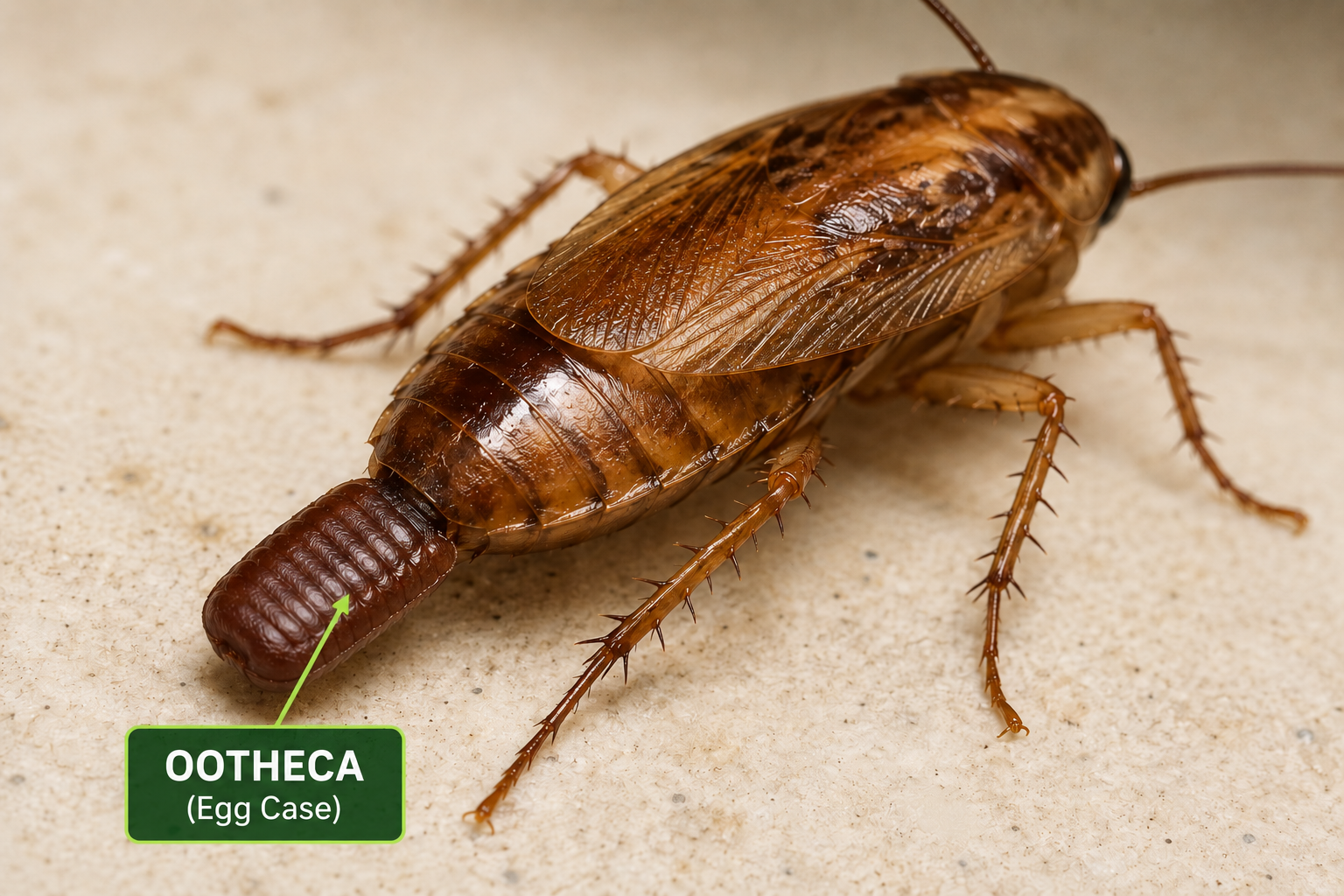
Cockroach eggs are not laid singly. Instead, the female assembles a hardened protein capsule called an ootheca that holds the eggs in two parallel rows, sealed against desiccation, predation, and most pesticides. Ootheca characteristics are species-specific and useful both for ID and for control planning:
- Number of eggs per ootheca ranges from about 14 (American cockroach) to 30–48 (German cockroach).
- Color ranges from pale tan to nearly black, again species-specific.
- Handling behavior is the most important biological distinction: most species deposit the ootheca in harborage soon after formation, sometimes gluing it to a surface, and abandon it. The German cockroach is unique in carrying the ootheca attached to the tip of the abdomen until hours before hatching. This single behavioral difference is the reason German cockroach populations grow so explosively: nearly every ootheca produced reaches successful hatching because the female protects it actively the entire time.
For control: ootheca structure is largely impermeable to insecticide. A residual surface spray that kills active cockroaches will not sterilize an ootheca lying nearby. This is one of the reasons insect growth regulators (IGRs) are paired with adulticides in modern programs — IGRs are picked up by emerging nymphs and prevent them from developing normally to reproductive adults, breaking the breeding cycle that the ootheca's chemical defense protects.
Aggregation Pheromones
Cockroaches produce aggregation pheromones — chemical signals deposited in feces and on the body that attract conspecifics to a harborage site. This explains why you commonly find cockroach groups rather than scattered individuals, and why even after a control intervention, surviving cockroaches will recolonize the same harborage (the pheromone signal lingers in the fecal residue). This is the biological basis for placing gel bait directly into harborage cracks rather than on open surfaces — the cockroaches are actively attracted to those spots by their own pheromones.
Aggregation pheromones also help explain the sudden "appearance" of cockroaches when a harborage is disturbed. A cabinet that looks empty has cockroaches packed deep in a pheromone-rich crack — open the door, and the alarm response (also pheromone-mediated) sends them scattering into view. The applicator who waits patiently and uses a flushing agent to reveal harborage will diagnose the infestation accurately. The applicator who only treats what is visible at first glance will treat 5% of the population.
Lifecycle Speed and the Population Math
The reason German cockroach infestations spiral out of control is not mysterious. Under typical Florida indoor conditions (75–85°F, with food and water access), German cockroach development from egg to reproductive adult takes 45–60 days. Each female produces 3–6 oothecae over her lifetime, with 30–48 eggs per ootheca. The mathematical consequence: a single mated female introduced via a cardboard box can theoretically produce 30,000+ descendants in her first year before her own death from old age. Real-world numbers are lower (predation, competition, mortality), but the trajectory of an untreated infestation routinely doubles every 4–8 weeks. Other species develop more slowly — American cockroaches take 6–18 months from egg to adult — but their adults live up to 2 years, providing a long reproductive window.
The 45–60 day egg-to-adult window for German cockroaches in Florida explains the standard monthly residential service interval for active cockroach accounts. A 30-day service frequency catches each new generation of nymphs before they reach reproductive age. Quarterly service is generally inadequate for active German cockroach accounts — entire reproductive generations cycle between visits. For commercial accounts with severe pressure (food handling, multi-family housing), 14-day service intervals are common during the initial knockdown phase, transitioning to 30-day maintenance once monitoring trap counts drop below threshold.
Cockroaches as a Public Health Concern
Cockroaches are not just an aesthetic problem. They are mechanical vectors of foodborne pathogens (Salmonella, Shigella, E. coli, Staphylococcus), they contaminate food with feces and shed cuticle fragments, and — most significantly — they are a leading source of indoor allergens.
Two cockroach proteins, Bla g 1 (in feces) and Bla g 2 (a digestive enzyme), are now recognized as major indoor allergens, particularly in urban housing. The National Cooperative Inner-City Asthma Study and follow-up CDC research have repeatedly shown that cockroach allergen sensitization is one of the strongest predictors of childhood asthma severity. Reducing cockroach populations in apartments, schools, and daycare facilities reduces measurable asthma incidence in sensitized children. As a Florida operator working in these environments, you are not only providing a pest service — you are reducing a documented public health hazard.
Lesson 2 covers the Florida species in detail. Before moving on, make sure the underlying biology — paurometabolous metamorphosis, ootheca handling differences, aggregation pheromones, and the speed of the German cockroach lifecycle — is firmly in place. These concepts will appear repeatedly in inspection logic, product selection, and resistance management.