
Florida is home to the most cockroach-rich pest fauna in the continental United States. Seven species drive nearly all professional pest management work in the state, and accurate species identification at the start of every job is non-negotiable. Treatment protocols, harborage zones, product selection, and even service interval all change based on which species is present. A "cockroach call" handled with a generic perimeter spray fails the customer roughly half the time — usually because the actual species was not identified.
This lesson covers each of the seven species in field-relevant detail. For each species you should be able to answer: what does it look like, where does it breed, is it indoor or outdoor, how does it disperse, and what is the general control approach. Detailed product chemistry comes in Lesson 4; for now, focus on recognizing the species and understanding their biology.
1. German Cockroach (Blattella germanica)
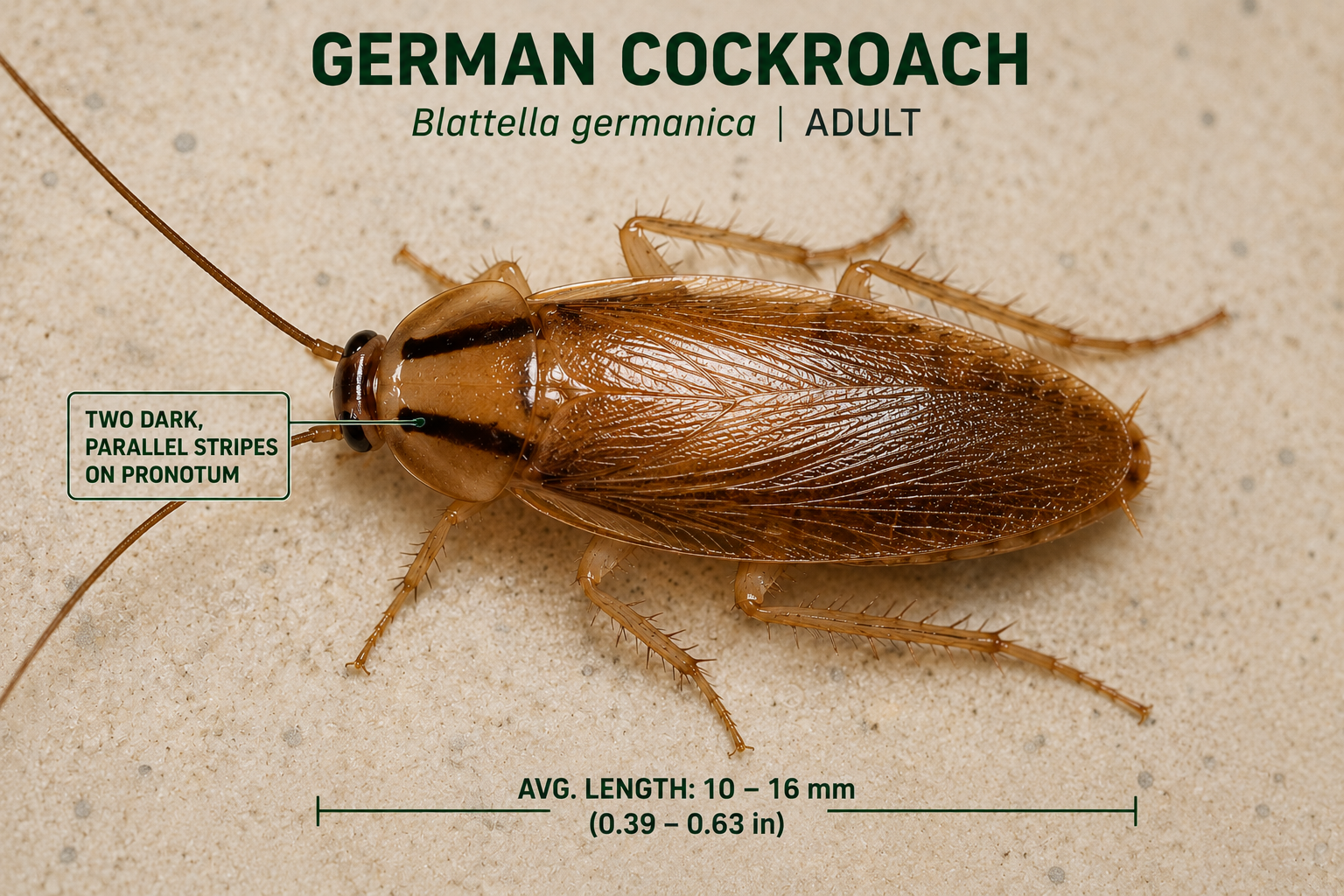
Identification
- Size: Adults 12–15mm; first-instar nymphs 1–2mm
- Color: Tan to light brown
- Pronotum: Two parallel dark longitudinal stripes — the diagnostic feature
- Wings: Adults are fully winged but rarely fly
- Nymphs: Nearly black with a single pale stripe down the center of the back; small, fast, and abundant in active infestations
- Ootheca: 30–48 eggs, light tan to brown, carried at the tip of the female's abdomen until hours before hatching — unique among Florida species
Biology and Behavior
The German cockroach is the most economically important structural pest cockroach in the world. In Florida it is the species that drives nearly all serious commercial cockroach work — restaurant infestations, multi-family housing complaints, hospital pest issues, and food processing problems. Its biology is essentially optimized for indoor human environments:
- Strictly indoor. German cockroaches cannot survive Florida outdoor conditions for any meaningful period — they need consistent warmth, moisture, and food. There is no outdoor reservoir population. Every German cockroach indoors arrived by human transport: cardboard boxes, used appliances, grocery deliveries, employee personal items, or by walking from an infested adjacent unit.
- Strongly thigmotactic. They seek body contact on top, bottom, and both sides simultaneously. This drives them into the tightest cracks available, especially near heat and moisture sources. They are almost never found in open areas during the day.
- Heat- and moisture-seeking. Refrigerator compressor compartments, dishwasher motors, oven and stove crevices, and the area beneath the kitchen sink are textbook harborage. Bathrooms (humidity, often a secondary water source) are frequently a secondary harborage.
- Rapid reproduction. Egg-to-adult in 45–60 days; female reproductive within two weeks of final molt. This biology makes German cockroach the species most likely to produce a population doubling between monthly service visits.
Inspection Priority Sites (in order)
- Refrigerator: compressor area at the rear bottom, condenser coils, motor housing
- Dishwasher: motor compartment, door gasket folds, undercounter recess
- Stove and oven: crack between stove and counter, broiler drawer, control panel interior
- Cabinet hinges (every cabinet — hinges are textbook thigmotactic harborage)
- Under sink: pipe penetrations, garbage disposal area
- Electrical: switch plates, outlets, junction boxes (especially in commercial kitchens)
- Small electronics: clocks, coffee makers, toasters, microwave interiors
- Commercial equipment: false bottoms, motor compartments, control panels
2. American Cockroach (Periplaneta americana)
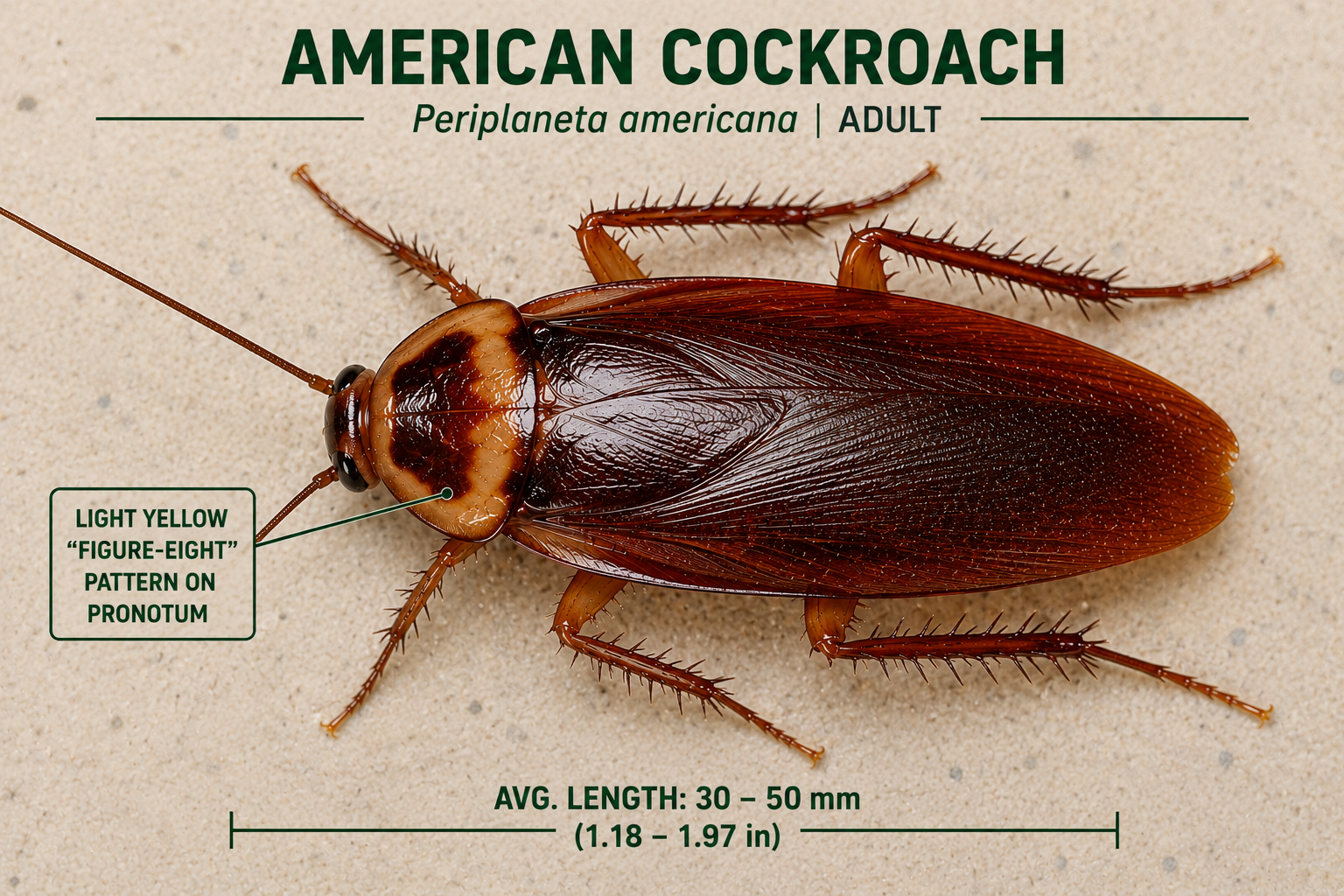
Identification
- Size: Adults 35–40mm — Florida's largest common cockroach; some individuals reach 45mm
- Color: Reddish-brown
- Pronotum: Pale yellowish figure-eight (or infinity symbol) pattern — the diagnostic feature distinguishing it from the otherwise similar Smoky-Brown
- Wings: Fully developed; capable of limited flight, especially in warm humid conditions
- Ootheca: 14–16 eggs, dark brown, deposited or glued to surfaces; female may produce up to 90 oothecae over a 1–2 year lifetime
Biology and Behavior
The American cockroach is peridomestic: its primary habitat is warm, moist outdoor environments, and it enters structures from the outdoors. Despite its name, it is believed to be African in origin and was introduced to North America via shipping. Primary outdoor habitats include:
- Sewer and storm drain systems — by far the most important reservoir habitat in Florida cities
- Steam tunnels and utility vaults
- Crawl spaces and basements
- Tree holes, hollow logs, palm tree boots
- Heavy mulch beds, leaf litter accumulation
- Stacked corrugated cardboard (preferred harborage)
- Marina docks, wood pilings, dumpster pads
The most common entry route into structures is through floor drains connected to municipal sewer systems, particularly in restaurants, food processing plants, and commercial buildings with floor drains. American cockroaches climb up the drain piping at night when usage is low. Other entry routes include door thresholds, weep holes, gaps around utility penetrations, and gaps under exterior doors.
An American cockroach found indoors during the day usually means a heavy outdoor population pressure — the ones you see during the day are pushed out of harborage by competition. Adults live up to 2 years, dramatically longer than German cockroaches; populations build slowly but persist for years.
3. Smoky-Brown Cockroach (Periplaneta fuliginosa)
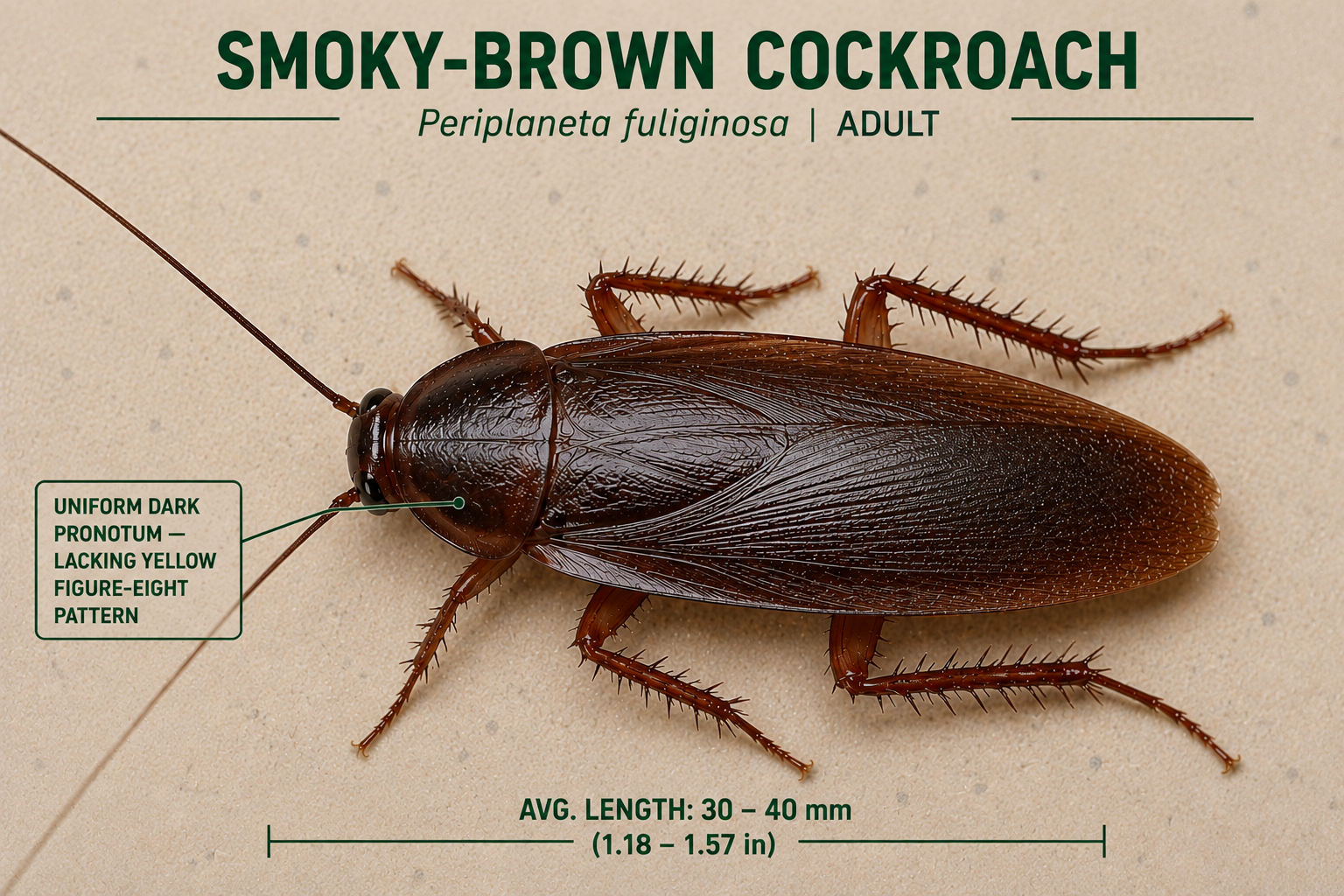
Identification
- Size: 30–35mm
- Color: Uniformly dark mahogany-brown to nearly black; surface has a glossy sheen
- Pronotum: No pattern — uniformly dark. This is the key field distinction from the American cockroach.
- Wings: Fully developed; strong flier (especially males); strongly attracted to lights at night
- Ootheca: ~20 eggs; glued to surfaces in protected harborage
Biology and Behavior
Smoky-Brown is a primarily peridomestic species in Florida, more moisture-sensitive than the American cockroach, and most common in older residential neighborhoods with mature tree canopy. Typical harborage:
- Tree holes and palm boots
- Attic spaces (especially attics with poor ventilation, accumulated leaf litter, or roof leaks)
- Wood piles, fence-line debris, and accumulated yard waste
- Clogged gutters with leaf debris (a major Florida harborage)
- Spanish moss, bromeliads, and dense ornamental plantings
The strong flight behavior — flying directly to lighted windows, pool decks, and porch lights at night — drives most Smoky-Brown service calls. Customers report adults entering through gaps around exterior light fixtures, screen tears, and porch doors. Light management (yellow LED or low-pressure sodium replacement of incandescent and white LED), gutter cleaning, and exterior harborage reduction are central to control.
4. Asian Cockroach (Blattella asahinai)
Identification and Behavioral Discrimination
The Asian cockroach is morphologically nearly identical to the German cockroach — same size, same tan color, same two parallel dark stripes on the pronotum. Definitive species discrimination requires either DNA analysis or careful examination by a specialist. For the Florida applicator, the practical distinction is behavioral:
- Asian cockroaches fly readily — they are strong fliers attracted to light. If a "German-looking" cockroach takes flight when disturbed, it is almost certainly an Asian cockroach.
- Asian cockroaches live outdoors in mulch, leaf litter, ornamental beds, and ground cover plantings. They do not establish persistent indoor breeding populations like German cockroaches do.
- They enter structures via light attraction at dusk — flying to lit windows and through open doors. Once inside they do not breed indoors.
This species was first identified in Florida (Lakeland area) in 1986 and has spread throughout the state's central and southern regions. Mistaken identification — treating an Asian cockroach call as a German cockroach problem — produces frustrated customers and ineffective interior treatments. Control is fundamentally an outdoor problem: granular bait in mulch and landscape beds, perimeter residual treatment, light management, and exclusion (door sweeps, intact screens).
5. Florida Woods Cockroach — "Palmetto Bug" (Eurycotis floridana)
Identification
- Size: 30–40mm; robust, oval-bodied
- Color: Dark reddish-brown to nearly black; matte rather than glossy
- Wings: Only short wing pads; flightless
- Defense: Sprays a pungent defensive chemical from rear abdominal glands when threatened — earning the alternative nicknames "skunk roach" and "stink roach." The odor is persistent and unpleasant.
- Ootheca: 20–22 eggs; deposited in protected outdoor harborage
Biology and Behavior
Florida woods cockroach is a strictly outdoor species. It lives in tree bark, decaying wood, leaf litter, palmetto plants (the source of the colloquial name), and bromeliads. It does not breed indoors. An individual found in a home entered accidentally through a ground-level gap and represents an exclusion failure, not an interior infestation.
Many Floridians use "palmetto bug" loosely to describe any large brown cockroach indoors. Most of the time those are actually American or Smoky-Brown cockroaches — both of which DO require treatment because they breed in peridomestic harborage near the structure. A true Florida woods cockroach indoors is usually a one-off accidental entry. Field discrimination: Florida woods is flightless and matte-dark; American has the figure-eight pattern and can fly; Smoky-Brown is glossy uniform dark and is a strong flier. Get the species right before you write the recommendation.
Other Cockroaches
Two additional species are encountered less frequently in Florida structural pest work but are worth knowing — they appear sporadically in specific account types and are easy to misidentify against the more common species above.
Australian Cockroach (Periplaneta australasiae)
- Size: 25–35mm; very similar to American in overall appearance
- Color: Reddish-brown
- Pronotum: Dark center bordered by a distinctive bright yellow stripe along the front (anterior) margin
- Wings: Fully developed; bright yellow markings at the base (shoulder area) of each forewing — also diagnostic
- Ootheca: ~24 eggs; deposited or glued in harborage
Australian cockroach is a tropical species concentrated in South Florida (Miami-Dade, Broward, Palm Beach, and the Keys), with patchy occurrence further north along the coastal climate corridor. It is most common in greenhouses, plant nurseries, dense tropical plantings, and adjacent structures. Australian cockroaches will occasionally feed on living plant material — making them an occasional concern in commercial nursery and conservatory settings, in addition to their structural pest impact. Control approach is similar to American/Smoky-Brown: exterior perimeter, harborage reduction, exclusion at structural openings.
Brown-Banded Cockroach (Supella longipalpa)
- Size: Adults 10–14mm — among the smallest pest cockroaches
- Color: Tan to light brown
- Pattern: Two pale yellowish transverse (crosswise) bands across the wings/abdomen — the key distinction from the German cockroach (which has lengthwise pronotal stripes)
- Wings: Sex-dimorphic — males have full wings extending past the abdomen and can fly; females have shorter wings that do not cover the full abdomen
- Ootheca: 10–18 eggs; glued to hidden surfaces on walls, ceilings, and furniture undersides — not carried by the female
Brown-banded is the indoor cockroach species most often misidentified as German because of similar size and color. The behavior is sharply different: they are not strongly thigmotactic and scatter throughout the structure rather than concentrating in tight kitchen and bathroom harborage. They prefer warmer, drier, higher locations — upper kitchen and bathroom cabinets, behind picture frames, inside televisions, computers, cable boxes, and audio equipment, in upper closet areas, and along ceiling-level molding. They tolerate drier conditions than German cockroach and are common in bedrooms and living areas, not just kitchens.
The control implication: place gel bait in elevated locations — top interior surfaces of cabinets, behind wall art, upper wall molding, inside electronics (using appropriate low-odor formulations rated for electronics use). Treating only the kitchen low-zone in a brown-banded infestation will produce poor results because the bulk of the population is upstairs and elevated.
Florida Cockroach Species at a Glance
| Species | Size | Field ID | Indoor / Outdoor | Key Harborage |
|---|---|---|---|---|
| German | 12–15mm | Two lengthwise stripes on pronotum | Strictly indoor | Kitchen heat/moisture, low cracks |
| American | 35–40mm | Yellowish figure-eight on pronotum | Peridomestic | Sewers, drains, mulch, basements |
| Smoky-Brown | 30–35mm | Uniform mahogany; flies to lights | Peridomestic / outdoor | Trees, attics, gutters, wood piles |
| Australian | 25–35mm | Yellow front edge of pronotum | Peridomestic / outdoor | Greenhouses, dense tropical plantings |
| Brown-Banded | 10–14mm | Two crosswise pale bands on wings | Indoor | Upper cabinets, electronics, ceiling-level |
| Asian | 12–15mm | Identical to German; flies to light | Outdoor / peridomestic | Mulch, leaf litter, ground cover |
| FL Woods | 30–40mm | Flightless; defensive odor spray | Strictly outdoor | Palmetto, leaf litter, woodpiles |
Lesson 3 covers inspection protocol — how you systematically locate harborage and quantify infestation level — and the sanitation and IPM framework that supports any chemical control program.