
The single largest determinant of cockroach control success is not the active ingredient on the truck — it is the quality of the inspection and the willingness of the customer to address sanitation and exclusion. A skilled applicator using a moderately effective product on a thoroughly inspected and well-sanitized account will outperform a marginally skilled applicator using the best product available on a poorly inspected, dirty account every time. This lesson covers the inspection protocol, the sanitation conversation, and the IPM framework that ties them together.
Pre-Inspection Customer Interview
Before any flashlight comes out, the customer interview captures essential information that directs the inspection:
- How long have you been seeing them? Recent onset (days to weeks) suggests a new introduction (cardboard, used appliance, recent move-in). Long-standing (months to years) suggests an established population, often with sanitation contributors.
- Where have you seen them? Customer-reported sightings prioritize inspection zones. Be specific — "the kitchen" is not enough; ask which cabinet, which side of the refrigerator, what time of day.
- How big are they? Customer descriptions of size and color help pre-identify species before you begin. "Tiny tan ones running around the dishwasher" = German. "Big brown ones at night near the floor drain" = American. "Big dark ones flying to the porch light" = Smoky-Brown.
- Have you treated yourself? Off-the-shelf bombs (total release foggers) and pyrethroid sprays applied indiscriminately by the customer can scatter a German cockroach population, contaminate gel bait sites, and complicate professional control. Document any prior DIY treatment.
- Recent deliveries, moves, or appliance changes? A specific introduction event helps confirm German cockroach origin and reinforces sanitation messaging.
Systematic Harborage Inspection
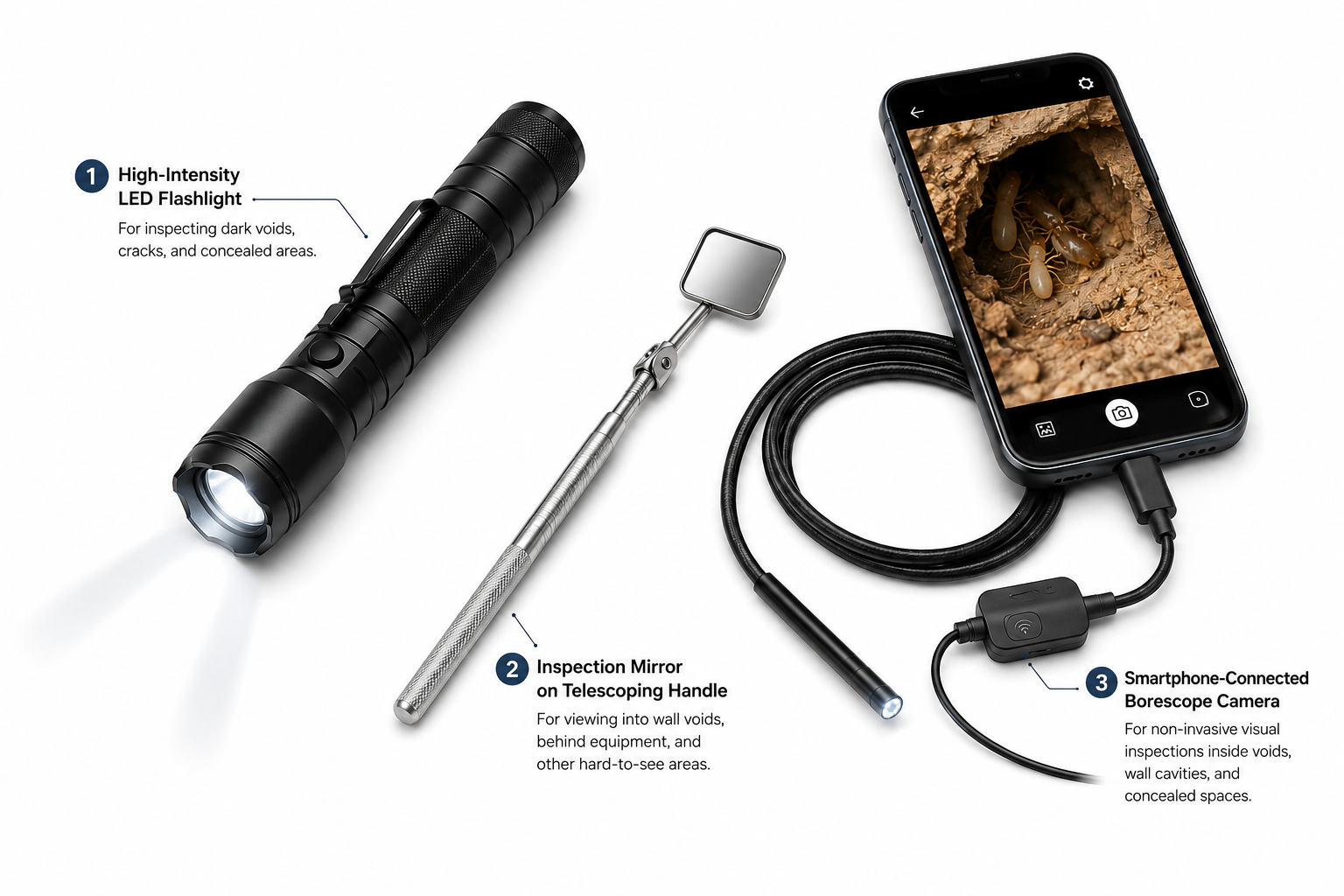
A good cockroach inspection takes 20–45 minutes for a typical residential kitchen and longer for commercial kitchens or multi-room infestations. Equipment and technique matter:
- High-intensity flashlight (LED, 500+ lumens) with a tight beam. The cheap flashlights in the truck console are inadequate for inspecting deep cabinet recesses and motor compartments.
- Dental mirror or inspection mirror on a telescoping handle for inspecting cabinet hinge interiors, refrigerator compressor bottoms, and the back side of equipment.
- Flexible borescope camera (smartphone-connected models are inexpensive and excellent) for wall voids, drain interiors, and hollow equipment.
- Hand lens (10x) for confirming species ID on smaller specimens and examining frass.
- UV flashlight (365 nm) for revealing fluorescent urine and frass in dark corners.
- Flushing aerosol (pyrethrin, prallethrin) used carefully to drive cockroaches out of suspected harborage for visual confirmation. Use sparingly — flushing kills active cockroaches and is incompatible with subsequent gel bait placement in the same area.
German Cockroach Inspection Sequence
Work systematically from highest-priority zones outward:
- Refrigerator — pull it out from the wall. Inspect the compressor coils and motor housing on the back. Look at the drip pan beneath. Inspect the floor and wall behind. Then check the door gasket folds with a flashlight.
- Dishwasher — open the door and examine the gasket folds. Check the under-counter recess. Inspect the motor compartment from beneath if accessible.
- Stove and oven — pull from wall. Inspect the broiler drawer, control panel rear (with power off), and crack between stove and adjacent counter. Check oven racks and crevices.
- Cabinets — open every door. Inspect every hinge with a mirror. Examine corners, undersides of shelves, and gaps where the cabinet meets walls.
- Under sink — examine pipe penetrations, the garbage disposal mount, and the cabinet floor. Moisture damage is a particular harborage clue.
- Electrical — switch plates, outlet covers, junction boxes. Use a flashlight at the cover edge.
- Counter equipment — coffee makers, toasters, microwaves, clocks. Lift, inspect undersides and motor compartments.
- Bathroom and laundry — secondary harborage when kitchen is heavily infested. Under sink, behind toilet, washer/dryer motor area.
Detection Cues — What to Look For
Most cockroaches are hidden during inspection. Indirect evidence is therefore the foundation of population mapping:
- Fecal spotting. Dark, pepper-grain to small dot shaped fecal pellets concentrated in harborage. Heavy spotting (smearing or staining of surfaces) indicates long-standing high-density infestation. Aggregated dots are gold-standard evidence of an active harborage.
- Cast nymphal skins. Translucent, exoskeleton-shaped molts, fragile and easily missed. Their presence proves active reproduction.
- Spent oothecae. Empty egg cases stuck to surfaces, especially for brown-banded (which glues them) and American (which deposits them). Each spent ootheca represents 14–48 nymphs already in the structure.
- Live cockroaches. Daytime sightings — especially adults running across open surfaces during inspection — indicate severe overcrowding (the resident population has exceeded harborage capacity and individuals are forced into the open).
- Odor. Heavy German cockroach infestations produce a distinctive musty-oily odor from aggregation pheromones. Florida woods cockroach defensive spray is detectable from several feet away.
- UV fluorescence. Fresh cockroach urine fluoresces blue-white under UV light; dried urine appears yellow-amber. Systematic UV scan of floor-wall junctions can reveal activity invisible under white light.
Monitoring Sticky Traps
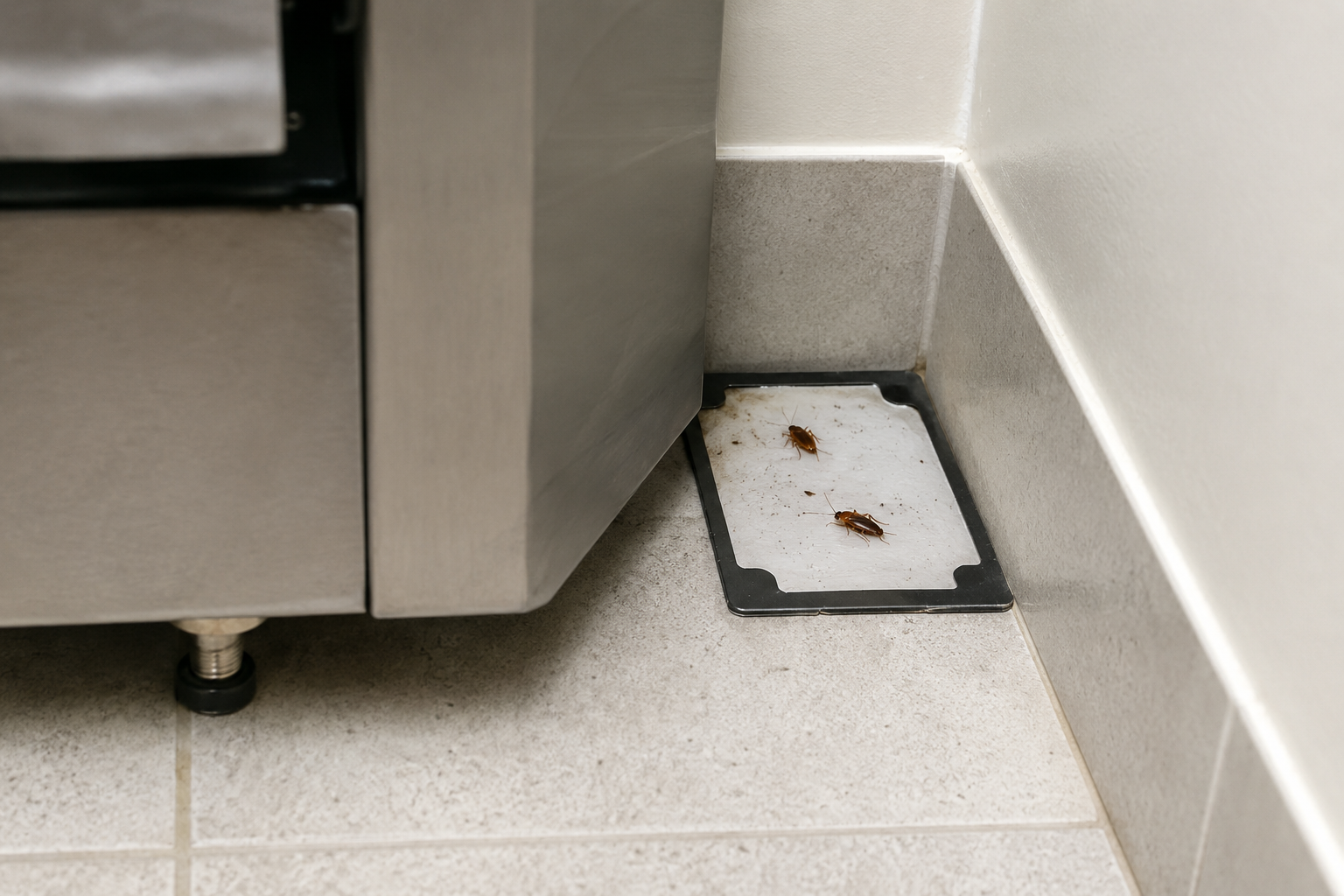
Sticky monitoring traps (insect monitors, glue boards) are the most objective tool for measuring cockroach populations. Used correctly, they provide:
- Pre-treatment baseline counts to demonstrate the scope of the problem
- Post-treatment efficacy data to confirm the program is working
- Early warning of resurgence when counts climb between visits
- Species confirmation (small adults caught early in a sticky give clear ID)
Trap Placement Principles
- Place traps in 90° corners where cockroaches running along walls cannot detour. Open-floor placement catches almost nothing.
- Place traps in actual harborage zones — behind appliances, inside cabinet corners, under sinks. Visible kitchen counter placement is for the customer, not the cockroach.
- Document placements on a floor plan map with each trap numbered. Map placements are reproducible across visits and create defensible documentation.
- Count cockroaches per trap per night (not per inspection) and record numerically. Ranges: 0 = no detected activity; 1–5 = light; 6–25 = moderate; 26+ = heavy. Use the same scale every visit.
- Replace traps when full or every 4–6 weeks regardless. Stale glue catches less reliably.
Sanitation — The Inescapable Foundation
Chemical control alone cannot succeed in cockroach management when food, water, and harborage remain abundant. The applicator's job is partly technical (find harborage, place product correctly) and partly educational (explain to the customer what they need to do). A clear, specific sanitation conversation — backed by what the inspection actually found — is the single most under-utilized tool in residential and commercial cockroach work.
Three Targets: Food, Water, Harborage
- Food. Eliminate accumulated grease and food residue from under and behind appliances; clean drain interiors and disposal units; store dry goods in sealed pest-proof containers; remove pet food at night. In commercial kitchens, schedule deep cleaning behind cooking equipment monthly.
- Water. Repair leaking pipes immediately; eliminate standing water under refrigerator drip pans; reduce condensation on cold lines; ventilate humid bathrooms. German cockroaches will tolerate marginal food but cannot survive without water.
- Harborage. Eliminate cardboard storage (preferred cockroach harborage and the most common introduction route); seal unnecessary cracks with caulk after treatment; reduce clutter in pantries and storerooms; replace damaged cabinet liners.
Customers often hear sanitation feedback as criticism. Frame it as a partnership: "Here is what the cockroaches are doing, here is what I'm going to do about it, and here are the three or four specific things you can do to make my treatment work better and stay working longer." Be specific — "keep the kitchen clean" is forgettable; "clean the grease trap behind the stove this week and store the dog food in a sealed container at night" is actionable. Document the recommendations on the service ticket. When a customer calls back complaining of resurgence, the documented sanitation recommendation gives you a productive starting point rather than a defensive one.
Exclusion
Exclusion — physically blocking entry — is more effective for peridomestic species (American, Smoky-Brown, Asian, Florida woods) than for German cockroach (which is primarily transported by humans), but it matters for both. Key exclusion targets:
- Door sweeps on all exterior doors, including doors to garages and storage rooms. Gaps under doors are a primary entry route.
- Sealing utility penetrations with steel wool, caulk, or foam sealant where pipes and conduits enter the structure.
- Weep holes in masonry exteriors should have stainless mesh inserts that allow drainage but block insect passage.
- Floor drain covers with intact mesh, particularly in commercial kitchens with sewer-system drains.
- Window screens intact and tight to frame; storm doors with intact gaskets.
- Light fixtures and exterior outlets with intact gaskets; adjusted exterior lighting (yellow LED replaces white) to reduce flying species attraction.
The IPM Framework
Integrated Pest Management (IPM) is not just a regulatory buzzword — it is a structured decision framework that produces better outcomes at lower cost than reactive spray-only programs. The Florida certified operator's IPM workflow for cockroaches:
- Identify. Confirm the species before recommending treatment. Different species require different control programs.
- Inspect. Map harborage with monitoring traps and direct visual assessment. Document baseline activity numerically.
- Establish thresholds. Determine what level of cockroach activity triggers what treatment intensity. In food handling, thresholds are zero (any sighting requires immediate response). In residential settings, customer tolerance and program economics define thresholds.
- Address contributing conditions. Sanitation and exclusion recommendations documented on the service ticket. The applicator's findings drive specific recommendations.
- Apply targeted control. Lesson 4 covers the chemical tools — gel baits, IGRs, dusts, residuals — and how to choose among them. The IPM principle is to use the most targeted product, applied to the smallest effective area, for the shortest necessary period.
- Monitor and document. Re-evaluate at every service visit using the same metrics established in step 2. Service records should reflect actual measured activity, not generic "treated for cockroaches" entries.
- Adjust. If trap counts are not declining, change something — harborage missed, product not accepted, sanitation contributor uncorrected, resistance suspected. Repeating the same ineffective approach is the most common failure pattern.
Compliance Documentation
Florida certified operators must maintain pesticide application records under FDACS Rule 5E-9.032 — date, time, location, target pest, product name, EPA registration number, application rate, applicator name and license number, and weather conditions where applicable. Cockroach service records should additionally document the inspection findings (which species, where, what trap counts), the sanitation and exclusion recommendations made, and the customer's response to those recommendations. This documentation is not bureaucratic overhead — it is the evidence that lets you defend your work if a complaint or inspection arises, and it is the data that lets you adjust strategy across visits.
Lesson 4 turns to the chemical toolbox: gel baits, dusts, IGRs, residuals, mode-of-action chemistry, rotation strategy, and resistance management.