
Modern professional cockroach control is built around gel baits as the primary tool, with insect growth regulators (IGRs), dusts, and targeted residuals as complementary tools applied to specific situations. Broadcast residual sprays — the dominant tool of cockroach control in the 1980s — are no longer the foundation of effective programs and in many cases are counterproductive. This lesson covers each chemical class, the active ingredients you will encounter most often, mode of action, and a rotation strategy designed to slow resistance development.
Gel Baits — The Cornerstone
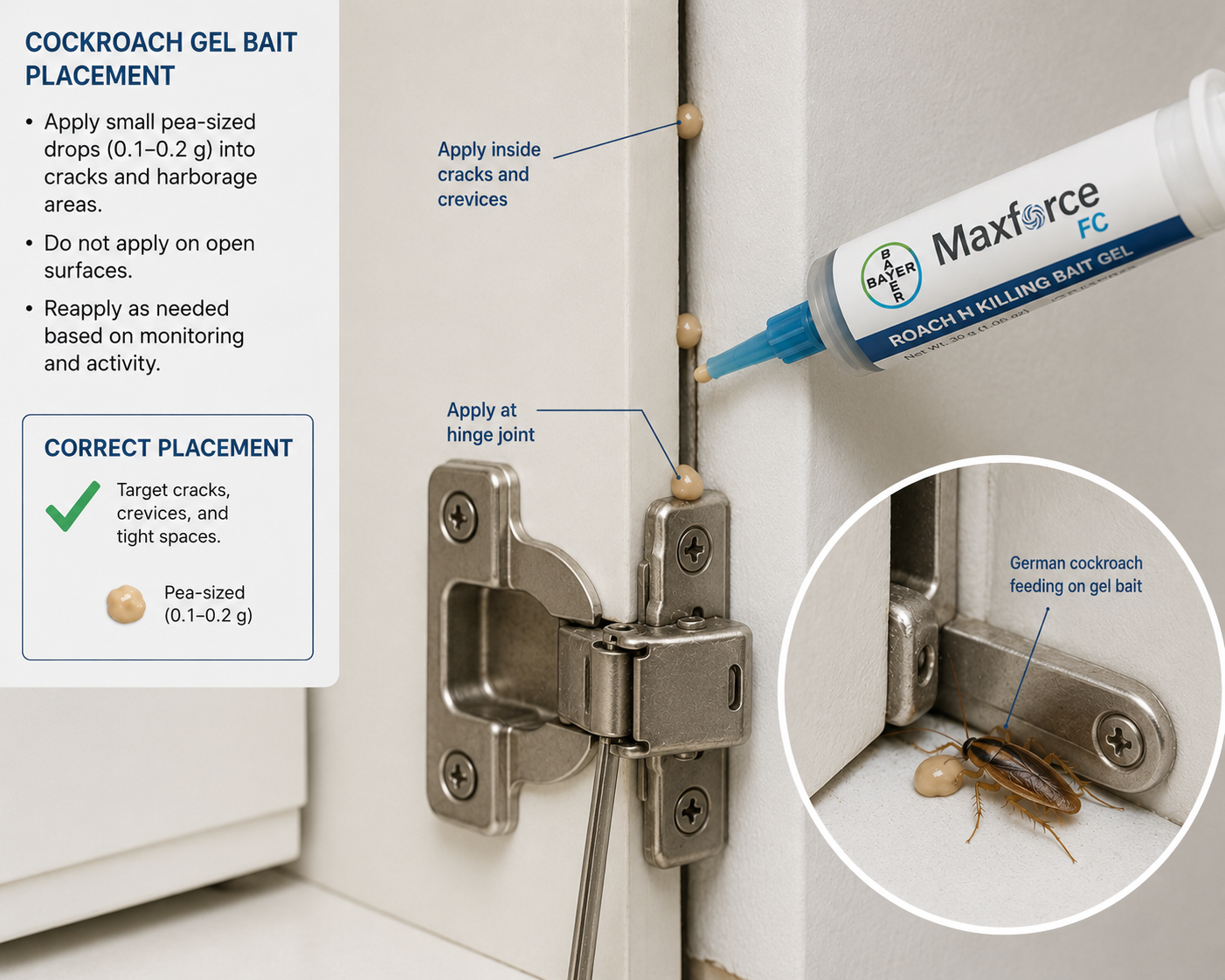
Gel bait works because cockroaches actively forage and chew solid food. The bait matrix combines a slow-acting toxicant with attractants and feeding stimulants, packaged in a moisture-retaining gel. The cockroach feeds, returns to harborage, and dies. Other cockroaches in the harborage feed on the dead body, the feces, and the regurgitated bait — producing a secondary kill cascade that wipes out colony members never directly exposed to the bait. This is the mechanism that makes a small amount of well-placed gel bait control a large population.
Gel Bait Placement Science
The science of placement is as important as the chemistry of the active ingredient. Errors here are the most common cause of "the bait isn't working" callbacks:
- Pea-sized placements (0.1–0.3g) directly into harborage cracks. The cockroach contacts bait simultaneously on dorsal and ventral body surfaces and is biologically primed to feed at sites where aggregation pheromones concentrate.
- Many small placements outperform few large placements. Ten pea-sized drops distributed across an active harborage zone produce far better population reduction than one or two large drops in the same area. Each placement intercepts a different foraging trail.
- Bait must be fresh. Hardened, dried bait is no longer attractive — replace placements every 4–6 weeks regardless of consumption.
- Bait must not be contaminated. Repellent insecticide residue (pyrethroids especially) transferred to bait surfaces makes it unpalatable. Place bait before applying any sprays in the area, and keep at least 12 inches between bait placements and any pyrethroid spray treatment.
- Avoid open surfaces. Bait placed on the open floor or on a flat counter is rarely fed on — cockroaches commit to feeding only at sites with body contact and pheromone presence. The placement is wasted.
Active Ingredients in Modern Gel Baits
| Active Ingredient | Class | Mode of Action | Example Product |
|---|---|---|---|
| Fipronil | Phenylpyrazole | GABA-gated chloride channel blocker; CNS hyperexcitation | Maxforce FC Magnum; Combat Pro |
| Indoxacarb | Oxadiazine | Bioactivated by insect metabolism; voltage-dependent sodium channel block | Advion Cockroach Gel |
| Imidacloprid | Neonicotinoid | Nicotinic acetylcholine receptor agonist | Maxforce Impact; Premise Bait |
| Abamectin | Avermectin | Glutamate-gated chloride channel activation; paralysis | Avert Dry Flowable; Vendetta Plus |
| Dinotefuran | Neonicotinoid | Nicotinic acetylcholine receptor agonist (different binding profile from imidacloprid) | Alpine Cockroach Gel |
Time-to-kill is intentionally slow — typically 24–72 hours after feeding. Fast-killing baits would not produce the secondary cascade through cannibalism and coprophagy that drives effective colony reduction. A "fast knockdown" bait is the wrong tool.
Insect Growth Regulators (IGRs)
IGRs do not kill adults. They disrupt the molt-to-adult transition by mimicking juvenile hormone — the cockroach hormone that maintains the nymphal state. With IGR present, nymphs molt to a non-functional pseudo-adult that cannot reproduce. The reproductive cycle breaks; eventually all adults die of old age and no replacement reproductive generation appears.
- Hydroprene (Gentrol) — the most widely used cockroach IGR; available as point-source disks, aerosol, and concentrate. Particularly effective in void treatments where vapor migration distributes the active ingredient through the void.
- Pyriproxyfen — similar juvenile hormone mimic; appears in some combination products with adulticide bait.
IGRs are most powerful as the second leg of an adulticide-plus-IGR program. The adulticide bait kills existing adults and large nymphs; the IGR ensures that any new nymphs emerging from oothecae fail to reach reproductive maturity. The result is a faster, deeper population collapse than either tool achieves alone.
Dusts
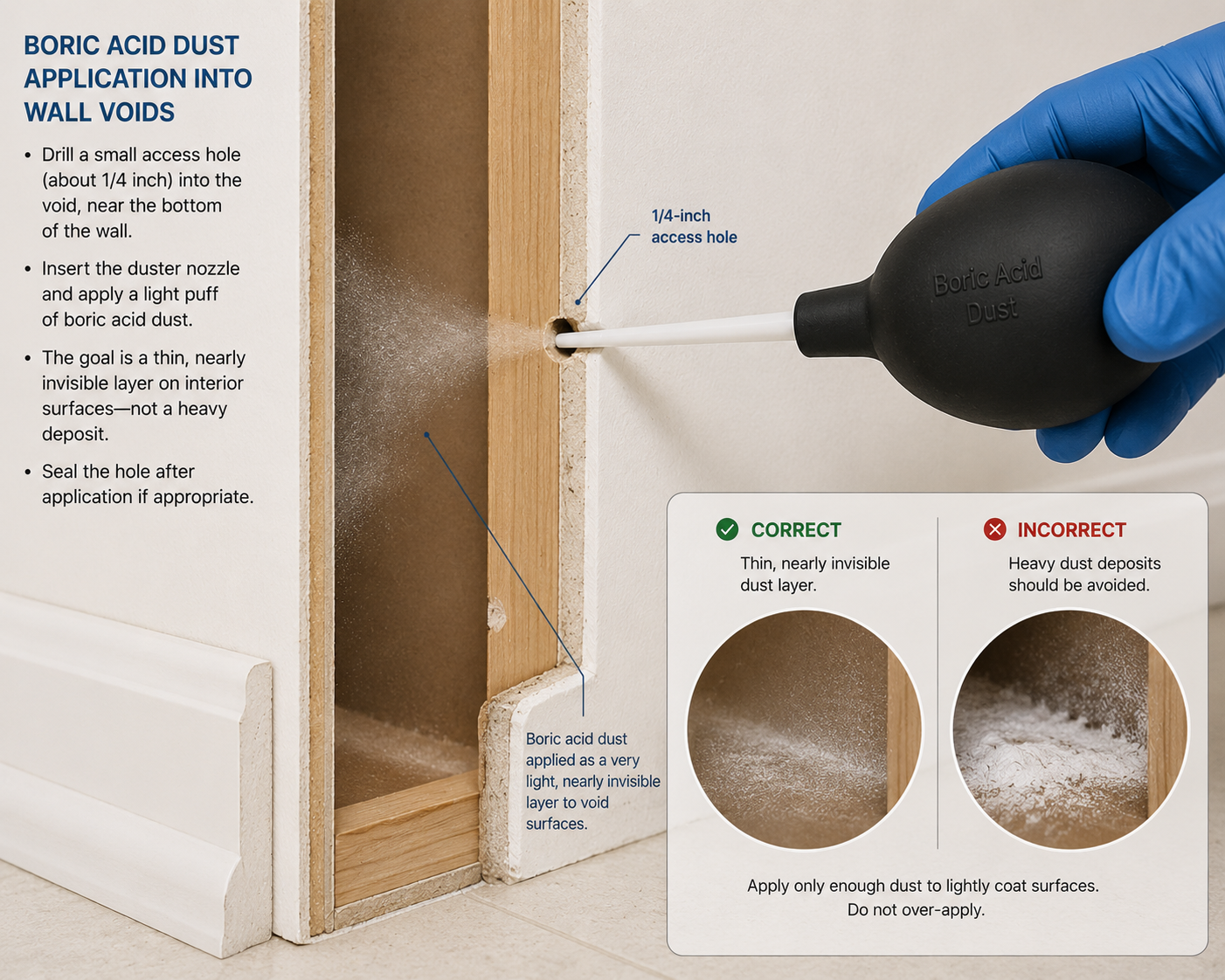
Dust products are essential for void and difficult-access harborage where liquids cannot reach. Three actives dominate professional cockroach dust use:
- Boric acid — inorganic; works by abrading the cuticle and acting as a stomach poison after grooming. No documented insecticide resistance after 50+ years of use, because the mode of action is essentially physical-chemical rather than receptor-targeted. Slow-acting (3–10 days). Most effective in dry void spaces. Application thickness is critical: a barely-visible thin film works; a visible powder pile is detected and avoided.
- Deltamethrin dust (Delta Dust) — pyrethroid in dust formulation; moisture-resistant (a major advantage in Florida humid voids); faster knockdown than boric acid. Routinely used in wall voids, drain interiors, electrical equipment voids (with power off).
- Diatomaceous earth (DE) — physical mode of action; abrades cuticle. Slow-acting. Used in low-toxicity programs and around children/pets, but inferior to boric acid for general cockroach work.
- Silica aerogel (CimeXa, Drione) — extremely fine particles that absorb cuticular wax; very effective; rapid desiccation kill.
Boric acid effectiveness depends almost entirely on application thickness. Too thick (visible piles): cockroaches detect and walk around it. Too thin or absent: no effect. The correct technique uses a bulb duster or handheld power duster to puff a cloud into the void; the cloud settles into a thin uniform film. The film should be barely visible at low-angle flashlight inspection — a faint dust trail and slight slippery feel when run through. Reapply when moisture or cleaning removes it.
Residual Sprays
Liquid residual sprays still have a role in cockroach programs — but a smaller, more targeted role than they had a generation ago. Modern uses:
- Exterior perimeter for peridomestic species (American, Smoky-Brown, Asian, Australian, FL Woods). Treat the foundation, door frames, weep holes, utility penetrations, exterior light fixtures.
- Targeted void injection through drilled access holes or behind switch plates.
- Crack-and-crevice treatment with non-repellent residuals only — repellent pyrethroids contaminate gel bait and disrupt program efficacy.
Active ingredients commonly used in cockroach perimeter and crack-crevice work:
- Bifenthrin (Talstar) — pyrethroid; long residual; widely used for perimeter cockroach work.
- Lambda-cyhalothrin (Demand CS) — pyrethroid; encapsulated for extended residual.
- Fipronil (Termidor SC labeled uses) — phenylpyrazole; non-repellent; used in perimeter and void applications.
- Chlorfenapyr (Phantom) — pyrrole; non-repellent; bait-compatible; uncoupler of oxidative phosphorylation.
- Indoxacarb (Arilon) — non-repellent; bait-compatible.
One of the most common professional mistakes in cockroach control: spraying a pyrethroid surface spray first, then placing gel bait in the same area. Pyrethroid molecules volatilize and condense onto nearby surfaces — including the bait. Cockroaches detect the repellent on the bait and refuse to feed. The result is a treatment that looks complete on paper but produces poor population reduction. Bait first, then spray. Or use non-repellent residuals (fipronil, chlorfenapyr, indoxacarb) when both tools are needed in the same zone.
Aerosols and Space Treatments
- Pyrethrin / piperonyl butoxide flushing aerosols (PT 565 Plus XLO, others) — short-lived, used during inspection to drive cockroaches out of suspected harborage and confirm activity. Not a control tool by itself.
- Total release foggers ("bombs") — broadcast pyrethroid space treatment. Not recommended for German cockroach control. They scatter populations into deeper harborage, contaminate bait sites, and produce cosmetic kill of exposed individuals while leaving the bulk of the population untouched. Customer DIY use of foggers before a professional service is a chronic problem.
Resistance Management
Insecticide resistance is well-documented in Florida German cockroach populations. Two major resistance mechanisms drive most field failures:
Metabolic and Target-Site Resistance
Pyrethroid resistance is widespread in Florida German cockroaches. Decades of routine pyrethroid surface spray exposure have selected for populations with elevated detoxification enzymes (cytochrome P450s, esterases) and altered sodium channel binding sites (kdr mutations). A pyrethroid that produced reliable kill in 1995 may produce only 30–60% mortality in the same building today. Solutions: rotate active ingredient classes, use non-repellent chemistries, and rely on bait rather than surface spray as the primary control tool.
Behavioral Resistance — Glucose Aversion
A remarkable behavioral resistance mechanism has been documented in German cockroach populations across the United States: glucose aversion. Normal cockroaches are attracted to glucose, a common ingredient in many bait matrices. Aversion populations carry a single amino acid change in a gustatory receptor neuron that makes glucose taste repellent. Aversion individuals refuse to feed on glucose-containing baits — bait placements appear untouched after weeks of exposure. Solution: rotate to non-glucose bait formulations. Advion Cockroach Gel (indoxacarb) uses a sweetener system designed to avoid glucose aversion. Avert Dry Flowable (abamectin) uses a peanut butter base, avoiding the sugar problem entirely. If a bait that worked previously suddenly seems to be ignored, glucose aversion is a leading suspect.
Active Ingredient Rotation Schedule
Rotate the gel bait active ingredient at each service cycle. A reasonable rotation:
- Cycle 1: Fipronil (phenylpyrazole — Maxforce FC Magnum)
- Cycle 2: Indoxacarb (oxadiazine — Advion)
- Cycle 3: Imidacloprid or dinotefuran (neonicotinoid — Maxforce Impact or Alpine)
- Cycle 4: Abamectin (avermectin — Avert)
- Document rotation in service records. Repeat the cycle.
Pair gel bait rotation with consistent IGR use (hydroprene), perimeter or void residual where appropriate, and dust applications in dry voids. The combination program — rather than reliance on any single product — is what sustains long-term control.
Food Facility Restrictions
Applications in food-handling facilities require strict label compliance under FDA, FDACS, and OSHA oversight:
- No surface sprays on food-contact surfaces (prep tables, cutting boards, equipment interiors, food packaging lines).
- Gel baits must be placed in cracks and voids away from food-contact surfaces — not on shelves where food is stored, not on or near conveyor belts, not in any location where bait can fall onto product.
- Space sprays require complete removal or covering of all food and food-contact equipment before application; observe re-entry intervals before resuming food handling.
- Dust applications inside electrical panels require power off during application and adequate ventilation before re-energizing.
- Every application must be documented: date, product name, EPA registration number, application rate, target pest, location, applicator name and license number.
- The client should maintain a pest control log available for FDA, FDACS, USDA, or third-party audit inspection.
Putting It All Together — A German Cockroach Program
For a typical moderate-to-heavy German cockroach infestation, the standard professional protocol:
- Initial visit: Inspect, identify species, place monitoring traps, document baseline. Sanitation conversation. Place gel bait (fipronil) at 10–15 sites in primary harborage. Apply hydroprene IGR point-source disks in 2–4 void locations. Apply boric acid dust in dry wall voids near plumbing.
- Two-week follow-up: Read trap counts. Replace consumed bait at active sites. Add bait at additional sites identified by fresh fecal evidence. Address any sanitation issues that have not been corrected.
- Four-week follow-up: Read trap counts. Rotate to indoxacarb gel bait at primary sites. Refresh IGR.
- Eight-week follow-up: Trap counts should be approaching zero. If they are not, reassess: missed harborage, glucose aversion, sanitation contributor not addressed, or possibly a new introduction event.
- Maintenance: Once trap counts hold at zero across two consecutive monthly visits, transition to monthly monitoring service with bait refresh as needed.
For peridomestic species (American, Smoky-Brown, Asian, Australian, FL Woods), the program shifts to exterior emphasis: perimeter residual treatment, drain IGR (methoprene point-source for floor drains), exterior harborage reduction, and exclusion. Interior gel bait is used as a knockdown tool for populations that have already entered, not as the primary control method.
Cockroach control is technique-dependent work. The active ingredients on the truck are roughly equivalent in laboratory efficacy — what separates a good cockroach program from a poor one is the inspection, the placement, the rotation discipline, and the customer cooperation that the applicator builds into the work. A well-run cockroach program is one of the most rewarding parts of professional pest management — a clear before-and-after, documented in trap counts, that improves a customer's quality of life and demonstrably reduces a public health hazard.
You've completed all four lessons of this course. Revisiting the objectives from the start, you should now be able to:
- Describe cockroach biology, anatomy, and the egg-nymph-adult life cycle, and explain why it drives control decisions.
- Identify the cockroach species found in Florida and distinguish domestic from peridomestic species and habits.
- Conduct a professional inspection using monitoring traps and sanitation within an IPM program.
- Select and place gel baits, insect growth regulators, and dusts correctly, and apply resistance-management and bait-rotation practices.
Complete the quiz to confirm your grasp of these objectives and earn your FDACS-13325 Record of Attendance.