
Weed management in Florida turf is fundamentally a contest between two living plant systems — the desirable turfgrass and the weed species competing with it for light, water, nutrients, and space. The single most important fact a Florida certified operator can hold onto is this: healthy, well-adapted, properly maintained turfgrass is the most effective weed-control tool available. Herbicides are the second tool, not the first. A weak, mismatched, drought-stressed, or overwatered lawn will produce weeds no matter how much chemistry you apply, because the underlying conditions favor the weeds. The order in which a weed-management program is built therefore matters: start with the turfgrass species, then the cultural practices, then the IPM framework, and only then the herbicide selection covered in Lessons 3 and 4.
This first lesson covers the foundation that the rest of the course builds on: the major Florida turfgrass species, the cultural practices that produce dense and competitive turf, and the integrated pest management (IPM) framework — including the case for spot-treatment over broadcast spraying that runs through the rest of the course.
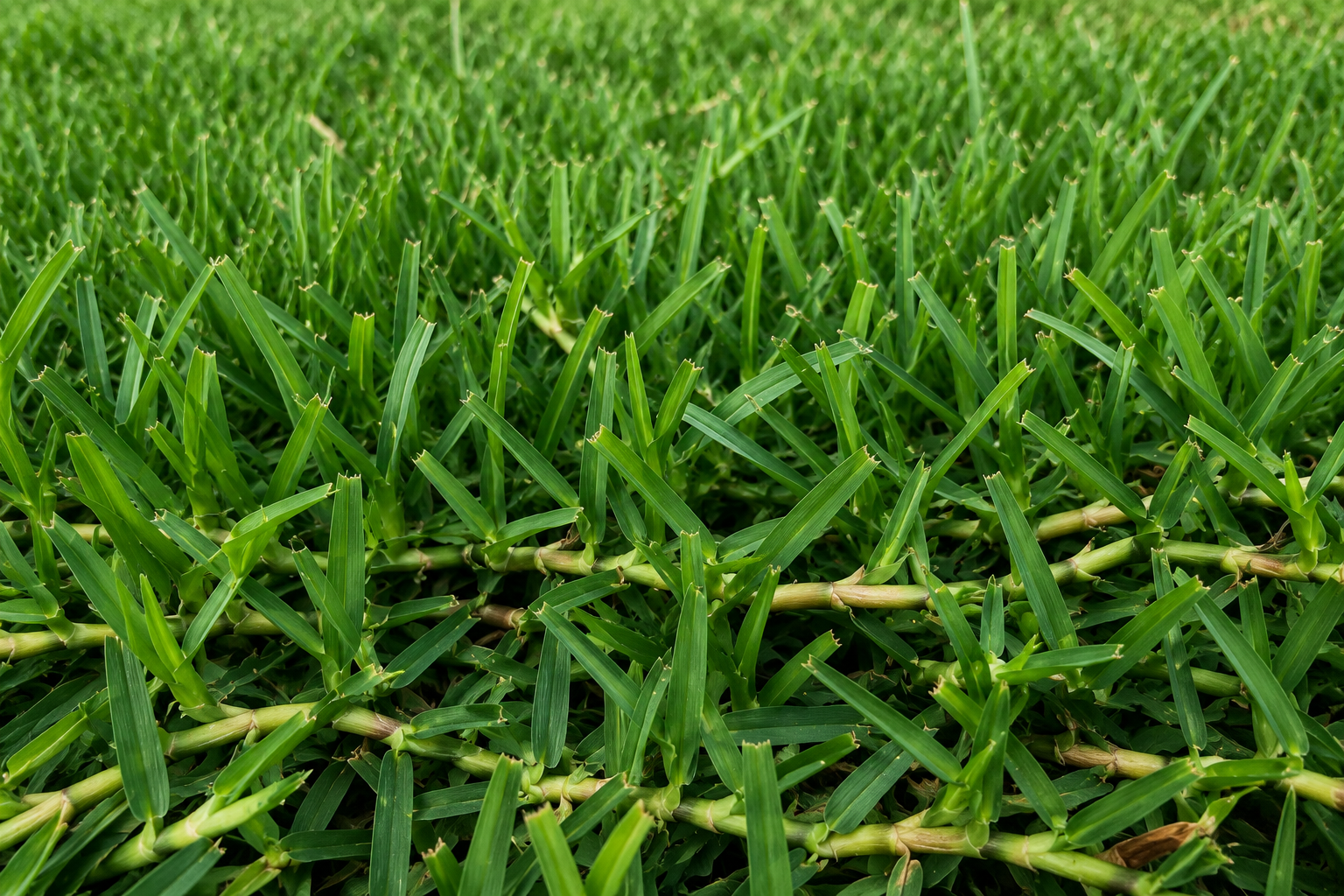
Florida's Turfgrass Inventory
Florida supports approximately 2 million acres of managed turfgrass — among the most intensively managed turf areas in the nation. Six warm-season turfgrass species dominate the residential, commercial, and recreational landscape, and each has distinct characteristics that determine which weeds become problems and which herbicides are safe to use.
St. Augustinegrass (Stenotaphrum secundatum)
St. Augustine is the dominant residential turfgrass across most of Florida — it accounts for the majority of single-family lawns from Jacksonville south through Miami, and is the species you will most often be working on. Major cultivars include 'Floratam' (the long-standing standard, but susceptible to chinch bugs and gray leaf spot), 'Palmetto' (improved cold tolerance, slightly finer texture), 'CitraBlue' (improved disease resistance), and 'ProVista' (genetically engineered for glyphosate tolerance and slow growth — important to know since broadcast glyphosate will not kill this cultivar). St. Augustine spreads by above-ground stolons (runners), produces a coarse-textured leaf, prefers a mowing height of 3.5–4 inches, and tolerates light shade better than most warm-season grasses. It is sensitive to certain herbicides — particularly 2,4-D at high rates and most photosystem-II inhibitors except atrazine — which limits broadleaf herbicide selection significantly.
Bahiagrass (Paspalum notatum)
Bahia is the workhorse low-maintenance turf of Florida — common on roadsides, large-acreage rural lots, and inexpensive commercial properties. The two dominant cultivars are 'Pensacola' (finer leaf, more cold-tolerant, common across north and central Florida) and 'Argentine' (broader leaf, prefers central and south Florida). Bahia spreads by short rhizomes and by seed, tolerates poor sandy soils with low fertility, and produces the distinctive Y-shaped seed head you will see waving above an unmown lawn. Mowing height is typically 3–4 inches. Bahia tolerates a wider range of broadleaf herbicides than St. Augustine — including 2,4-D and dicamba at standard rates — but is sensitive to several grass-selective products.
Bermudagrass (Cynodon dactylon and hybrids)
Bermudagrass is the dominant turf for golf courses, athletic fields, sod farms, and high-end commercial landscapes. Common types include common bermudagrass (often a weed in St. Augustine and centipede lawns) and improved hybrid varieties such as 'Tifway 419', 'TifTuf', 'TifGrand', and 'Celebration'. Bermuda spreads aggressively by both stolons and rhizomes — a fact that makes it a frequent weed when it invades adjacent St. Augustine, centipede, or zoysia turf. Mowing heights range from 0.5 inches on putting greens to 1.5–2 inches on home lawns. Bermuda tolerates a much broader herbicide palette than other Florida turfgrasses — including products such as foramsulfuron and trifloxysulfuron that would kill St. Augustine outright.
Zoysiagrass (Zoysia spp.)
Zoysia is a slower-growing, dense, fine-to-medium textured turf increasingly popular in residential applications across central and south Florida. Common cultivars include 'Empire', 'Zorro', 'Geo', 'Innovation', and the older 'El Toro'. Zoysia spreads by stolons and rhizomes, mowed at 1–2 inches, and tolerates a wide range of soils and modest shade. Its slow growth makes it inherently weed-competitive once established, but slow recovery from damage means herbicide injury heals slowly.
Centipedegrass (Eremochloa ophiuroides)
Centipede is a low-maintenance, light-yellow-green warm-season grass common in north Florida and the Panhandle. It spreads by stolons only (no rhizomes), prefers acid soils with low fertility, and is mowed at 1.5–2 inches. Centipede is notably sensitive to atrazine and to many sulfonylurea herbicides — herbicide selection on centipede is more restricted than on any other Florida turf except seashore paspalum.
Seashore Paspalum (Paspalum vaginatum)
Seashore paspalum is grown primarily on coastal golf courses and high-salinity sites where other grasses fail. It tolerates seawater irrigation and brackish runoff. Cultivars include 'SeaIsle 1', 'SeaIsle 2000', and 'SeaDwarf'. Mowed at 0.5–1.5 inches. Salt tolerance is the primary selection driver. Herbicide tolerance is narrow — many standard products injure paspalum at normal rates.
Almost every herbicide injury claim in Florida pest control traces to a misidentified turfgrass. Before mixing or recommending any product, confirm the grass species and, where possible, the cultivar. Look at leaf texture, stolons vs. rhizomes vs. both, ligule shape, and growth habit. When in doubt, ask the homeowner who installed the lawn or check sod-company records — and choose the safest available chemistry until the grass is confirmed. The cost of an extra five minutes is far less than replacing a stunted lawn.
Cultural Practices — the Foundation of Weed Suppression
A dense, vigorous turf canopy physically excludes most weed seedlings. Weeds germinate where light reaches the soil surface; a complete canopy denies them that light. Three cultural variables drive turf density more than any other:
Mowing Height
Mowing the turf at the upper end of its recommended range dramatically improves weed competitiveness. A St. Augustine lawn maintained at 4 inches outcompetes weed seedlings far better than the same lawn at 2.5 inches, because the taller canopy shades the soil surface continuously. The "one-third rule" — never remove more than one-third of the leaf blade in a single mowing — preserves root reserves and keeps the canopy dense between mowings. Scalping (cutting too short) opens light gaps that broadleaf and grassy weeds exploit within days.
Irrigation
Florida turf is most weed-prone when irrigated too often and too lightly. Frequent shallow watering keeps the top inch of soil moist — exactly the zone where most weed seeds germinate — while doing little to encourage deep turfgrass root development. The correct pattern is deep and infrequent irrigation (typically 0.5–0.75 inches per cycle, applied only when the lawn shows early signs of moisture stress). This pattern produces deeper turfgrass roots that outcompete shallow-rooted weed seedlings, and it allows the soil surface to dry between cycles, suppressing weed germination. Most Florida water-management districts have day-of-week irrigation restrictions that align with this principle.
Fertility
Adequate but not excessive nitrogen produces the dense canopy that suppresses weeds. Underfertilized lawns thin out and admit weeds. Overfertilized lawns produce excessive succulent growth that is more prone to disease, more attractive to pests, and — counterintuitively — often more weed-prone because flushes of growth followed by collapse open canopy gaps. Florida county fertilizer ordinances (especially in counties with a "summer blackout" prohibiting nitrogen application during the rainy season) make fertilization timing a regulated activity in much of the state.
Integrated Pest Management — A Working Definition
The acronym IPM is sometimes used as marketing language with no operational meaning. For purposes of this course, IPM is a structured decision framework with the following steps applied to weeds:
- Identify the weed species correctly — broadleaf, grassy, or sedge — and confirm the turfgrass species you are working in.
- Establish a threshold for action. A lawn with 3% weed cover may not warrant treatment; a lawn with 30% weed cover almost certainly does. Customer aesthetics, contract terms, and environmental site factors all inform thresholds.
- Address contributing conditions — mowing height, irrigation pattern, soil compaction, fertility, drainage. A weed problem that is actually an irrigation problem will not stay solved with herbicide.
- Apply the most targeted control consistent with the situation. This is the principle that produces the spot-treatment philosophy that runs through the rest of this course.
- Monitor and document — return to the site, evaluate efficacy, adjust the program. Re-treat where necessary, change strategy where needed.
The Case for Spot Treatment
Many traditional lawn programs default to broadcast herbicide application — covering the entire lawn with the same product at the same rate, regardless of where weeds are or are not present. Broadcast application is simple to deliver, easy to bill, and often technically labeled. It is also the most over-applied, least-targeted, and most likely-to-injure-turfgrass approach available, and modern Florida IPM increasingly favors a different model: frequent, small, spot-treatment applications targeting only actual weed populations.
The case for spot treatment is concrete:
- Lower total herbicide use. Treating only the 5–10% of lawn area that actually has weeds delivers a 90% reduction in active ingredient compared to broadcast application — a major environmental, cost, and label-stewardship benefit.
- Reduced turfgrass injury. Even labeled herbicides cause subtle stunting, color shift, or root suppression on tolerant turf. A St. Augustine lawn broadcast-sprayed with 2,4-D ester in summer will stress visibly within a week. The same lawn with the same product spot-treated to dollarweed patches shows no general lawn injury — only the dollarweed dies.
- Better stewardship of regulated chemistry. Several Florida-specific restrictions (atrazine setbacks from water, ordinance-driven nitrogen and herbicide bans during summer in some counties) are easier to comply with when the application footprint is small and documented.
- Reduced drift and off-target damage. Spot application from a hand-held wand or backpack sprayer at low pressure produces large droplets that fall close to the target. Broadcast boom sprayers at high pressure produce fine mist that drifts into ornamental beds, neighbors' yards, and water bodies.
- Better customer outcomes over time. A monthly walk-through with spot kill of small weed patches keeps a lawn nearly weed-free year-round. Broadcast quarterly programs produce visible weed flushes between treatments, customer dissatisfaction, and the operator-treats-harder-next-time cycle that drives over-application.
Picture two service models. Service A applies a broadcast pre-emergent and a broadcast broadleaf herbicide every quarter — four broadcast applications per year, regardless of weed pressure. Service B applies a targeted pre-emergent at the right window in fall and spring, then walks the property monthly with a backpack sprayer to spot-treat any weeds that escape. Service B uses 30–50% less herbicide annually, produces a more uniform lawn, has fewer customer callbacks, and costs less in product. The trade-off is that Service B requires more attention per visit. The IPM mindset is not 'spend less time on the lawn' — it is 'use what you apply more precisely.'
The remaining lessons in this course are organized around this approach. Lesson 2 covers Florida weed identification — without accurate ID, no herbicide selection is reliable. Lesson 3 covers the herbicide chemistry and the program design (when to use pre-emergent, when to use post-emergent, what works on what weed in what turfgrass). Lesson 4 covers the practical handling, calibration, drift management, and recordkeeping that make the program legal and safe in the field.