
Accurate weed identification is the most important diagnostic step in turf weed management — far more important than herbicide selection. The same chemical that controls dollarweed in St. Augustine will not control nutsedge in the same lawn, and a misidentified weed leads directly to wasted product, repeat callbacks, and frustrated customers. Florida turf operators must be able to place every weed they encounter into one of three broad categories — broadleaf, grassy, or sedge — and then narrow that category to a working species ID. This lesson covers the diagnostic features of each category and walks through the most economically important species in each.
The Three-Category Framework
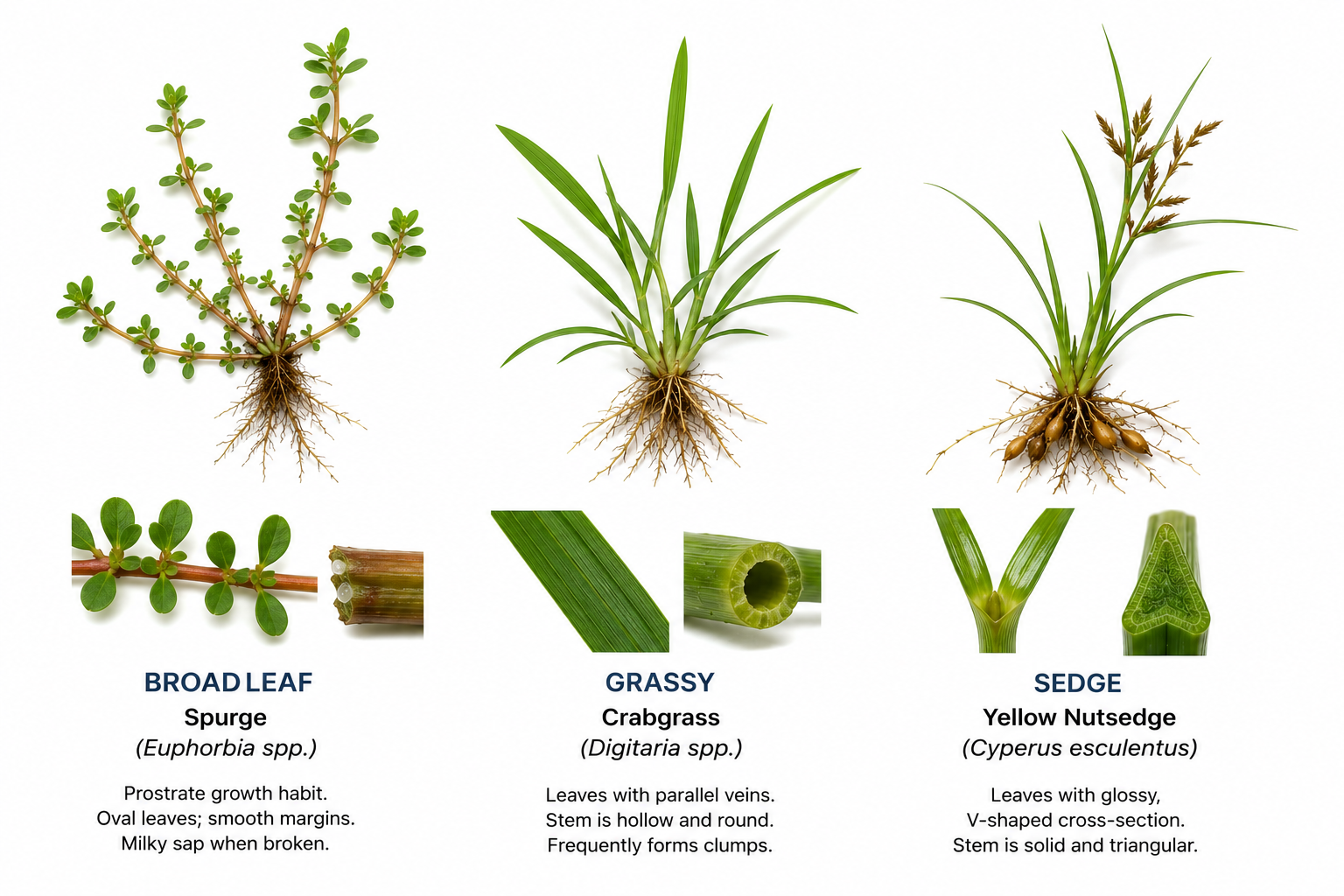
Every weed encountered in Florida turf falls into one of three botanical categories. The category determines which herbicide chemistries will work — herbicides labeled for "broadleaf weeds" will not control grassy weeds or sedges, and grass-selective herbicides do nothing to sedges. Get the category right and product selection becomes manageable; get the category wrong and no amount of expensive chemistry will produce results.
Broadleaf Weeds (Dicots)
- Botanical class: dicotyledons — two seed leaves at germination
- Leaves: usually wider than long, with a netted (reticulate) vein pattern
- Stems: typically branched, with growing points at the tips and at leaf nodes
- Examples in Florida turf: dollarweed, betony, oxalis, spurge, chamberbitter, lespedeza, dichondra, plantain, white clover, Virginia buttonweed, dandelion, wild violet
Grassy Weeds (Annual or Perennial Grasses)
- Botanical class: monocotyledons in the family Poaceae
- Leaves: long and narrow with parallel veins; arranged in two rows on the stem
- Stems: round or flattened, hollow at internodes (most species), with swollen nodes
- Examples in Florida turf: crabgrass, goosegrass, dallisgrass, torpedograss, smutgrass, annual bluegrass (Poa annua), bermudagrass-as-weed, signalgrass
Sedges
- Botanical class: monocotyledons in the family Cyperaceae — related to but distinct from grasses
- Leaves: long and narrow with parallel veins, arranged in three rows from the stem (vs. two rows in grasses)
- Stems: triangular in cross-section, solid (not hollow) — the diagnostic feature you can confirm by feeling the stem between thumb and forefinger
- Examples in Florida turf: yellow nutsedge, purple nutsedge, green kyllinga, false-green kyllinga, globe sedge, annual sedge
The classic mnemonic sedges have edges, rushes are round, grasses have nodes from the top to the ground is worth memorizing. The triangular stem of a sedge can be felt by rolling the stem between your fingers — you will feel three flat sides and three edges, completely different from the round or flattened stem of a grass. Most pest-significant sedges in Florida — yellow and purple nutsedge in particular — also reproduce by underground tubers (sometimes called "nutlets"), which is why standard mowing and even broadleaf herbicides have no effect on them. The tubers must be controlled chemically with sedge-specific products covered in Lesson 3.
How Weeds Spread
Understanding how a weed reproduces and spreads is essential for selecting the right management tool and the right timing.
- Seed. Most annual weeds (crabgrass, goosegrass, chamberbitter, spotted spurge, Florida pusley, annual bluegrass) reproduce primarily by seed. A single plant can produce thousands of seeds that lie dormant in the soil seed bank for years. Pre-emergent herbicides (Lesson 3) work by intercepting these seeds at germination — but only if applied before the seeds germinate.
- Stolons. Above-ground horizontal runners that root at nodes — bermudagrass and torpedograss spread aggressively this way. Stolon-spreading weeds are extremely difficult to control with mowing alone, since each fragment can re-root.
- Rhizomes. Below-ground horizontal stems that produce new shoots — torpedograss and bermudagrass spread by rhizome as well as stolon, which is why they are nearly impossible to dig out and re-establish elsewhere.
- Tubers. Underground storage structures with multiple growing points — yellow and purple nutsedge spread primarily by tubers. Hand-pulling a nutsedge plant leaves the tubers behind, which is why pulled nutsedge always returns thicker.
- Crowns and creeping roots. Some perennial broadleaves (dollarweed, dichondra, white clover, dandelion) spread by creeping roots or expanding crowns.
- Wind, water, mowers, and animals. All weed seeds disperse passively. Mowing equipment moved between properties without cleaning is one of the most underappreciated vectors for spreading torpedograss, bermudagrass, and nutsedge between accounts.
Florida Broadleaf Weeds — Key Species
Dollarweed (Hydrocotyle spp.)
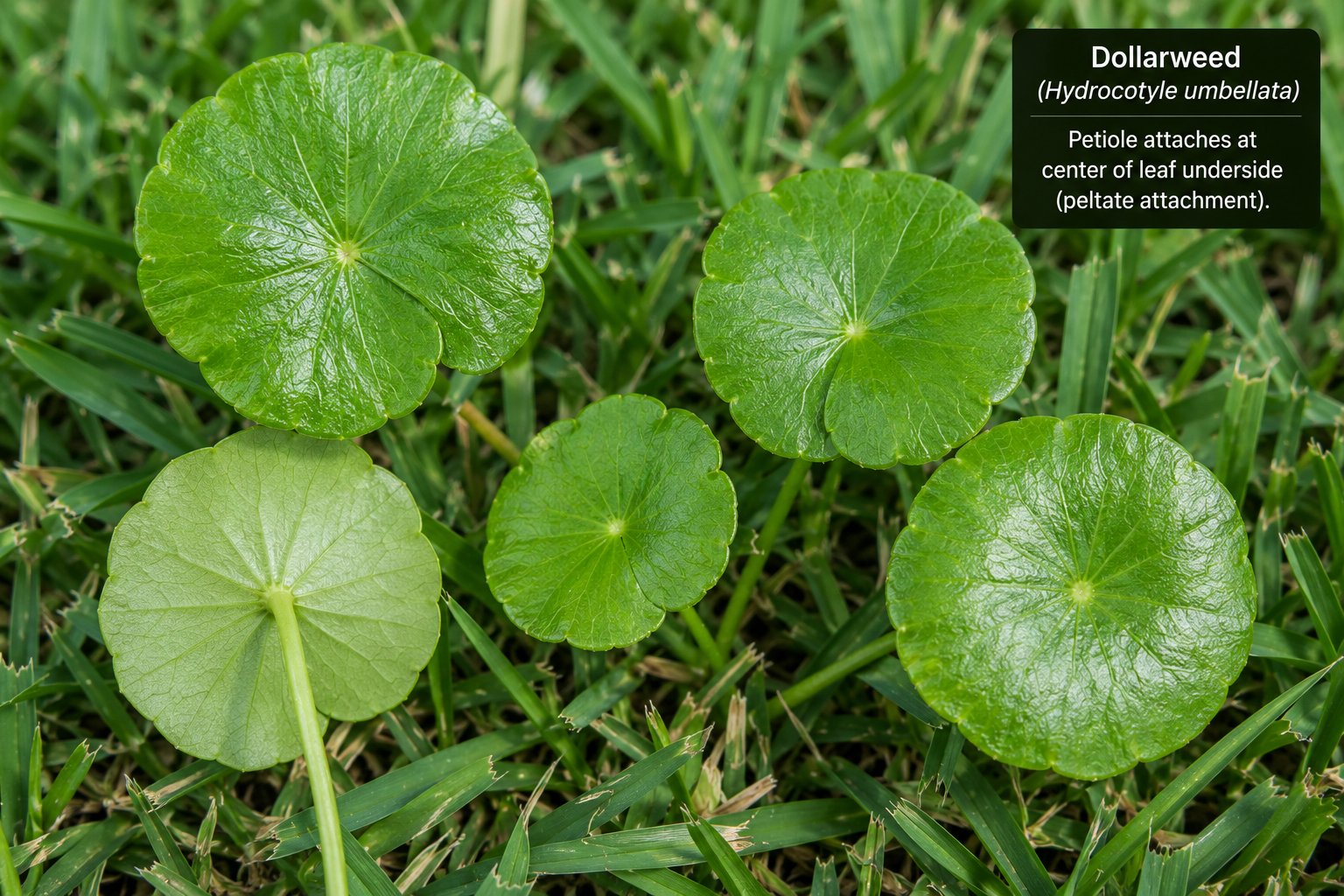
One of the most common and aggressive broadleaf weeds in Florida lawns, particularly in over-irrigated St. Augustine. ID: bright glossy green round leaves about the size of a dollar coin, with the leaf stem attached at the center of the underside (the diagnostic feature — most weeds attach the petiole at the leaf edge). Spreads by rhizomes and seed; thrives in continuously moist soil. Cultural fix: reduce irrigation frequency, improve drainage. Chemical: 2,4-D + dicamba (Trimec mixes), atrazine in St. Augustine, metsulfuron, sulfentrazone.
Florida Betony (Stachys floridana) — "Rattlesnake Weed"
Perennial broadleaf in the mint family with square stems, opposite triangular leaves, and the distinctive segmented white underground tubers that give it the rattlesnake-weed nickname. Tubers regrow even after the foliage is killed, making single-application control unreliable. Repeated post-emergent applications of 2,4-D + dicamba + MCPP, or atrazine in St. Augustine, are usually required across the cool season.
Oxalis / Yellow Woodsorrel (Oxalis stricta)
Three-leaflet clover-like leaves (heart-shaped leaflets), small yellow flowers, slender erect stems. Spreads by seed and creeping rhizomes. Common in sparse turf and shade. Controls: atrazine, 2,4-D + dicamba combinations, sulfentrazone.
Spotted Spurge (Euphorbia maculata)
Prostrate summer annual with small opposite leaves, often with a dark spot in the leaf center; broken stems exude a milky white sap (a key ID feature shared with all Euphorbia). Highly seed-prolific in compacted bare areas. Pre-emergent (prodiamine, dithiopyr, indaziflam) catches it well; post-emergent control with sulfentrazone, mesotrione, or 2,4-D + dicamba.
Chamberbitter (Phyllanthus urinaria)
Summer annual with mimosa-like compound leaves and tiny round green seed capsules attached underneath the leaflets — the diagnostic feature. Very seed-prolific; shows up after summer rains in thin turf. Best controlled by pre-emergent in late spring; post-emergent control with atrazine, sulfentrazone, or 2,4-D + dicamba combinations.
Common Lespedeza (Kummerowia striata)
Summer annual with three-leaflet leaves and prostrate wiry stems; often appears in thin, compacted turf. Atrazine in St. Augustine, sulfentrazone, or 2,4-D + dicamba combinations.
Virginia Buttonweed (Diodia virginiana)
Aggressive perennial broadleaf with opposite lance-shaped leaves, prostrate growth, and small white tubular flowers in leaf axils. One of the most difficult-to-control broadleaves in Florida turf; requires repeated applications of 2,4-D + dicamba + MCPP, or metsulfuron, with multiple treatments across the growing season.
Other broadleaves you will encounter
- Florida pusley (Richardia scabra) — summer annual with rough hairy leaves and white star-shaped flowers in clusters
- White clover (Trifolium repens) — three leaflets with white V-mark, white flower heads
- Common lawn dandelion (Taraxacum officinale) — basal rosette, yellow composite flower, distinctive seed puffball
- Pennywort — distinct from dollarweed but easily confused; smaller leaves with kidney-shape and lobed margin
- Asiatic hawksbeard (Youngia japonica) — winter annual with lobed basal rosette and small yellow composite flowers
Florida Grassy Weeds — Key Species
Crabgrass (Digitaria sanguinalis and D. ciliaris)
Summer annual grass that is by far the most common grassy weed nationwide, although less dominant in Florida than in northern states. Round, jointed stems that root at the lower nodes; finger-like seed heads radiating from the top of an upright stem. Pre-emergent control (prodiamine, pendimethalin, dithiopyr) applied before soil temperatures reach 55°F at 4-inch depth — typically February in central and south Florida — is the standard program. Post-emergent control with quinclorac on bahiagrass, bermudagrass, and centipede; on St. Augustine the options are narrower.
Goosegrass (Eleusine indica)
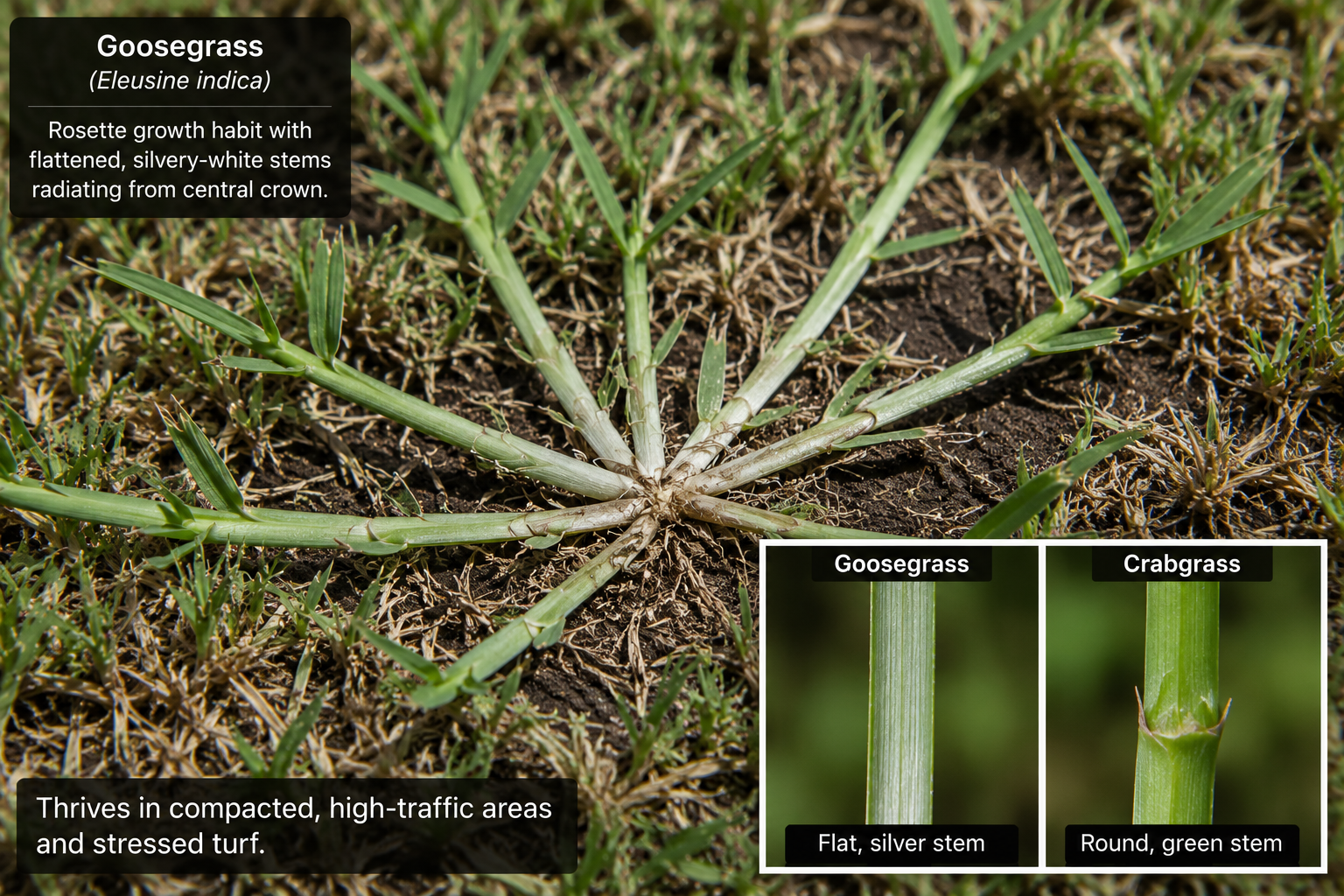
Summer annual that often follows crabgrass in turf with compaction and high traffic. ID: distinctive flattened silvery-white stems radiating outward in a rosette from a central crown — a "wagon-wheel" appearance unmistakable once seen. More resistant to standard pre-emergents than crabgrass; requires higher-rate or different chemistry (oxadiazon, indaziflam) for reliable pre-emergent control. Post-emergent options are limited in St. Augustine.
Annual Bluegrass (Poa annua)
Cool-season annual that germinates in fall and dominates Florida lawns from October through April. Light green, fine-textured, with small white seed heads even at low mowing height. Pre-emergent application timing in Florida is critical — applications must be made in early to mid-fall (September–October) before fall germination. Indaziflam is currently one of the best options. Glyphosate spot-treatment of dormant warm-season turf in winter is a common Florida tool.
Dallisgrass (Paspalum dilatatum)
Coarse, clump-forming perennial grass with a tall seed head bearing distinctive black-spotted seeds. Spreads by short rhizomes and seed. Difficult to control; selective options are limited. Spot treatment with glyphosate (kills the surrounding turf, requires re-sodding) or repeated applications of MSMA (now restricted) historically were used.
Torpedograss (Panicum repens)
Aggressive perennial spreading by stout sharp-tipped rhizomes (the source of the name). One of the most difficult-to-control grasses in Florida lawns; once established, complete eradication usually requires kill-and-replace of the affected area. Quinclorac suppresses it; sethoxydim and fluazifop are options in some non-grass turf situations.
Smutgrass (Sporobolus indicus)
Coarse perennial bunchgrass common in pastures and bahiagrass lawns; tall stems with dark seed heads sometimes covered with sooty fungal mold (the source of the name). Hexazinone (Velpar) is the historic pasture standard but is not labeled for residential turf.
Bermudagrass-as-Weed
Common bermudagrass invading St. Augustine, centipede, or zoysia is one of the most frequent customer complaints in Florida turf. The grass-selective graminicide pair fluazifop (Fusilade) and sethoxydim (Vantage) selectively kill bermuda in many tolerant turfs — but require careful product-and-turf matching since both products injure bermuda's relatives at high rates.
Florida Sedges — Key Species
Yellow Nutsedge (Cyperus esculentus)
The most common sedge in Florida turf. Light yellow-green color, glossy V-shaped leaves arranged in three rows, triangular stem, distinctive yellow-tan seed head. Spreads aggressively by tubers (nutlets) — the tubers can persist in soil for several years. Sedge-specific herbicides covered in Lesson 3 (halosulfuron, sulfentrazone, imazaquin) are the only reliable controls.
Purple Nutsedge (Cyperus rotundus)
Dark green, slightly stiffer leaves than yellow nutsedge, purple-brown seed head, and chained tubers (the tubers connect in a string rather than each forming independently). More aggressive and harder to control than yellow nutsedge; halosulfuron and sulfentrazone are the standard tools, with multiple applications usually required.
Green Kyllinga and False-Green Kyllinga (Kyllinga spp.)
Low-growing perennial sedges that form a dense mat in moist, sunny turf. Distinctive small spherical green seed heads (kyllinga) or oval seed heads (false-green kyllinga). Sulfentrazone, halosulfuron, and imazaquin are the standard tools.
Globe Sedge and Annual Sedge
Summer annuals with globular seed heads at the top of the triangular stem. Generally easier to control than the perennial nutsedges because there are no tubers — pre-emergent or single post-emergent application usually works.
Sedges are not grasses and they are not broadleaves. The herbicide modes of action that work on broadleaves (synthetic auxins like 2,4-D and dicamba) and on grasses (graminicides like fluazifop) do not control sedges reliably. Sedge control requires a small set of sedge-specific products — primarily halosulfuron (Sedgehammer), sulfentrazone (Dismiss, Q4 Plus), imazaquin (Image), and some combination products. Putting 2,4-D + dicamba on a nutsedge problem produces frustrated customers and live nutsedge. Confirm the category before you mix.
Lesson 3 turns from identification to chemistry: pre-emergent versus post-emergent timing, the major herbicide modes of action, the products labeled for each Florida turfgrass, and how to match herbicide choice to weed species.