
This lesson covers the chemistry of turf herbicides — pre-emergent and post-emergent timing, the major modes of action, the active ingredients labeled for each Florida turfgrass, and the matching of product to weed species. The goal is for you to be able to look at a field problem (turf species, weed category, weed species, season) and arrive at a defensible product choice without reaching for the back of a calendar or hoping. Lesson 4 will cover how to actually deliver the application — calibration, drift, recordkeeping, spot-treatment technique, and resistance management.
Pre-Emergent vs Post-Emergent — The Fundamental Distinction
Every turf herbicide is either a pre-emergent (applied to soil before weed seeds germinate) or a post-emergent (applied to actively growing weeds after they have emerged). The difference drives every decision in program design.
Pre-Emergent Herbicides
Pre-emergent herbicides form a chemical barrier in the upper layer of soil that interrupts weed-seed germination. They do not control weeds that have already emerged — applying a pre-emergent to a lawn full of weeds wastes the product. Their effectiveness depends entirely on application timing relative to seed germination, soil incorporation by rainfall or irrigation within 24–72 hours of application, and adequate residual life in the soil through the germination window.
Post-Emergent Herbicides
Post-emergent herbicides kill weeds after emergence by disrupting plant biochemistry — depending on the chemical class, this may involve hormonal disruption, photosynthesis blocking, amino-acid synthesis blocking, or membrane disruption. Post-emergents are effective only on actively growing weeds; applications to drought-stressed, dormant, or already-injured weeds produce poor results. They are the primary tool for weeds that escape the pre-emergent program — the spot-treatment workhorses covered in Lesson 4.
Pre-Emergent Timing in Florida
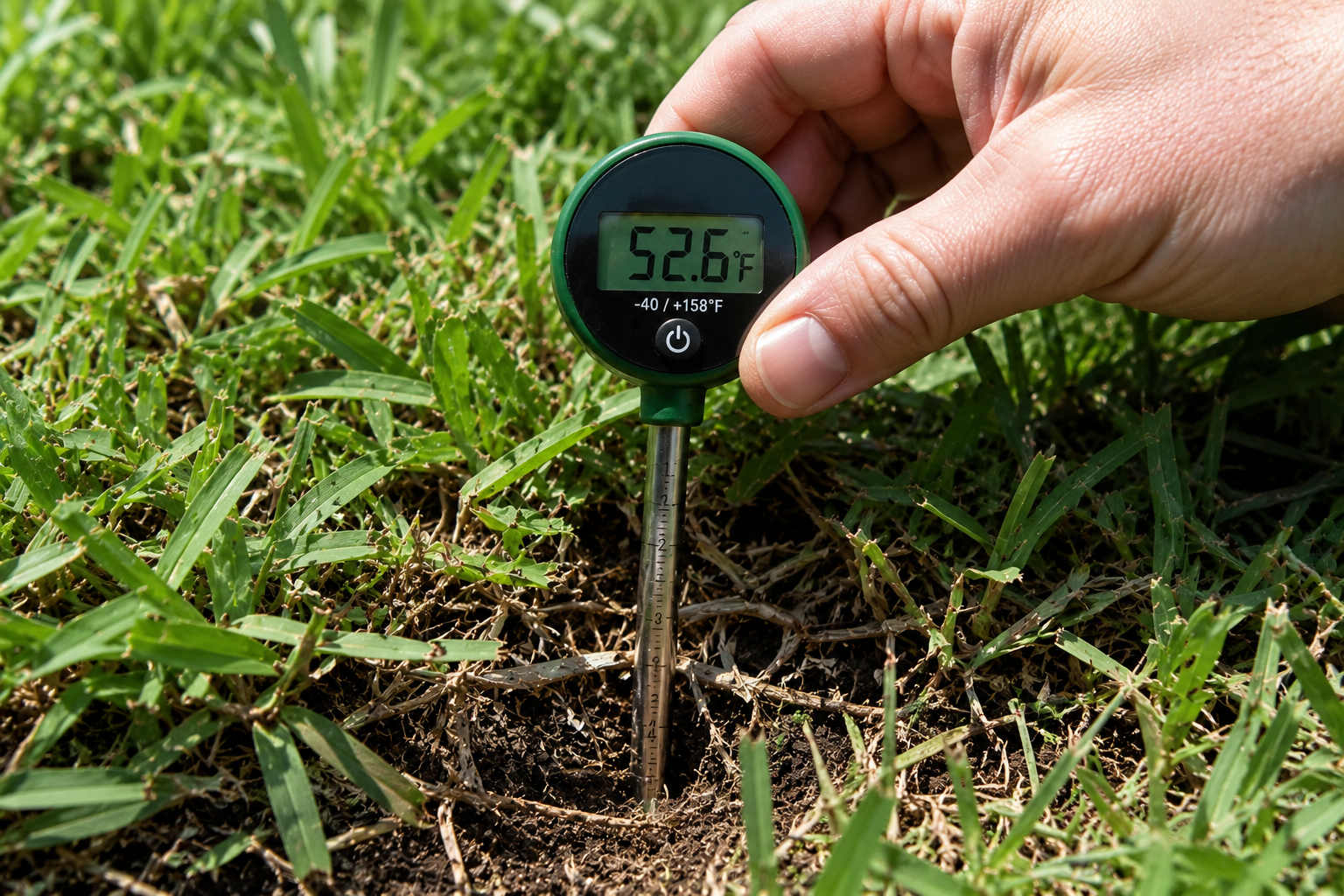
Pre-emergent applications must be in place before seeds germinate. The trigger is soil temperature, and Florida's geography produces two distinct seasonal windows:
- Spring window (for summer annual weeds — crabgrass, goosegrass, chamberbitter, spotted spurge, Florida pusley): apply when 4-inch soil temperature reaches the mid-50s°F and is climbing. In central and south Florida this is typically late January through February; in north Florida and the Panhandle, mid-February through early March. A second application 8–10 weeks after the first extends the residual through the full germination window.
- Fall window (for winter annual weeds — annual bluegrass / Poa annua, hop clover, henbit, lawn burweed): apply when 4-inch soil temperature is in the 70s°F and falling. In Florida this is typically late September through October.
A pre-emergent applied even two to three weeks late often produces visibly poor control — by the time it goes down, a percentage of seeds have already germinated and the chemical no longer reaches them. Calendar-based programs that ignore actual soil-temperature timing are one of the most common reasons "pre-emergent doesn't work."
Common Pre-Emergent Active Ingredients
| Active Ingredient | Class | Notes |
|---|---|---|
| Prodiamine (Barricade) | Dinitroaniline | Long residual; standard spring crabgrass tool; safe on most established warm-season turf |
| Pendimethalin (Pendulum) | Dinitroaniline | Yellow-staining; widely used in granular fertilizer-pre-emergent combinations |
| Dithiopyr (Dimension) | Pyridine | Some early post-emergent activity on small crabgrass — useful when timing slips slightly |
| Oxadiazon (Ronstar) | Oxadiazole | Stronger goosegrass control than dinitroanilines; granular only on most labels |
| Indaziflam (Specticle) | Alkylazine | Premium product; broad spectrum; controls Poa, goosegrass, sedge seedlings; long residual; check turfgrass tolerance |
| Atrazine | Triazine | Pre- and post-emergent activity; only on St. Augustine and centipede; Florida groundwater restrictions |
| Simazine (Princep) | Triazine | Similar profile to atrazine; some St. Augustine and centipede labels |
Florida regulates atrazine use more strictly than the federal label. Florida Administrative Code prohibits atrazine application within 200 feet of bodies of water on sandy soils due to groundwater contamination risk. This is a state restriction beyond the federal label requirements. Sandy soils dominate most of Florida, so this restriction applies on most properties. Document which turf zones are inside the setback and use alternative chemistry there. Atrazine misuse has been a recurring driver of FDACS enforcement action against Florida applicators.
Post-Emergent Herbicides — Modes of Action
Post-emergent herbicides are organized by mode of action — the biochemical pathway the herbicide disrupts. Mode of action determines which weeds are controlled, what turfgrasses are tolerant, and how to design rotations that delay resistance development.
Synthetic Auxins (Group 4)
Synthetic plant hormones that cause uncontrolled, abnormal growth in dicots, killing the plant within 1–3 weeks. The classic broadleaf herbicide class. Active ingredients: 2,4-D, dicamba, MCPP (mecoprop), MCPA, triclopyr, fluroxypyr, quinclorac (which has unusual broad-spectrum activity including some grasses and broadleaves). Common combination products: Trimec Classic (2,4-D + MCPP + dicamba), Speedzone (2,4-D + MCPP + dicamba + carfentrazone), Q4 Plus (2,4-D + quinclorac + dicamba + sulfentrazone).
Turfgrass tolerance: Bahia, bermuda, zoysia, and centipede tolerate standard rates of 2,4-D ester. St. Augustine is sensitive to 2,4-D ester at high rates and to dicamba in summer heat — use St. Augustine-labeled formulations (typically 2,4-D amine plus reduced rates), apply when temperatures are below 85°F, and never broadcast 2,4-D ester on St. Augustine.
ALS Inhibitors (Group 2) — Acetolactate Synthase Inhibitors
Block synthesis of branched-chain amino acids; effective on broadleaves, sedges, and some grasses; long residual at very low use rates. Active ingredients: halosulfuron (Sedgehammer) for sedges; metsulfuron (Manor, Blade) for broadleaves and some grasses; imazaquin (Image) for sedges and broadleaves; sulfentrazone (Dismiss) sedge and broadleaf; foramsulfuron (Revolver), trifloxysulfuron (Monument), flazasulfuron (Katana) for grasses and sedges in tolerant turf.
Turfgrass tolerance varies sharply by product. Foramsulfuron and trifloxysulfuron tolerated by bermuda but kill St. Augustine. Halosulfuron tolerated by all common Florida turfgrasses. Read the label.
Photosystem II Inhibitors (Group 5)
Block photosynthesis. Triazines (atrazine, simazine) and substituted ureas (diuron) are the main examples. Useful pre- and post-emergent on broadleaves and some grasses. Atrazine is the workhorse on St. Augustine and centipede in Florida; diuron is more restricted but appears in some bermuda and bahia products.
HPPD Inhibitors (Group 27)
Block carotenoid pigment synthesis, producing the distinctive bleached-white turf injury when applied to non-tolerant turfgrass. Active ingredients: mesotrione (Tenacity), topramezone (Pylex). Mesotrione has activity on a wide range of broadleaves and grassy weeds and is one of the few selective options for goosegrass and crabgrass in St. Augustine — but expect temporary bleaching on the treated turf.
PPO Inhibitors (Group 14)
Disrupt cell membranes, producing rapid contact injury (visible within 24–48 hours). Active ingredients: sulfentrazone (Dismiss), carfentrazone (QuickSilver). Often used in combination products to provide fast visible response (the "burn-down" component) alongside slower-acting auxins.
Graminicides (Group 1) — ACCase Inhibitors
Selectively kill grasses while sparing broadleaves and (importantly) most non-grass turf. Active ingredients: fluazifop (Fusilade), sethoxydim (Vantage), clethodim (Envoy). Useful for taking out bermudagrass-as-weed in non-grass landscape beds, and at reduced rates for selective bermuda removal in zoysia and other tolerant turfs.
EPSP Synthase Inhibitor (Group 9) — Glyphosate
Glyphosate (Roundup, Eraser, many generics) is the only common Group 9 product. Non-selective — kills any green plant it contacts. Used as a spot-kill tool in landscape beds, for taking out problem grasses and weeds before re-sodding, and for dormant-season treatment of warm-season turf to control winter weeds. Important Florida note: 'ProVista' St. Augustine is genetically engineered for glyphosate tolerance — broadcast glyphosate intended to brown a lawn for renovation will not work on this cultivar.
Matching Herbicide to Weed and Turf
Before selecting any herbicide, answer two questions in this order: (1) What turfgrass am I in? This sets the upper limit on what is safe. (2) What weed am I controlling — what category and what species? This sets the lower limit on what will work. The herbicide must be labeled for the turfgrass and effective on the weed. Many control failures and many turfgrass injury claims trace to skipping question (1) or (2). When the turfgrass is unknown or uncertain, choose the safest available chemistry — typically a sulfonylurea labeled across the warm-season turfs, or a basic 2,4-D amine — until the turfgrass is confirmed.
Quick Reference — Common Florida Pairings
- Crabgrass (small, post-emergent) in St. Augustine: mesotrione + atrazine; quinclorac is NOT labeled in St. Augustine
- Crabgrass (small) in bermuda or bahia: quinclorac (Drive XLR8 and combinations)
- Goosegrass in St. Augustine: mesotrione, topramezone — pre-emergent indaziflam is the better long-term answer
- Yellow nutsedge in any common turf: halosulfuron (Sedgehammer); sulfentrazone (Dismiss)
- Purple nutsedge in any common turf: halosulfuron + repeat applications; sulfentrazone
- Dollarweed in St. Augustine: atrazine; metsulfuron; sulfentrazone; 2,4-D amine combinations at St. Augustine-safe rates
- Florida betony in St. Augustine: atrazine; 2,4-D + dicamba + MCPP combinations across the cool season
- Virginia buttonweed in St. Augustine: repeated metsulfuron or 2,4-D + dicamba + MCPP applications
- Annual bluegrass (Poa annua) in any turf: indaziflam pre-emergent in fall is the program tool; spot-treat surviving plants with glyphosate on dormant warm-season turf
- Bermudagrass invading St. Augustine: selective options are limited; spot-treat with glyphosate and re-sod, or accept the bermuda
- Bermudagrass invading zoysia: reduced-rate fluazifop or sethoxydim applications; multiple treatments required
Reading the Label — the Non-Negotiable Step
Every herbicide product label specifies the labeled turfgrasses (sometimes by cultivar), labeled use sites, application rate, application timing window, irrigation/rainfall instructions, re-treatment interval, re-entry interval, drift restrictions, and disposal requirements. The label is a federal legal document; applying a product in a manner inconsistent with the label is a violation of FIFRA and Florida Statute Chapter 487. Off-label use is one of the leading causes of FDACS enforcement action against Florida pest control licensees.
Critical label sections to read every time:
- Use sites and labeled turfgrasses — confirm the product is labeled for the turfgrass you are treating before you mix.
- Application rate in the units the product specifies (oz per 1,000 sq ft, oz per acre, lb per acre — the units differ between products and getting this wrong is a common error).
- Maximum annual rate — many products have a per-acre annual cap that can be exceeded by routine seasonal programs.
- Re-entry interval (REI) — minimum time before people may re-enter the treated area without specific PPE.
- Florida-specific instructions — atrazine setback, sensitive-site language, runoff restrictions.
Lesson 4 closes the course with the practical handling, calibration, drift control, and resistance management practices that turn a written program into safe and legal field work — including the spot-treatment technique that runs through the entire weed-management approach.