
Lessons 1 through 3 covered turfgrass biology, weed identification, and herbicide chemistry. This final lesson covers the practical work that turns a sound program into safe, legal, effective field application: handling and PPE, calibration, drift control, the spot-treatment technique that defines a modern Florida weed program, recordkeeping, and resistance management. The single most important theme connecting all of these topics is the same one introduced in Lesson 1 — frequent, small, targeted applications outperform infrequent broadcast applications on every dimension that matters: efficacy, turf safety, environmental stewardship, regulatory compliance, and customer satisfaction.
Herbicide Handling and Personal Protection
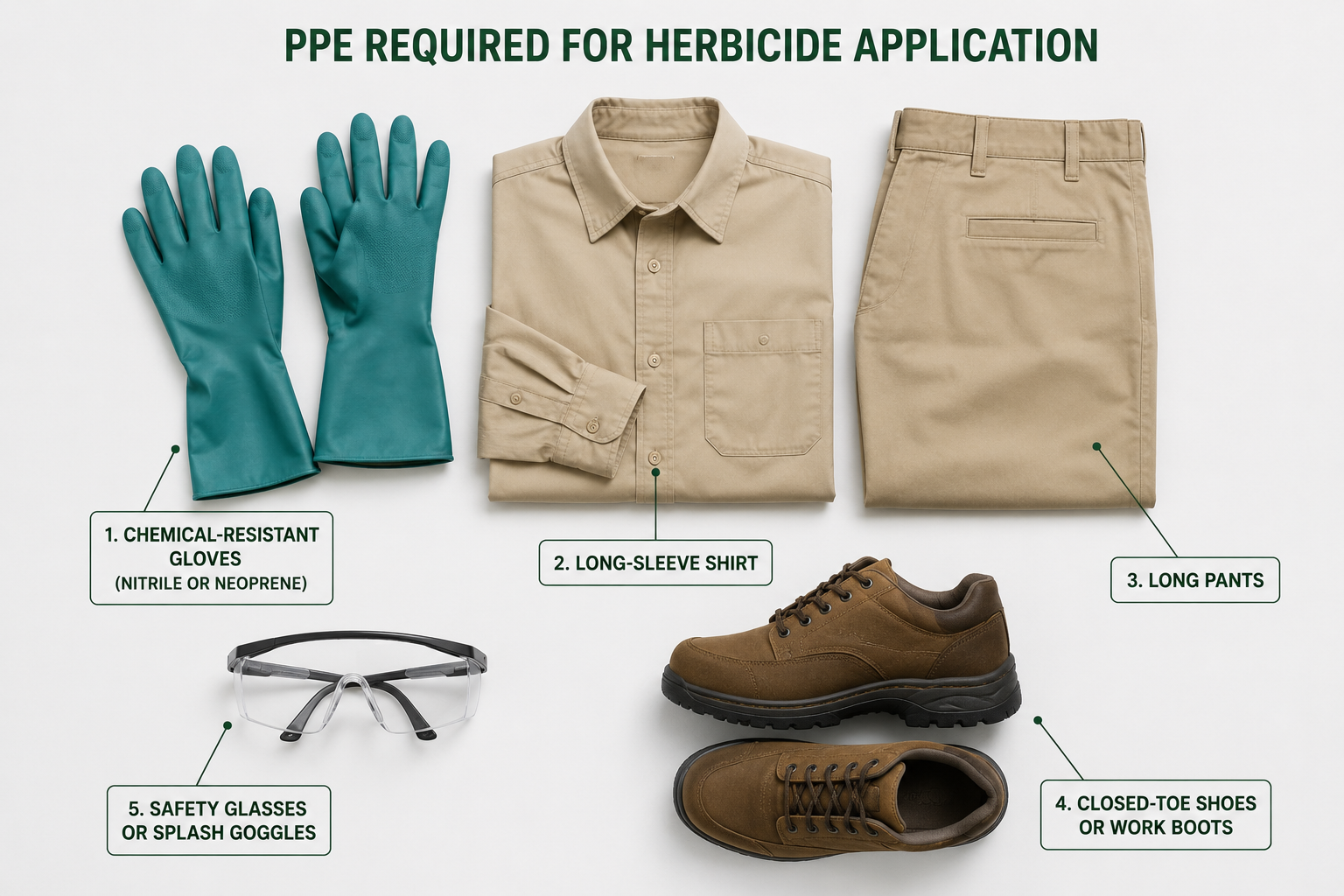
Read the Label First
Every herbicide label specifies a minimum PPE set under the "Hazards to Humans and Domestic Animals" or "Personal Protective Equipment" section. The minimum almost always includes long sleeves, long pants, closed shoes plus socks, chemical-resistant gloves, and eye protection. Some products require additional protection — chemical-resistant apron during mixing, NIOSH-approved respirator, chemical-resistant footwear. Treating "long sleeves and gloves" as the universal answer will eventually result in a label violation.
Mixing and Loading
- Mix on a hard surface (concrete, paved area) where any spill can be contained and cleaned up — not on bare soil or grass.
- Maintain at least 50 feet from any well, water source, or storm drain when mixing.
- Use a closed-system mixing setup where available; otherwise pour at the lowest practical height to minimize splash.
- Wear the full mixing PPE (gloves, eye protection, apron if required) — exposure during mixing is typically higher than during application because the product is being handled at full label concentration.
- Keep the original container with intact label until the product is fully used; do not transfer to unmarked containers.
Drift Control
Off-target drift is the source of most herbicide damage claims and a frequent driver of FDACS complaint investigations. The variables that control drift are well-understood and applicator-managed:
- Droplet size. Coarse droplets (300+ microns) fall close to the target; fine droplets (under 100 microns) drift on minor air movement. Use lower spray pressures (15–30 psi for backpack work, not 60+ psi), drift-reduction nozzle types (air-induction, flat-fan with larger orifice), and drift-retardant adjuvants where appropriate.
- Wind speed. Apply only when wind is 2–10 mph. Below 2 mph there is risk of temperature-inversion drift (where fine particles travel long distances on cold-air layers); above 10 mph drift is excessive.
- Wind direction. Note wind direction and avoid spraying upwind of sensitive sites (ornamental beds, water bodies, neighboring properties, vegetable gardens, schools).
- Temperature inversions. Calm, cool, foggy mornings often coincide with temperature inversions in which spray particles can travel hundreds of feet horizontally on a cold-air layer rather than dispersing. Watch for fog, cool dew, smoke that travels horizontally without rising — these are inversion indicators. Do not spray.
- Boom height. Boom or wand at the lowest height that still produces uniform coverage. Excess boom height multiplies drift exposure.
Calibration
An uncalibrated sprayer or spreader produces unknown application rates and unreliable results. Calibration takes 5–10 minutes and is required for every piece of equipment, at the start of every season, and any time speed, pressure, nozzle, or pattern changes.
Backpack Sprayer Calibration (1/128 Method)
Mark off a 1,000 sq ft area (typically 18.5 × 54 ft, or 25 × 40 ft). Spray plain water across this area at the same pace and pressure you will use during the actual application. Time the application and measure water used. The ounces of water applied to 1,000 sq ft is the gallons-per-acre output (because 1,000 sq ft is 1/43.56 of an acre, and the ounce-to-gallon-acre conversion lines up at 1/128). Calculate product per tank to deliver label rate over the area you can cover with one tank, and document the result on the equipment.
Granular Spreader Calibration
Set the spreader to the manufacturer's recommended setting for the product. Apply a measured weight of product across a measured area. Weigh the remaining product and calculate the actual application rate per 1,000 sq ft. Adjust the setting until actual rate matches label rate. Repeat any time the product, pace, or operator changes.
The Spot-Treatment Strategy in Practice
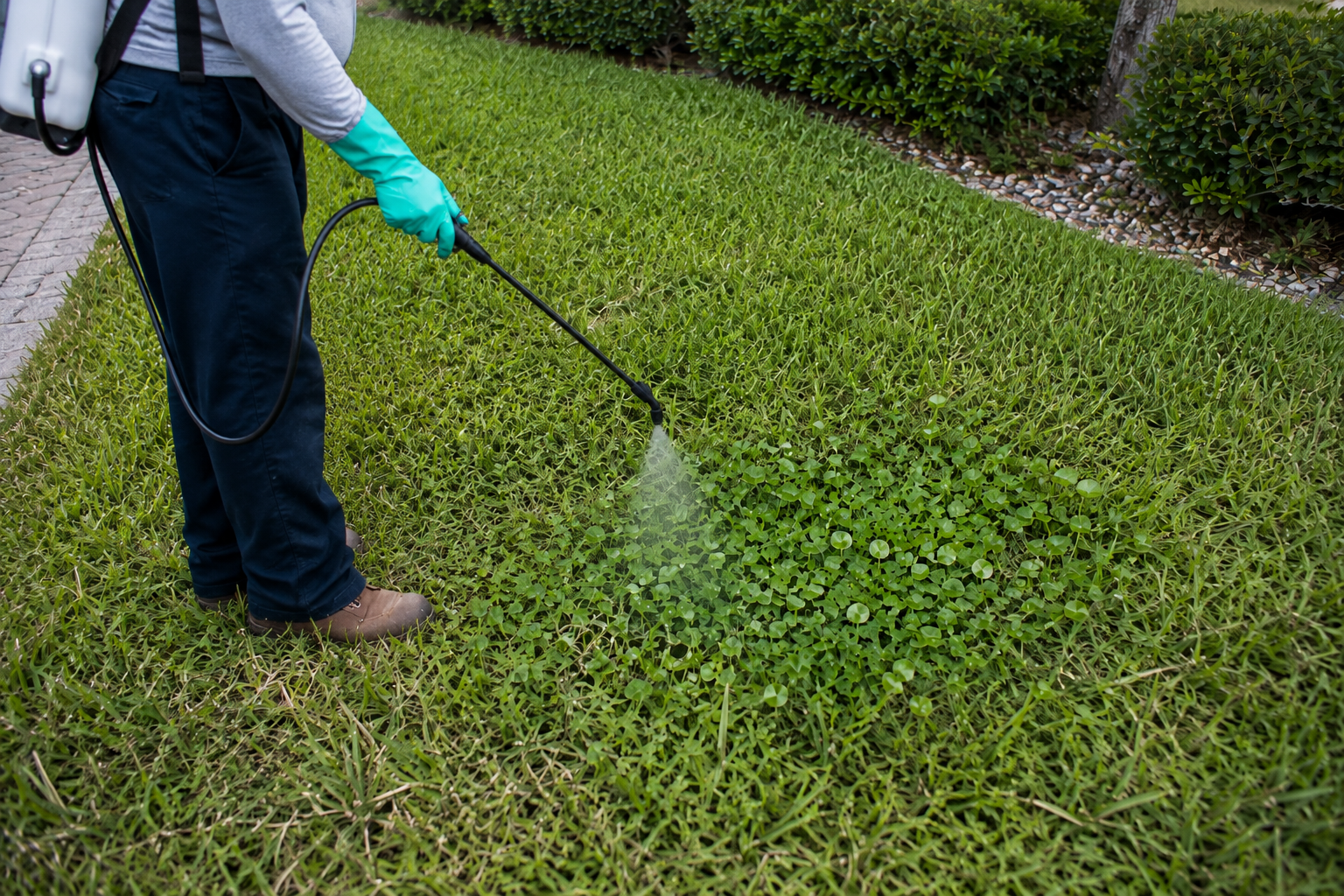
Lesson 1 introduced the case for spot treatment over broadcast. This section covers the practical execution. The model assumes a routine service interval (often monthly during the active growing season, sometimes every 6 weeks during cooler months) with the following structure:
- Walk the property. Before any equipment comes off the truck, walk the entire lawn with a notepad or phone. Identify weed species, mark locations, and estimate the total area of each weed type. A 30-minute walk on a 10,000 sq ft lawn often turns up several distinct weed problems requiring different products.
- Group the targets by chemistry. All sedge patches get one product (halosulfuron). All broadleaf patches that are St. Augustine-safe get one tank mix (e.g., low-rate 2,4-D amine + dicamba + MCPP). All goosegrass and crabgrass small enough to treat get a mesotrione or topramezone application. This grouping minimizes tank cleanouts and allows efficient routing.
- Spot-treat with low-pressure equipment. Backpack sprayer with adjustable wand at 15–30 psi produces large droplets and a tight spray pattern. Hand-pump bottle for very small spots. Wick applicator (a sponge or rope-wick saturated with product) for individual large weeds in sensitive landscapes.
- Mark treated areas. Many post-emergents include a marker dye, or a separate spray-pattern indicator can be added. The dye fades within a day but lets you and the customer see exactly what was treated.
- Document on the service ticket. Record products applied, areas treated, weed species targeted, and any notes for follow-up. This documentation supports compliance and informs the next visit's strategy.
- Return on schedule. Most weeds require 1–3 weeks for full kill. Re-treat survivors at the next service visit; don't repeat-treat at this visit and risk turfgrass injury.
Picture a 10,000 sq ft St. Augustine lawn with three small weed patches at any given moment — say 200 total square feet of dollarweed and two clusters of nutsedge. Broadcast treatment puts product on 10,000 sq ft. Spot treatment puts product on 200 sq ft. The spot treatment applies roughly 2% of the total active ingredient to achieve the same control on the actual target. The remaining 98% of the lawn is not exposed to herbicide that month — meaning no cumulative herbicide stress, no broadcast-rate root suppression, no non-target broadleaf kill of clover or other beneficial plants the customer may want, and no chemical residue moving with rainfall to storm drains. Across a year of monthly service, total herbicide use drops 50–80% versus a quarterly broadcast model, while weed control improves because problems are caught when small.
Resistance Management
Herbicide resistance — populations of weeds that survive label-rate applications because of genetic adaptation — is documented in many Florida weed populations. Goosegrass populations resistant to dinitroaniline pre-emergents have been confirmed across the Southeast. Annual bluegrass populations resistant to ALS-inhibiting herbicides (Group 2) are widespread. Glyphosate-resistant ryegrass and amaranth species are spreading. Resistance does not appear because of a single application; it appears because the same mode of action is applied repeatedly to the same population, selecting for the few naturally tolerant individuals each generation.
The discipline that delays resistance is straightforward:
- Rotate modes of action across applications. A pre-emergent program that alternates dinitroaniline (Group 3) one year with indaziflam (Group 29) the next applies different selection pressure each cycle.
- Use combination products where appropriate. A single application that combines two modes of action requires the weed population to be resistant to both simultaneously — orders of magnitude less likely than resistance to either alone.
- Apply at full labeled rate, not sub-label rates. Sub-label rates kill only the most sensitive individuals and accelerate resistance development.
- Use cultural and mechanical tools alongside chemistry. Mowing height, irrigation pattern, hand-pulling of small weed patches, and sod replacement of severely infested areas all reduce reliance on chemistry alone.
- Document mode of action used. WSSA mode-of-action group numbers (Group 1, 2, 3, 4, 5, 9, 14, 27, 29, etc.) appear on most modern labels and are the practical tool for tracking rotation.
Recordkeeping and Florida Compliance
Florida certified operators are required by Rule 5E-9.032 to maintain pesticide application records for a minimum of two years. For each application, records must include:
- Date and time of application
- Address of the application site
- Target pest (in this case, weed species)
- Product brand name
- EPA registration number
- Total amount of product applied
- Application rate
- Total area treated (in square feet or acres)
- Name and certification number of the certified operator and applicator
- Weather conditions where required by label
For a spot-treatment program in particular, recording the total area treated (not just the lawn size) is important — it documents that you applied product to 200 sq ft, not to 10,000 sq ft, which becomes the defensible record if a complaint or audit arises.
Several Florida-specific regulatory frameworks apply to L&O herbicide work beyond the standard label. Many counties (notably Pinellas, Sarasota, Lee, Manatee, Charlotte, and several others) have summer fertilizer ordinances that prohibit nitrogen application during the rainy season, and some ordinances also restrict herbicide application within specified setbacks from water bodies. The Florida Department of Environmental Protection "Green Industries Best Management Practices" (GI-BMP) certification is required by many local government contracts and is voluntarily completed by most professional operators in regulated counties. Atrazine setbacks (Lesson 3) are state-level. Sensitive sites also include schools, daycares, and medical facilities — applications during occupied hours may require notification and may be restricted by local rule. The professional standard is to know the local ordinances on every property you service, not to discover them retroactively.
The Bigger Picture
Florida turf weed management is the most chemistry-intensive segment of the L&O license category. Done well, it produces consistently weed-free lawns with minimal cumulative herbicide load, low off-target impact, and high customer retention. Done poorly, it produces injured turf, repeat callbacks, regulatory exposure, and customer churn. The difference between the two is not which products are on the truck — it is the combination of accurate weed and turfgrass identification, correct timing of pre-emergent applications, low-pressure spot-treatment of post-emergent escapes, and steady recordkeeping that lets the program improve across visits and years.
Two final points worth emphasizing as you finish the course:
- The first call is more important than the chemistry. Twenty minutes walking the property to identify turfgrass, weed species, and contributing conditions is the single highest-value activity in the entire service. The herbicide selection that follows is almost mechanical once those facts are clear.
- Spot treatment is not a shortcut — it is the standard. A monthly walk with a backpack sprayer, killing small weed patches before they spread, is the highest-skill, lowest-chemistry, lowest-injury approach available. It requires more attention per visit and produces dramatically better outcomes per year.
Complete the quiz to confirm your grasp of Florida turfgrasses, weed categories, herbicide chemistry, application practice, and the IPM spot-treatment strategy that ties them together.