
You have probably heard the term "Integrated Pest Management" dozens of times — in training, on job postings, maybe on a state exam. But in a lot of shops, IPM gets treated as a buzzword, something you say to sound professional before you grab the pump sprayer. This course is about what IPM actually is, why it outperforms spray-and-pray programs every single time, and — most importantly — how you, the technician, are the person who makes it work on the ground.
We are going to cover IPM from the inside out: the definition, the decision hierarchy, what happens when companies skip it, and what it looks like in the real world across both structural accounts and outdoor turf and ornamental work. By the end of this lesson you should be able to explain IPM to a customer in plain language and, more importantly, apply its logic on every service you run.
What IPM Actually Is
The Environmental Protection Agency defines Integrated Pest Management as "an effective and environmentally sensitive approach to pest management that relies on a combination of common-sense practices." That definition is accurate but not especially useful in the field. Here is a more practical one:
IPM is a structured decision framework that uses monitoring, thresholds, and a hierarchy of control methods to manage pests with the least possible risk to people, non-target organisms, and the environment.
Break that definition down and every word matters. "Structured decision framework" means you are not reacting — you are following a process. "Monitoring and thresholds" means you are measuring the problem before you respond to it. "Hierarchy of control methods" means chemical application is not your first move — it is your last, applied only after you have exhausted or ruled out less-hazardous options. "Least possible risk" means you are always asking whether there is a safer way to get the same outcome.
Notice what IPM is not: it is not "use less pesticide." It is not "go organic." It is not "avoid chemistry." Sometimes IPM leads you straight to a chemical application — but only after inspection has told you what you are dealing with, where it is coming from, and why it is there. That prior knowledge is what makes the chemical application targeted, effective, and defensible instead of a broadcast guess.
The IPM Hierarchy: Building from the Ground Up
Think of IPM as a pyramid. The foundation is wide and strong — it is where most of your pest management work actually happens. The apex is narrow — it is where you end up when everything below it has been exhausted or is insufficient on its own.
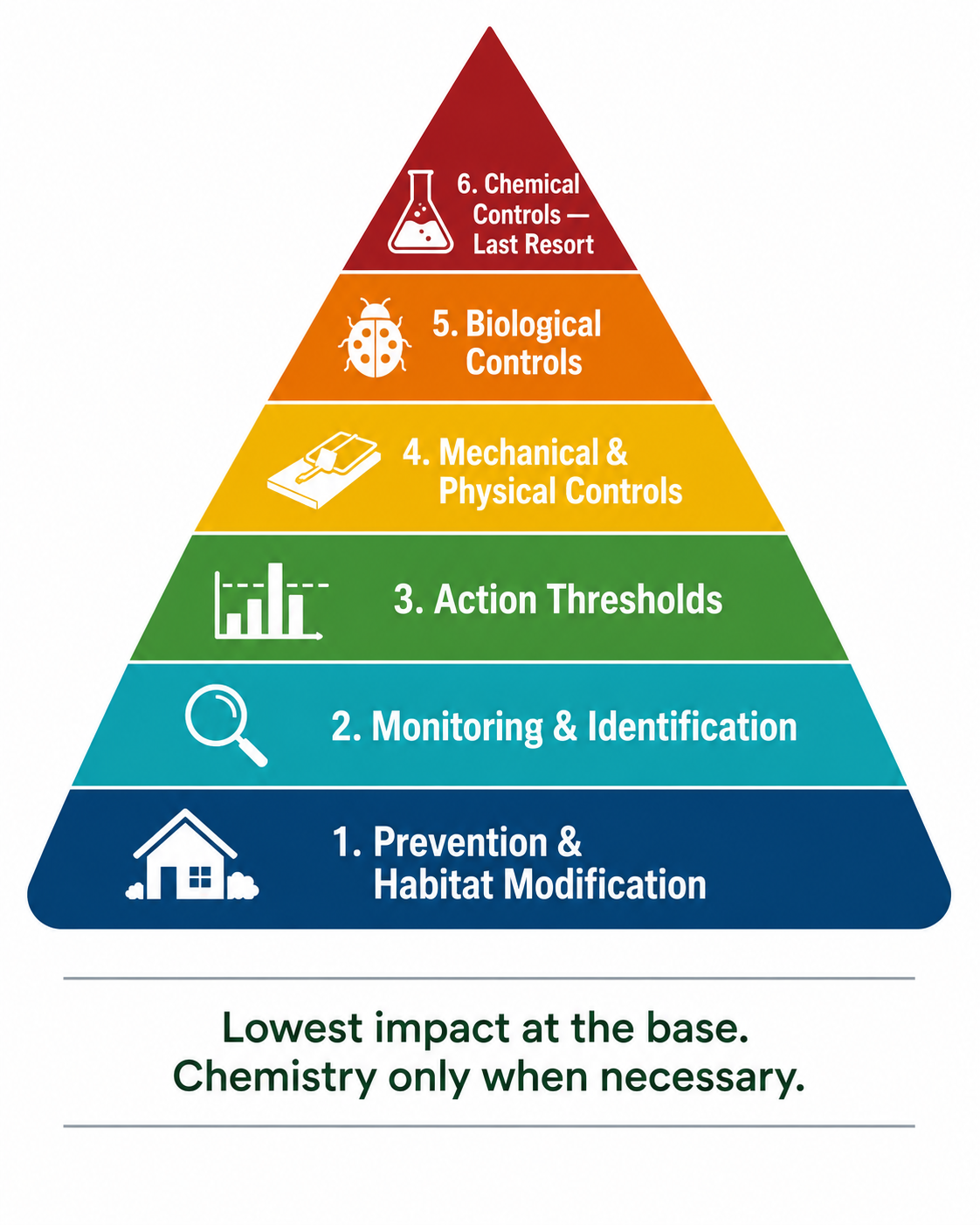
Level 1 — Prevention and Habitat Modification
The base of the pyramid is everything that makes the environment inhospitable to pests before they arrive or before a minor population becomes a problem. In structural pest management this includes sealing entry points, eliminating standing water, reducing clutter and harborage, and recommending sanitation corrections. In lawn and ornamental work it includes proper irrigation scheduling, appropriate fertilization, selection of pest-resistant plant varieties, and mowing at the correct height for the turf species.
Prevention is the most cost-effective tier of IPM because it works continuously between service visits without any product cost, re-entry concerns, or resistance pressure. It is also the tier that most spray-and-pray programs skip entirely — which is exactly why those programs generate callbacks.
Level 2 — Monitoring and Identification
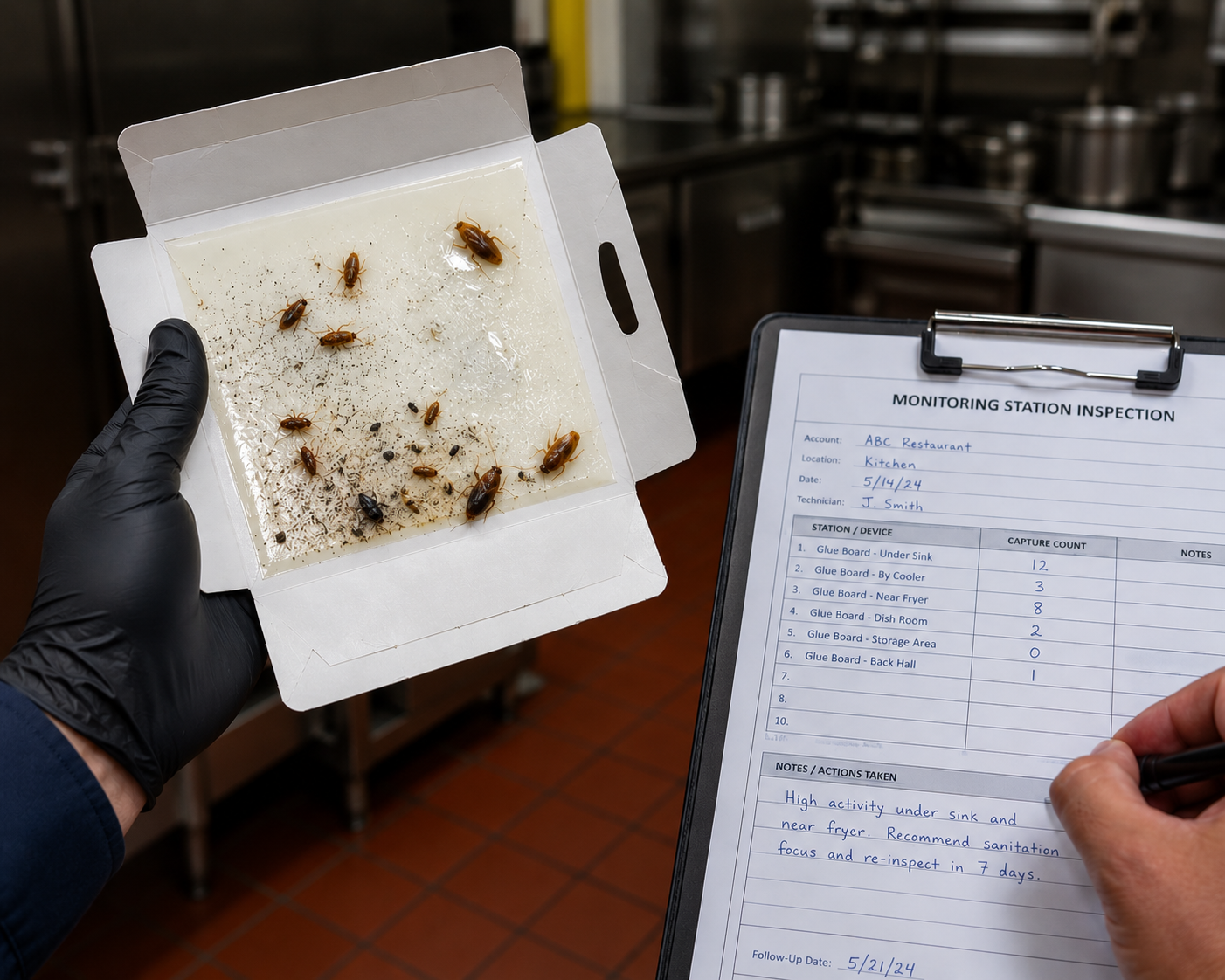
You cannot manage what you have not measured. Monitoring means systematically checking for pest activity, quantifying what you find, and recording it. The tools vary by situation — sticky traps, pheromone traps, visual inspection with a flashlight and mirror, trap counts on rodent bait stations, and scouting grids in turf — but the principle is always the same: generate data, not guesses.
Identification is inseparable from monitoring. Knowing that there is pest activity somewhere is not enough. You need to know what species it is, how many individuals are present, and what life stage they are in. A single American cockroach in a kitchen drain is a completely different problem from a hundred German cockroach nymphs behind a dishwasher motor — and the treatment for each is completely different.
Level 3 — Action Thresholds
An action threshold is the point at which pest population levels or environmental conditions indicate that pest control action must be taken. Below the threshold, you document, monitor, and wait. At or above the threshold, you act.
Thresholds matter for two reasons. First, they prevent unnecessary treatments — applying pesticide to a problem that would resolve itself, or to a level of pest activity that is not actually causing harm, increases risk and cost without benefit. Second, they create accountability: your service records show when the threshold was crossed, what action you took, and what the outcome was. That documentation protects your company and your customer.
Thresholds are not always numeric. For some high-consequence pests — any live bed bug, any termite swarm evidence, any sign of stored product pest in a food processing facility — the threshold is effectively zero. For others, like occasional-invader ants on a perimeter, a small number of individuals does not justify immediate chemical intervention. Knowing the difference is part of what this course is building toward.
Level 4 — Control Methods, in Order of Preference
When monitoring tells you the threshold has been crossed and passive prevention is not enough, you move to active control. IPM prioritizes control methods from least to most hazardous, in this order:
- Mechanical and physical controls: Traps, exclusion materials, vacuuming, heat treatment, caulk and sealant, door sweeps, screens. These methods target the pest directly, leave no chemical residue, and create no resistance.
- Biological controls: Beneficial insects, nematodes, microbial pesticides (like Bt for caterpillars). More relevant in turf and ornamental IPM than in structural work, though some biological controls — such as beneficial nematodes for certain soil-dwelling pests — do have structural applications.
- Chemical controls: Pesticides, applied only where monitoring confirms pest activity, at the labeled rate, using the formulation and application method best suited to the situation. Spot treatments over broad-area sprays. Baits over residuals where pests are amenable to baiting.
Every experienced technician has been on accounts where the previous company's answer to every problem was a can of pyrethrin. Those accounts are usually where you find the worst infestations, the most resistant pest populations, and the most skeptical customers. IPM does not prohibit chemistry — it requires you to earn it. Inspect first. Identify the pest. Understand the pressure. Then choose your tools. When you reach for chemistry because the problem genuinely calls for it, you are far more likely to get the outcome the customer is paying for.
Why Spray-and-Pray Programs Fail
The phrase "spray and pray" describes a service model where the technician arrives, mixes product, and applies it to the same locations on the same schedule regardless of what is actually happening on the property. It is common. It is also reliably expensive for pest control companies in the long run. Here is why.
Resistance Development
Insect and rodent populations evolve. Every time you apply a pesticide, you are applying selection pressure: susceptible individuals die, resistant individuals survive and reproduce. When the same active ingredient is applied repeatedly to the same population on a fixed schedule — regardless of pest pressure, pest species, or life stage — resistance develops faster than it would under an IPM program. German cockroaches resistant to pyrethroid insecticides are already common in Florida; some populations also show reduced susceptibility to certain gel bait active ingredients. Resistance is irreversible at the population level. Once a local population is resistant, your chemistry stops working for every customer in that area.
Re-Invasion and Callbacks
A broadcast residual application kills pests that contact the treated surface during the residue's effective window. It does nothing to address the source of the infestation. If German cockroaches are breeding in the motor compartment of a dishwasher and you spray the kitchen baseboards, you will knock down some foragers, temporarily reduce visible activity, and collect your service fee. Three weeks later, the customer calls back because the roaches are just as bad. The source was never addressed. An IPM inspection would have found the dishwasher motor harborage on the first visit.
Regulatory Exposure
Florida's FDACS takes misapplication seriously. Broad-area applications in sensitive sites — schools, daycare facilities, food handling areas — that exceed label requirements or use inappropriate formulations for the site create liability for your company. An IPM program generates the documentation that demonstrates due diligence: what was found, what threshold triggered action, what product was applied and why, where it was applied, at what rate. That paper trail matters in a complaint investigation.
When a customer calls back within thirty days, something in the service failed. In a spray-and-pray operation, the typical response is to send someone out to spray again — same product, same locations, same result. In an IPM program, the callback is treated as data: the inspection did not find the source, the threshold was wrong, the product choice was inappropriate, or the customer conditions changed. You investigate before you re-apply. That difference is what separates companies with strong re-treatment rates from companies that slowly lose accounts to competitors.
The Technician's Role: Eyes on the Ground
Here is something the IPM literature does not always make clear: the certified operator designs the program, but the technician runs it. The certified operator is not on every account every visit. You are. That makes you the most important person in the IPM process.
Every service visit is a monitoring event. Before you mix or apply anything, you are collecting information: Is there new pest activity since the last visit? Has something changed — a new delivery area, a leak under the sink, a bag of mulch stored against the foundation? Are the sticky traps showing counts consistent with last month or have numbers spiked? Did the customer mention something at the door that changes the picture?
Your observations are the data that the certified operator uses to make program-level decisions. If you notice that German cockroach activity in a restaurant has doubled three months in a row and you flag it, the operator can intervene before it becomes a health department problem. If you notice that a crack in a garage door frame is letting American cockroaches in from the parking area and you document it, that exclusion recommendation prevents a recurring complaint. If you catch a moisture issue under a bathroom vanity before it creates a fungus gnat or silverfish problem, you have done more real pest management than three rounds of chemistry ever could.
This is what "integrated" actually means in practice. It is not a product category. It is a mindset that you bring to every account, every visit: inspect, measure, decide, act, document, and follow up. The technician who operates this way is genuinely valuable — to the company, to the customer, and to the regulator who is watching how Florida's pest management industry performs.
What "Integrated" Means Across Tool Categories
The "integrated" in IPM refers to combining multiple control categories rather than relying on any single approach. The four categories you will hear most often are physical/mechanical, cultural, biological, and chemical.
Physical and mechanical controls are hands-on interventions that directly exclude, trap, or remove pests without chemistry: sealing a gap with copper mesh, setting snap traps along a rodent runway, applying weatherstripping to a door with a 3/4-inch gap. These methods have no resistance risk, no re-entry interval, and no label requirements. They are also not free — they take time and sometimes materials — which is why they get skipped in high-volume service models. In IPM, they are the first line of defense.
Cultural controls modify conditions to make the environment less suitable for pests. Fixing a dripping under-sink pipe eliminates the moisture source that German cockroaches and silverfish need. Recommending that a homeowner move firewood away from the house foundation eliminates harborage for subterranean termites and American cockroaches. These are the recommendations you make at the service visit — documented in your notes and communicated to the customer. You are not just a chemical applicator. You are a consultant.
Biological controls use living organisms to suppress pest populations. In structural pest management this is mostly relevant at the program design level — beneficial nematodes for certain soil pests, or microbial bait products containing Bt or spinosad for specific applications. In turf and ornamental IPM, biological controls are a much larger part of the toolkit, which Lesson 3 covers in depth.
Chemical controls, as discussed above, complete the toolkit when the other approaches are insufficient. The chemistry you choose, where and how you apply it, and what you apply it for all change based on what the inspection found — not based on the calendar or a preset service formula.
IPM Indoors vs. Outdoors: A Preview
The principles of IPM are universal, but the specific tools, pests, and pressure points are very different between structural pest management and turf and ornamental work. Understanding that difference matters because Florida technicians often work both settings — sometimes on the same property, sometimes within the same service day.
In structural IPM, the environment is a building. Pest pressure comes largely from the outside in — entry points, moisture intrusion, harborage created by human activity. The pests are primarily cockroaches, rodents, ants, bed bugs, stored product pests, and occasional invaders. Monitoring tools include sticky traps, visual inspection, and customer interviews. The service area is defined and bounded. Sanitation and exclusion are your primary cultural and physical tools. Lesson 2 covers structural IPM in full detail.
In turf and ornamental IPM, the environment is open and dynamic — affected by weather, soil conditions, irrigation, fertilization, and adjacent plant communities. Pest pressure involves insects, mites, plant diseases, and weeds. Threshold decisions are made by scouting, not by trap counts. Biological controls are more routinely applicable. Lesson 3 covers this setting in full.
The thread connecting both settings is the same: you inspect before you act, you identify what you are dealing with, you apply the threshold question, you choose tools in order of preference, and you document everything. That decision-making sequence does not change based on whether you are inspecting a kitchen or scouting a St. Augustine lawn.
Moving Forward
Lesson 2 takes everything introduced here and puts it to work inside a structure. We will walk through the pre-service inspection sequence for a residential account from front door to exterior penetrations, work through how to read pest evidence, cover monitoring tool placement and threshold thinking, and address when chemistry is — and is not — the right call. We will also cover the customer communication piece, because explaining to a homeowner why you are inspecting before you spray is itself an IPM skill that protects the relationship and the outcome.
Before you move on, fix this in your mind: IPM is not something you do after you are done with the service. It is how you run the entire service, from the moment you park to the moment you document and close out the account. The technician who operates that way does better work, generates fewer callbacks, and builds accounts that renew. That is the goal.