
Everything you learned about IPM as a decision framework applies indoors — and the same logic extends the moment you step outside. The lawn, the landscape beds, the building perimeter, the ornamental shrubs along a fence line — these are not separate from your pest management program. They are part of the same system. A technician who only thinks about the inside of a structure is leaving half the job undone.
Florida's climate makes outdoor IPM especially important. Warm temperatures, high humidity, abundant rainfall, and year-round growing seasons mean that turf and ornamental pests are active virtually every month of the year. The conditions that make Florida lawns beautiful also make them habitat for chinch bugs, sod webworms, mole crickets, and a dense population of weeds. Your job outdoors is the same as your job indoors: understand the system before you reach for a product.
The Lawn as an IPM System
Start with this idea: a healthy, dense, properly maintained lawn is itself a pest and weed suppression tool. This is not a metaphor — it is a physical reality. A lawn with 95% desirable turfgrass cover, mowed at the correct height, and receiving appropriate water and fertility has almost no space for weeds to establish. Weed seeds need bare soil, thin coverage, or compacted areas to germinate and hold. A thick stand of St. Augustinegrass, bahiagrass, or zoysiagrass physically crowds them out.
The same principle applies to insects. Turfgrass under stress — drought stress, shade stress, mowing stress — produces thin, yellowing growth that is significantly more susceptible to chinch bug damage, sod webworm feeding, and fungal disease than the same species maintained at appropriate conditions. Stressed turf is a pest magnet. When you walk a property and see concentrated damage, your first question should not be "which product do I apply?" It should be "why is this area stressed?"
Understanding this puts you in a fundamentally different position than a technician who treats every lawn visit as a spray event. You become a diagnostician. Your eyes on the ground are what separates IPM from calendar-based pesticide applications.
The Outdoor IPM Inspection: What to Look at Before Recommending Any Treatment
Before you recommend or perform any outdoor treatment, you need to conduct a systematic inspection. This is not a long process once you develop the habit — a trained technician can walk most residential properties in 10 to 15 minutes and gather the information needed to make a good decision. Here is what you are looking for:
Turfgrass Species Identification
Florida's most common residential lawn grasses are St. Augustinegrass, bahiagrass, zoysiagrass, bermudagrass, and centipedegrass. Each has different tolerances, pest vulnerabilities, and management requirements. St. Augustinegrass is highly susceptible to chinch bugs and southern chinch bugs but tolerates shade reasonably well. Bahiagrass is drought-tolerant but prone to mole cricket damage and iron deficiency. Zoysiagrass is dense and shade-tolerant but slower to recover from damage. Knowing which species you are working with determines which problems you should be looking for and which cultural practices are appropriate.
Thatch Depth
Thatch is the layer of partially decomposed organic material between the green blades and the soil surface. A thatch layer under half an inch is normal and beneficial. A thatch layer over an inch becomes a problem — it harbors insects, holds moisture unevenly, interferes with pesticide and fertilizer contact with the soil, and creates conditions favorable to fungal disease. You can check thatch depth quickly by cutting a small plug of turf with a knife and looking at the cross section.
Mowing Height
Each turfgrass species has a recommended mowing height range. St. Augustinegrass should be mowed at 3.5 to 4 inches — not the scalped 2-inch cut that many homeowners request. Bahiagrass performs best at 3 to 4 inches. Bermudagrass can be maintained lower, at 0.5 to 1.5 inches, depending on the type. When turf is consistently mowed too short, the root system is reduced proportionally, making the plant less drought-tolerant and far more vulnerable to pest and disease pressure. Mowing equipment that is dull or improperly set also leaves ragged cuts that invite disease entry.
Irrigation Pattern and Drainage
Walk the property during or after irrigation if possible, or ask the customer about their schedule. Look for dry spots, overly wet areas, and areas with surface standing water. Irregular irrigation patterns create irregular stress patterns that often show up as irregular pest or disease damage. A dry corner of a lawn that looks like chinch bug damage may actually be a broken irrigation head. Overly irrigated turf invites fungal issues and can cause take-all root rot in St. Augustinegrass. Poor drainage creates persistently saturated areas that stress grass roots and promote nuisance pests like fungus gnats and mosquitoes in adjacent areas.
Soil Compaction and Shade
Compacted soil — common in high-traffic areas, around driveways, and under large trees — reduces water infiltration and root depth. Compacted turf thins out and opens space for weeds. Shade creates entirely different competitive dynamics: some grasses tolerate shade, some do not, and the appropriate management of a shaded area is different from a full-sun area. A shaded, compacted patch under a large oak tree may need a shade-tolerant ground cover alternative rather than repeated pesticide applications to a struggling turfgrass.
Pest and Weed Thresholds Outdoors: Not Every Problem Needs a Product
The concept of action thresholds is central to IPM, and it applies outdoors just as it does indoors. The key word is "threshold" — the point at which a pest population or weed coverage causes economic or aesthetic damage significant enough to warrant treatment. Below that threshold, monitoring and cultural controls are the appropriate response. Above that threshold, intervention is justified.
For weeds in a residential lawn, 5% weed cover is not the same problem as 40% weed cover. A lawn that is 95% St. Augustinegrass with a few scattered dollar weed plants near a drip edge is not a lawn in crisis — it is a normal lawn with a minor weed presence that attentive cultural practices and spot treatment will address. A lawn with 40% broadleaf weed cover has likely had an underlying management problem for months or years. That's a different conversation: What failed? What do we need to fix culturally before we apply product? Will a blanket herbicide application even solve this if the root cause — compaction, poor mowing, irregular irrigation — is not addressed?
For insect pests, location and pattern matter as much as population count. Chinch bug damage in St. Augustinegrass almost always starts at the margins of a damaged area — the yellowing, expanding edge where the active insects are feeding. The brown, dead center of a chinch bug patch is already lost turf, and applying insecticide there will not save it. Your treatment target is the expanding margin, where you can confirm live insects (use the flotation test: push an open coffee can into the soil at the damage edge, fill with water, and watch for chinch bugs floating up within a few minutes). Treating the whole lawn because the center is dead is wasted product and unnecessary chemical exposure.
To confirm chinch bug activity in St. Augustinegrass: remove both ends of a coffee can, push one end firmly into the turf at the edge of the damaged area (where yellowing turf meets green turf), fill with water, and observe for 3–5 minutes. Chinch bugs will float to the surface. This is the correct confirmation method — do not treat based on visible damage alone, as drought stress, disease, and irrigation failure produce identical-looking symptoms.
Mole cricket damage in bahiagrass follows a similar principle. Soil tunneling from mole crickets causes spongy, raised turf that pulls apart easily. A soap flush (mix 2 tablespoons of dish soap in a gallon of water and apply to a two-square-foot area; mole crickets will come to the surface within minutes) confirms active infestation. Treatment is most effective in late summer when nymphs are small and near the surface — treating mature adults in winter is far less effective.
Cultural Controls First: Getting the Management Practices Right
The most powerful pest and weed controls in a lawn are the cultural practices the property manager or homeowner controls. Your role as a technician is to identify when those practices are contributing to pest pressure and to communicate that clearly to your customer or supervisor.
Mowing height: Scalped turf is stressed turf. A customer who mows St. Augustinegrass at 2 inches because "it looks neater" is creating conditions for chinch bug outbreaks, weed invasion, and disease. Recommending the correct mowing height — and explaining why — is a legitimate and valuable service.
Deep-and-infrequent irrigation: Florida's Extension Service and Water Management Districts recommend watering deeply and infrequently rather than shallowly and frequently. Deep watering (applying 0.5 to 0.75 inches per irrigation cycle) drives root growth downward, making the plant more drought-tolerant and less dependent on shallow surface moisture. Frequent shallow irrigation keeps roots near the surface, increases chinch bug activity in the humid thatch layer, and promotes fungal disease. Most irrigation systems are set on too-frequent schedules. Look for the controller during your inspection and note the schedule.
Fertility management: Excess nitrogen produces rapid, lush growth that is highly attractive to sucking insects like chinch bugs and aphids, and more susceptible to fungal pathogens. Under-fertilized turf thins out and allows weed invasion. The appropriate fertility program for Florida turfgrass depends on species, soil type, and seasonal timing. As a technician, you are not expected to design fertility programs, but you should be able to recognize that a lawn showing rapid, dark green, sappy growth may be over-fertilized and vulnerable.
Perimeter Pest Management: The Structure-to-Landscape Boundary
The single most important outdoor pest management zone for structural pest control technicians is the transition between the building and the surrounding landscape. Most ants, cockroaches, and rodents that end up inside a structure did not teleport there — they walked in from outside, following food odors, moisture trails, or harborage routes. The building perimeter is where you have the most leverage to intercept that movement before it becomes an interior problem.
During a perimeter inspection, focus on these conditions:
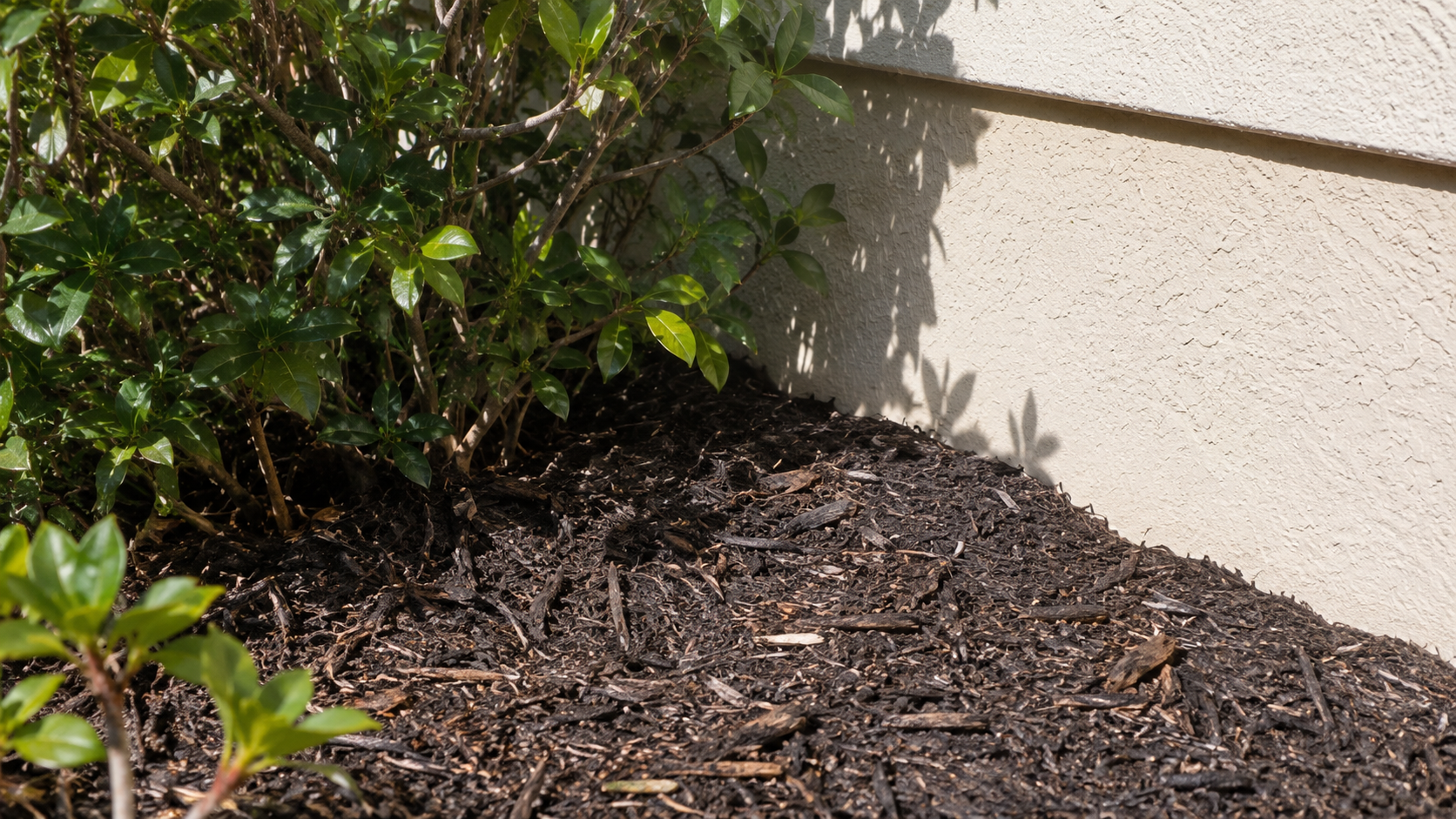
- Mulch depth and placement: Mulch beds that are piled against the foundation wall provide a perfect harborage environment for roaches, ants, earwigs, and moisture-loving pests. Mulch should be kept 6 inches away from the foundation and maintained at 2 to 3 inches deep — not the 6-inch "volcano mulch" application that traps moisture against wood and stucco.
- Weep holes and stucco gaps: Florida's concrete block and stucco construction commonly includes weep holes at the base of exterior walls. These are intentional — they allow moisture to escape — but they are also entry points for insects. Note their condition and whether appropriate screened covers are in place.
- Soffit vents and utility penetrations: Gaps around pipes, conduit, cable TV lines, and AC refrigerant lines entering the structure are common rodent and roach entry points. Identify them during inspection and recommend sealing with appropriate materials (copper mesh, foam backer rod with caulk, or hardware cloth).
- Woodpiles and debris near the foundation: Stored firewood, lumber piles, and construction debris within 10 feet of the foundation are perfect harborage for roaches, scorpions, and — critically — subterranean termites. Recommend relocating woodpiles away from the structure.
- Irrigation systems near the foundation: Irrigation heads that spray directly on the foundation, under doors, or into weep holes create the moisture conditions that attract and sustain pest populations. Identify and document them.
Perimeter treatment, when warranted, should be a targeted application — a 3-foot-wide band along the foundation and a 3-foot band on the ground, treating the actual harborage and travel routes you identified during inspection. Granular baits and low-volume liquid applications along this zone are far more effective per unit of pesticide than broad spray coverage.
Spot Treatment Outdoors: The Same Principle as Indoors
The same thinking that keeps you from spraying a whole kitchen because you saw one ant trail applies outdoors. Spot treatment means treating the actual problem area, confirmed through inspection, at the minimal effective rate. For weeds, this means a low-pressure backpack wand application to individual plants or small clusters — not a broadcast spray of the entire lawn because a few weeds are visible near the edge. A properly aimed spot treatment with a selective herbicide can eliminate a weed without affecting surrounding desirable turf or adjacent ornamental plants.
For perimeter pests, targeted granular applications along the foundation, under mulch, and around ant mounds are more effective and less disruptive than broad liquid sprays. Granular fire ant baits, for example, are most effective when applied around active mounds — not broadcast across the entire yard, which wastes product and exposes non-target areas unnecessarily.
Drift Awareness: Outdoor Applications Require More Care
One critical difference between indoor and outdoor applications is drift — the movement of pesticide droplets, spray, or dust away from the intended application site due to wind. Indoors, drift is a minor concern. Outdoors, it is a primary safety and compliance consideration.
Wind speed and direction determine your risk. Most labels specify not to apply when wind speeds exceed 10 mph (some specify lower limits for aerial applications, but ground applications also carry drift risk). Always check wind conditions before beginning an outdoor application. Never apply when wind is moving toward water bodies, neighbors' property, ornamental flower beds, or areas where people are present. Apply as a coarse, low-pressure spray rather than a fine mist — larger droplets are less susceptible to drift. Direct the spray nozzle close to the target surface.
Florida has abundant surface water — canals, ponds, retention basins, drainage ditches — and many labeled pest control products have specific buffer zone requirements from water. Know the label's environmental hazards section. A product that requires a 25-foot buffer from water bodies requires exactly that — not a rough estimate.
Pesticide drift onto a neighbor's property is not just an environmental violation — it can be a legal liability for your company. If a neighbor has organic garden beds, beehives, children's play equipment, or chemical sensitivities, drift from your application can trigger complaints and investigations. Always apply during calm wind conditions, use appropriate nozzle types and pressures, and document weather conditions at the time of outdoor applications. When conditions are marginal, reschedule rather than proceed.
Recognizing When a Lawn Problem Is Not a Pest Problem
One of the most valuable skills you can develop is recognizing when a lawn problem is caused by something other than a pest or weed — and communicating that accurately to your customer rather than defaulting to a pesticide application that will not solve the problem.
Florida lawns are commonly misdiagnosed because drought stress, disease, nutritional deficiency, and irrigation failure all produce symptoms — yellowing, browning, thinning, patchy dieback — that superficially resemble pest damage. Applying insecticide to a lawn suffering from drought stress or take-all root rot will not help the lawn and may actually worsen the plant's condition by adding chemical stress to physical stress.
Drought stress typically produces uniform browning across the lawn, often accompanied by a visible irrigation failure (broken head, missed zone) or a recent period without rainfall. The turf blades may fold longitudinally before turning brown. Walk the lawn and check soil moisture with a screwdriver — if it penetrates easily to 4 inches, the soil is adequately moist; if it stops within 2 inches, the soil is dry.
Take-all root rot in St. Augustinegrass produces irregular yellow patches that progressively enlarge. The grass blades look healthy from above but pull up easily — the roots are rotted and brown. This is a fungal disease exacerbated by overwatering, high pH soil, and shallow thatch. Insecticide will not touch it; the solution is cultural and sometimes fungicidal.
Iron deficiency (chlorosis) in centipedegrass or bahiagrass on alkaline soils produces interveinal yellowing — the tissue between the leaf veins turns yellow while the veins remain green. No pest causes this pattern. The solution is iron supplementation and pH management, not pesticide application.
When you suspect a non-pest problem, document your observations carefully, communicate them to your certified operator, and resist pressure to apply a product "just to do something." The customer may be frustrated, but applying the wrong treatment will not build trust — solving the actual problem will.
Ornamental IPM: Shrubs, Trees, and Landscape Beds
Ornamental plants — the shrubs, hedges, and trees that frame Florida properties — have their own pest community and require the same systematic inspection approach as turfgrass. The most common ornamental pests in Florida include scale insects, whiteflies, aphids, and caterpillars (including the fall webworm and various leafrollers).
Scale insects are among the most common and most damaging. Florida red scale, brown soft scale, and tea scale attach to stems and leaf undersides, sucking plant sap and producing honeydew that supports sooty mold growth. Small infestations on individual branches warrant spot treatment; heavy infestations across an entire hedge may require a systemic neonicotinoid application — but that decision should involve your certified operator, particularly near flowering plants where pollinator exposure is a concern.
Whitefly infestations — particularly the rugose spiraling whitefly on palms and gumbo-limbo — are visible as white waxy spirals on leaf undersides and large volumes of honeydew that drip onto surfaces below. Spot treatment with a labeled contact or systemic insecticide applied by a calibrated low-volume sprayer is appropriate for contained infestations. Blanket spraying of entire trees with a coarse sprayer is less precise and generates more off-target exposure.
Aphids in Florida typically appear in flush growth in spring and fall. They cluster on new growth, distorting leaves and producing honeydew. Natural control — predatory insects, parasitic wasps, and rainfall — often manages aphid populations without intervention. If aphid populations are below the threshold of causing meaningful plant damage and natural predators are present, monitoring rather than treatment is the appropriate IPM response. A strong stream of water from a hose removes aphids from most ornamentals without chemical input.
For ornamental pest decisions that involve tree-injected systemic products, aerial applications, or applications to large trees near water bodies, you should escalate to your certified operator. These applications require additional training, label compliance considerations, and in some cases a separate category certification.