
You have spent three lessons building up a picture of Integrated Pest Management as a decision framework — inspection first, thresholds before treatment, least-disruptive controls whenever possible, precise targeted application when pesticides are warranted. Now it is time to talk about the legal structure that governs every commercial application you make in Florida, because IPM without compliance is not just bad practice — it is illegal practice.
Chapter 482 of the Florida Statutes is the law that regulates structural pest control in Florida. It covers every commercial application of pesticides in or around a structure or lawn. It is enforced by the Florida Department of Agriculture and Consumer Services — FDACS. Every technician working in Florida should understand the framework of this law, not to pass a test, but because it defines exactly what you can do, what you cannot do, and who is ultimately responsible when something goes wrong.
What Chapter 482 Is
Florida Statute 482 — the Structural Pest Control Act — establishes the licensing requirements, operational rules, and enforcement mechanisms for all commercial pest control activity in the state. It applies to any person or company that applies pesticides for hire to a structure or its immediate surroundings. If you are applying a pesticide to a customer's home, business, landscape, or lawn as part of your employment — you are operating under Chapter 482, whether you have read it or not.
The law is supplemented by Rule Chapter 5E-9 of the Florida Administrative Code, which contains the specific operational requirements — recordkeeping formats, application standards, notification procedures, and equipment requirements. Together, the statute and the rule define what a lawful pest control application looks like in Florida.
Enforcement authority belongs to FDACS, which employs pest control inspectors authorized to observe applications in progress, inspect company vehicles and equipment, review application records, and issue violations. Violations can result in fines, license suspension, license revocation, and in serious cases, referral for criminal prosecution.
The Certified Operator vs. Technician Distinction
The most important structural feature of Chapter 482 for a working technician to understand is the division between the certified operator and the technician — because it defines exactly where your legal authority begins and ends.
A certified operator holds a Florida pest control license issued by FDACS in one or more categories (General Household Pest and Rodent Control, Lawn and Ornamental, Termite and Other Wood-Destroying Organisms, Fumigation, and others). The certified operator has passed state examinations, demonstrated knowledge of pest biology, pesticide chemistry, and safety, and accepted legal responsibility for every application made under their license. A pest control company operating in Florida must have at least one certified operator of record.
A technician — which is what you are — works under the supervision of a certified operator. Your authority to apply pesticides in Florida flows from that supervisory relationship. You are not applying pesticides on your own authority; you are applying them on the authority of the certified operator who is responsible for your work. This is not a technicality. It is the legal structure. When an FDACS inspector asks for the certified operator's name and license number at a job site, they are establishing who is legally responsible for the application in progress.
This structure has a practical implication that technicians sometimes underestimate: the certified operator's license is on the line for the quality of your work. When you mislabel a record, apply to an unlisted site, skip PPE, or spray the wrong product at the wrong rate, the complaint and enforcement action may fall on your certified operator, not just on you. Your competence protects their license. That is the relationship.
Chapter 482 permits a certified operator to supervise technicians who are working at remote job sites — in other words, you can be making applications at a customer's property while your certified operator is at a different location. However, supervision still requires that the certified operator be available by phone, that applications are made according to company protocols and label directions, and that the technician is adequately trained. Supervision is not a formality — if your company has not trained you and you make an application error, the "I had a supervisor" defense does not protect anyone.
What Technicians CAN Do
- Apply general-use pesticides under the authority and supervision of a certified operator
- Perform pest inspections and identify pest activity, harborage, and conditions conducive to infestation
- Make recommendations to customers based on inspection findings, within the scope of your company's services
- Maintain and complete application records as required by Rule 5E-9.032
- Operate and maintain application equipment
- Communicate re-entry intervals and other safety information to customers
What Technicians CANNOT Do
- Apply restricted-use pesticides without a certified operator physically present or under a supervisory arrangement that meets FDACS requirements for that product category
- Sign Wood-Destroying Organism (WDO) inspection reports — only a licensed inspector certified in Category 9 (Termite and Other Wood-Destroying Organisms) may do so
- Operate as an independent pest control business — pest control for hire requires operating under a licensed company
- Apply pesticides outside the scope of the company's certified categories (a company with only a General Household license cannot legally apply lawn pesticides commercially)
- Represent themselves as certified operators to customers or regulators
The Pesticide Label as Federal and State Law
Every pesticide label carries a statement that reads: "It is a violation of federal law to use this product in a manner inconsistent with its labeling." This statement has teeth. The Federal Insecticide, Fungicide, and Rodenticide Act (FIFRA) makes label non-compliance a federal violation. Florida Chapter 482 adds state-level enforcement on top of that federal baseline.
In practice, "inconsistent with its labeling" means a broad range of actions:
- Rate: Applying at a rate higher or lower than the label permits. Higher rates are not more effective — they are a violation and may cause damage or illegal residues.
- Site: Applying in locations not listed on the label. A product labeled for "indoor crack-and-crevice application" cannot be legally applied as a broadcast spray on a lawn. A product labeled for "residential lawns" cannot be applied on a golf course without checking whether golf courses are a listed site.
- Target pest: Applying for a pest not listed on the label is a violation, even if the product would theoretically affect that pest.
- PPE: Failing to use the PPE specified on the label during mixing, loading, or application.
- Re-entry interval: Allowing people to re-enter a treated area before the specified re-entry interval (REI) has elapsed.
- Environmental requirements: Ignoring buffer zones from water bodies, pollinator protection language, or restrictions on applications during rain.
One important nuance: the label on the container you are using is the controlling document. Labels are updated by manufacturers. A product you used two years ago may have a different label today. Always read the current label before using any product, especially if you have not used it recently.
Recordkeeping Under Rule 5E-9.032
Rule 5E-9.032 of the Florida Administrative Code specifies the records that must be maintained for every commercial pest control application. This is not optional documentation — these are legal requirements. Your company has its own forms and systems, but regardless of the system, every application record must include the following:
- Date and time of application
- Address of the application site
- Target pest(s) for which the application was made
- Product name (the brand name on the label)
- EPA registration number (found on the label, formatted as a two-part number, e.g., 432-1234)
- Amount of product applied (volume or weight, as applicable)
- Area treated (square footage, linear footage, or specific location description)
- Applicator name and, where applicable, certification number
- Weather conditions where required by label or rule (outdoor applications typically require noting wind speed, temperature, and whether rain was occurring)
Records must be maintained by the company for a minimum of two years from the date of application and must be made available for inspection by FDACS upon request. Customers may also request a copy of the application record for their own property, and companies are required to provide it.
Falsifying application records — recording an application that was not made, recording a product that was not used, or altering records to conceal a violation — is a serious offense that can result in license revocation and referral for criminal charges. When you complete a record, record what actually happened.
Application records are your professional protection as well as a legal requirement. If a customer later claims that an application caused damage to their pets, plants, or belongings — your accurate, complete record is the evidence that shows what was applied, where, at what rate, and under what conditions. A complete record protects you. An inaccurate or missing record leaves you with no defense. Get in the habit of completing records at the time of application, not at the end of the day from memory.
PPE Minimums: The Label Is the Floor, Not the Ceiling
The PPE requirements on a pesticide label are the legal minimum for that product. You must use at least that PPE. You may always use more protection than the label requires — there is no violation in wearing chemical-resistant gloves when the label only requires nitrile. There is a violation in skipping the gloves because you think you do not need them.
OSHA 29 CFR 1910.132 — the General Industry standard for personal protective equipment — places an additional layer of obligation on employers. Under the OSHA general duty clause and specific PPE standards, employers are required to assess workplace hazards, determine required PPE, and provide appropriate PPE to employees at no cost. This means your company is legally required to provide you with the PPE necessary to comply with the labels of the products you use. If you are being asked to apply products without the required PPE — or told that PPE requirements are optional — that is a compliance problem that goes beyond Chapter 482.
Re-Entry Intervals and Customer Safety
A re-entry interval (REI) is the period of time that must elapse between a pesticide application and re-entry into the treated area by people who were not involved in the application. REIs are established based on the toxicity and persistence of the product on treated surfaces. They are listed on the pesticide label.
For most general pest control products, REIs are relatively short — 4 hours, or "until dry" for many indoor applications. But REIs vary significantly by product, and some products have extended REIs that require written notification. The practical communication task for you as a technician is making sure customers know the REI for every application you make:
- Tell the customer verbally before you begin the application: "I will be applying [product] today. Please keep children and pets out of the treated areas for [REI] after I finish."
- Leave written notification when required by label or company policy
- Pay particular attention to sensitive sites: schools, daycare centers, and licensed medical facilities have additional notification requirements under Florida law (Chapter 482 and the Florida Pesticide Application Notification Act). Outdoor applications at schools during school hours require specific advance notification procedures.
Customers with asthma, chemical sensitivities, or infants are entitled to information about REIs and should be proactively told before you begin. A customer who walks back into a freshly treated home because no one told them to wait is not a regulatory violation by itself — but it is a customer service failure and a potential liability if they experience symptoms.
What to Do When Something Goes Wrong
Three situations require specific, practiced responses: a pesticide spill, an accidental exposure, and a customer complaint.
Pesticide Spill
If you spill pesticide — whether a small container tipping over in your vehicle or a larger volume during mixing — the response is: contain, do not dilute with hose water, and notify your certified operator immediately. Here is why each step matters:
- Contain: Use absorbent materials (kitty litter, dry soil, paper towels) to absorb the spill. Prevent it from moving to a drain, water body, or surface where it can spread.
- Do not hose: Spraying water on a pesticide spill does not clean it up — it spreads it over a larger area and may carry it into storm drains. Hosing a spill is how a small containable event becomes an environmental contamination incident.
- Notify your certified operator: They need to know. They may need to notify FDACS or the local emergency management authority depending on the product and quantity involved. This is not something you handle alone.
Accidental Exposure
If you or anyone else is exposed to a pesticide — skin contact, ingestion, inhalation, or eye contact:
- Follow the first aid instructions on the label immediately
- Call Poison Control: 1-800-222-1222. They are available 24 hours a day, 7 days a week, and have pesticide-specific information to advise you on appropriate treatment
- If symptoms are severe — difficulty breathing, loss of consciousness, seizures — call 911 immediately and provide the product label to emergency responders
- Document the exposure: product name, EPA registration number, active ingredient, nature of exposure, time, and what first aid was administered. This documentation is required for your company's OSHA incident records and may be needed for medical follow-up
Customer Complaint
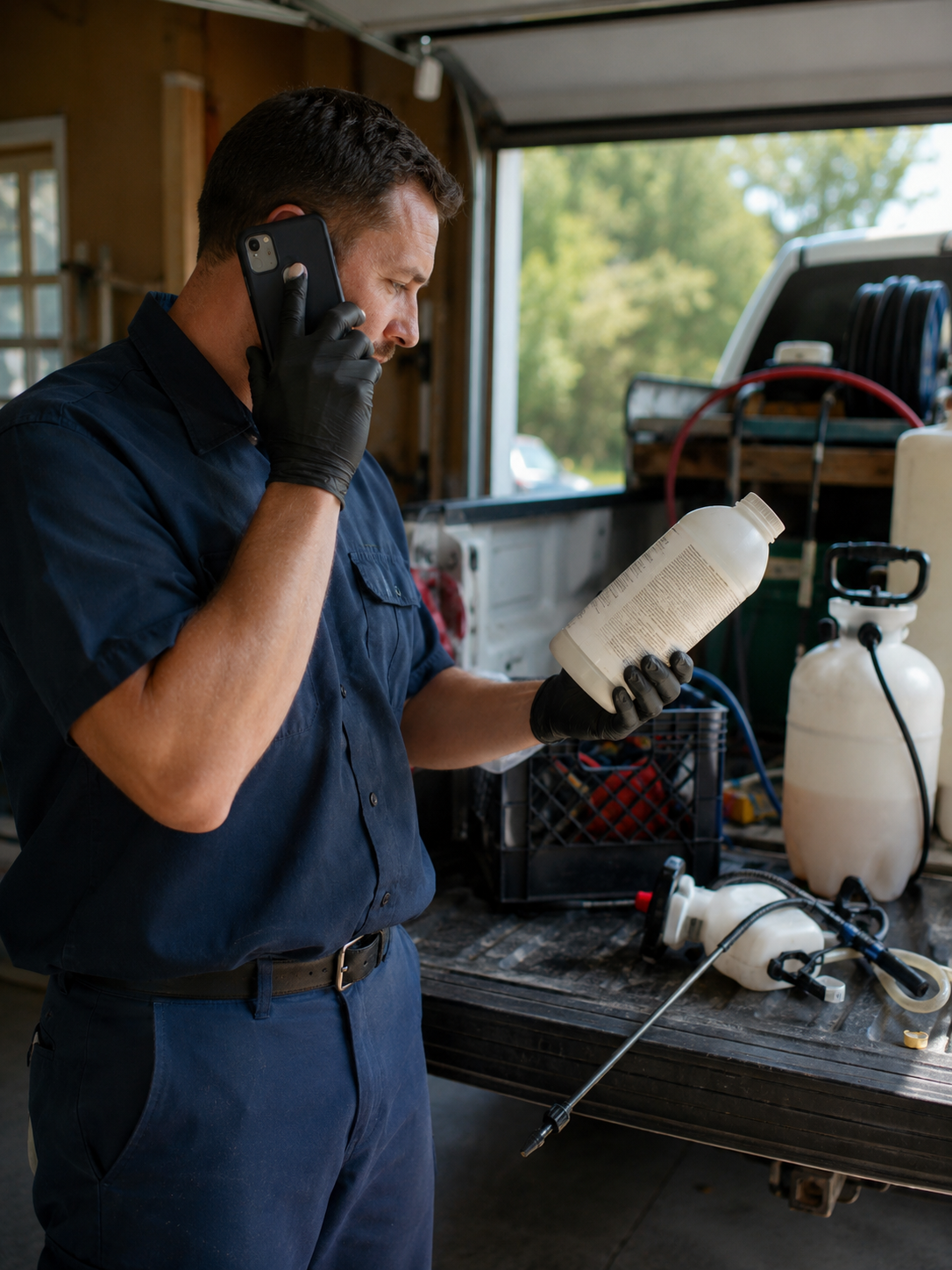
When a customer contacts you or your company to report that they believe a pest control application caused damage — to their property, plants, pets, or their own health — the correct response is: document, escalate, and do not argue.
- Document everything the customer tells you: what they observed, when, which areas were treated, and which products were used at the most recent service
- Escalate to your certified operator immediately — do not attempt to independently resolve a complaint that involves potential property damage or health effects
- Do not argue with the customer about whether the pesticide caused the problem. You do not have enough information to make that determination in the field, and arguing at the door never helps
- Provide your company's contact information and let the certified operator or management handle the investigation
FDACS Inspection and the Complaint Process
FDACS pest control inspectors may initiate an inspection based on a customer complaint, a referral from another agency, a routine compliance check, or observation of an application in progress. Inspectors are authorized to:
- Enter the company's place of business during normal business hours to inspect records, pesticide storage, and equipment
- Observe applications in progress
- Review application records and verify that they match the applications being made
- Inspect pesticide storage areas for proper labeling, containment, and segregation from food and feed
- Check that technicians are using the required PPE for the products being applied
- Verify that vehicles are properly identified with the company name and license number
When an inspector arrives at a job site where you are working, cooperate professionally. You do not need to answer questions beyond what is necessary to verify who you are, who you work for, and what you are applying. If you are uncertain how to respond to an inspector's questions, call your certified operator before answering.
Your application records are your best protection in any FDACS inspection or investigation. A technician with complete, accurate records showing label-compliant applications is in a fundamentally different position than a technician with missing or vague records. Documentation is not just a compliance task — it is professional self-protection.
The GI-BMP Program
The Green Industries Best Management Practices (GI-BMP) program is a Florida-specific training and certification program developed by the University of Florida IFAS Extension, the Florida Department of Environmental Protection, and several Water Management Districts. It is designed for anyone who applies fertilizers, pesticides, and irrigation to Florida's urban landscape — including pest control technicians who perform lawn and ornamental applications.
GI-BMP certification demonstrates that you understand Florida-specific best management practices for reducing nutrient runoff into surface and groundwater — a critical environmental concern in a state with hundreds of freshwater springs, lakes, and coastal estuaries. The certification requires completing a training course (available online and in person) and a written exam.
Increasingly, local government contracts for pest control services — municipal landscaping, school district contracts, county facility management — require that technicians performing lawn and ornamental work hold GI-BMP certification. If your company pursues government contracts or commercial landscape accounts, GI-BMP certification is a practical professional credential, not just a good idea.
GI-BMP training is offered through the University of Florida IFAS Extension system. Training is available online at the UF IFAS Extension website, as well as through in-person workshops offered by county extension offices across Florida. The course typically takes 4–6 hours to complete. Your company may provide reimbursement for the training cost — ask your certified operator or supervisor. Certification must be renewed periodically; check the current renewal requirements when you register.
Pulling It All Together: IPM Is a Mindset, Not a Product List
Four lessons ago, you started with the definition of Integrated Pest Management: a decision-making framework that uses inspection, threshold-based decision making, and a range of control tactics — of which pesticides are one tool, not the only tool. Now you can see how all of those ideas connect to the legal and professional structure of Florida pest control work.
The technician who inspects carefully — who walks the property with their eyes open before recommending anything — is practicing IPM and protecting themselves from liability at the same time. Inspection findings are the foundation of an accurate application record, which is the foundation of a defensible response to any complaint or inspection.
The technician who applies pesticides precisely — to confirmed infestation areas, at labeled rates, with correct PPE, under appropriate weather conditions — is doing IPM work and Chapter 482 compliance work simultaneously. Precision application and legal compliance are not separate goals. They are the same goal described from different angles.
The technician who escalates when needed — who calls their certified operator when a problem is outside their training, when a customer reports a potential exposure, when a situation looks like something they have not seen before — is using the supervisory structure that Chapter 482 was designed to support. The certified operator is not a bureaucratic formality. They are a resource, a partner, and ultimately the professional responsible for your work. Use that relationship.
And the technician who documents thoroughly — who completes every application record accurately at the time of application, who notes weather conditions, who records the product name and EPA number and area treated without cutting corners — is building a professional record that protects them, their certified operator, their company, and their customers.
IPM is not a product list. It is not a spray schedule. It is a way of approaching pest problems: systematically, thoughtfully, with the minimum necessary intervention, and with full professional accountability for every decision. You are the person on the ground. You see things no inspector, no certified operator, and no product label can see from a distance. That makes you the most important variable in whether IPM actually works — not in theory, but in every property you service, every day you go to work.