To qualify for CEU credit, you must complete this course material in its entirety. The full course is designed to require a minimum of 1 hour 50 minutes of reading and study at a reasonable pace, plus the review questions at the end. Your time in each section is being monitored and recorded.
This course covers wood-destroying organisms for Florida certified operators across four lessons. By the end of the course you will be able to:
- Apply the Florida Chapter 482 and Rule 5E-14 requirements that govern WDO inspections, reports, contracts, and recordkeeping.
- Describe termite biology and caste structure and explain how it informs treatment choices.
- Identify Florida's subterranean and drywood termite species, wood-destroying beetles, and wood-decaying fungi, and the conditions that favor them.
- Perform a WDO inspection and select appropriate treatment methods, including soil termiticides, baits, borates, and fumigation.
These objectives are reviewed at the end of the final lesson.
Section 1: Florida WDO Regulations
Florida regulates Wood-Destroying Organism (WDO) inspections and treatments under two primary bodies of law: Florida Statute Chapter 482 (Pest Control) and Florida Administrative Code (FAC) Chapter 5E-14. Every licensed WDO operator in Florida must understand these rules not as abstract legalese, but as practical daily requirements that govern how you inspect properties, write reports, structure contracts, and manage your financial responsibility obligations. Violations can result in license suspension, administrative fines, and civil liability.
What Counts as a Wood-Destroying Organism in Florida?
Under Florida law, the term "wood-destroying organism" covers more than just termites. The regulated WDO category includes subterranean termites, drywood termites, dampwood termites, wood-destroying beetles (such as old house borers and powderpost beetles), and wood-decaying fungi. This broad definition is important for inspectors: a WDO inspection report must account for evidence of all these organisms, not just the termite species a customer is asking about.
Chapter 482 Florida Statutes — Core Requirements
Licensing and Employee Identification
Any person performing pest control services in Florida for compensation must hold an appropriate identification card issued by the Florida Department of Agriculture and Consumer Services (FDACS). For WDO work specifically, both inspectors and treatment technicians must carry a current employee identification card with their photograph, license category, and employer information at all times while performing services. A licensee who allows an unlicensed employee to perform WDO inspections or treatments is subject to disciplinary action, even if the supervising certified operator is on-site.
A "certified operator" — a person who has passed the Florida structural pest control certification exam for the WDO category — must be employed by and directly responsible for each pest control business performing WDO work. The certified operator does not need to personally perform every inspection, but must be available for supervision and is professionally responsible for all work performed under their license.
Contracts and Required Disclosures
Before performing any WDO treatment, a written contract must be executed between the pest control company and the customer. The contract must include: the name and address of both parties, the property address, the pest(s) to be controlled, the method(s) to be used, a description of the treatment area, the total cost, the guarantee period and any conditions of the guarantee, whether a re-treatment or repair guarantee is offered, and notice of any pesticide application that will be made. For termite soil treatment contracts specifically, the contract must specify whether the guarantee covers re-treatment only, or re-treatment plus repair of damage.
Florida law requires that customers receive a copy of the contract before work begins. This is not a courtesy — it is a legal requirement. Failure to provide the contract is a violation of Chapter 482. Contracts for annual renewal services (such as bait system monitoring) must clearly state the annual fee, renewal terms, and what happens if the customer cancels.
The WDO Inspection Report (Form WDO-IR)
Any person who, for compensation, inspects a structure for wood-destroying organisms and provides a written report of the findings must use the standardized WDO Inspection Report (FDACS Form WDO-IR) or an equivalent form that meets all state requirements. This requirement applies to pre-sale inspections, re-inspections, and any other inspection for which a written report is provided to a third party such as a lender or real estate agent.
The WDO-IR must document: the date of inspection, the property address, the inspector's name and license number, the specific areas inspected and any areas not inspected (with reason), evidence of active infestation, evidence of previous infestation, visible damage, conducive conditions, and the species identified where possible. Importantly, the report must distinguish between visible evidence of active infestation versus evidence of previous infestation — a distinction that carries significant legal weight in real estate transactions.
A WDO inspection report is a legal document that real estate buyers, sellers, lenders, and courts rely upon. Failing to note visible evidence of infestation or damage, or failing to document areas that were inaccessible during the inspection, is among the most common sources of litigation against pest control companies in Florida. Always document inaccessible areas explicitly. "Could not inspect" is a legally defensible statement. Silence is not.
Financial Responsibility Requirements
Florida pest control companies performing WDO work must maintain proof of financial responsibility — either a surety bond or a certificate of insurance — filed with FDACS. This requirement exists to protect consumers if a pest control company fails to honor its re-treatment or repair commitments under a guarantee contract. The minimum financial responsibility amount is set by rule and must be maintained continuously while the license is active. A lapse in financial responsibility is grounds for license suspension.
Chapter 5E-14 FAC — Key Operational Rules
Florida Administrative Code Chapter 5E-14 contains the detailed operational rules that implement Chapter 482. Key provisions affecting day-to-day WDO work include record-keeping requirements (inspection reports and service records must be retained for a minimum of four years), pesticide application documentation (what was applied, where, in what quantity, and by whom), and the requirement that all pesticide applications conform to the EPA-registered label — the label is the law.
Rule 5E-14.142 specifically governs WDO inspection reports and requires that inspections be conducted in a thorough and workmanlike manner. An inspector who cannot access an area (crawlspace blocked by stored items, attic access panel painted shut, etc.) must document that the area was not inspected and why. It is a violation to report on areas that were not actually inspected.
Rule 5E-14.144 governs termite and other WDO treatment contracts and specifies what must appear in a written treatment agreement. Verbal agreements for WDO work are not enforceable under Florida law and place the company at risk.
- Employee ID card must be carried at all times during service — photograph, license category, and employer required
- Written contract required before any WDO treatment — must specify treatment method, area, cost, and guarantee terms
- WDO-IR (inspection report) required for any compensated inspection with a written report to a third party
- Distinguish active infestation from previous infestation on every WDO-IR — this distinction has legal consequences
- Document all inaccessible areas explicitly in writing on the inspection report
- Retain all inspection reports and service records for a minimum of four years
- Financial responsibility (bond or insurance) must be maintained continuously and filed with FDACS
- All pesticide applications must comply strictly with the EPA-registered label
Section 2: Termite Biology and Caste System
Before examining individual species, it is essential to understand the shared biology that defines all termites — because this biology directly determines why they are so destructive, why some treatments work and others fail, and why early detection is so critical to protecting Florida structures.
Termites are eusocial insects in the order Blattodea (closely related to cockroaches). They live in colonies organized into functionally distinct castes. Every treatment decision you make — whether to recommend a liquid barrier, a bait system, or localized wood treatment — must be grounded in an understanding of how termite colonies are structured and how they function.
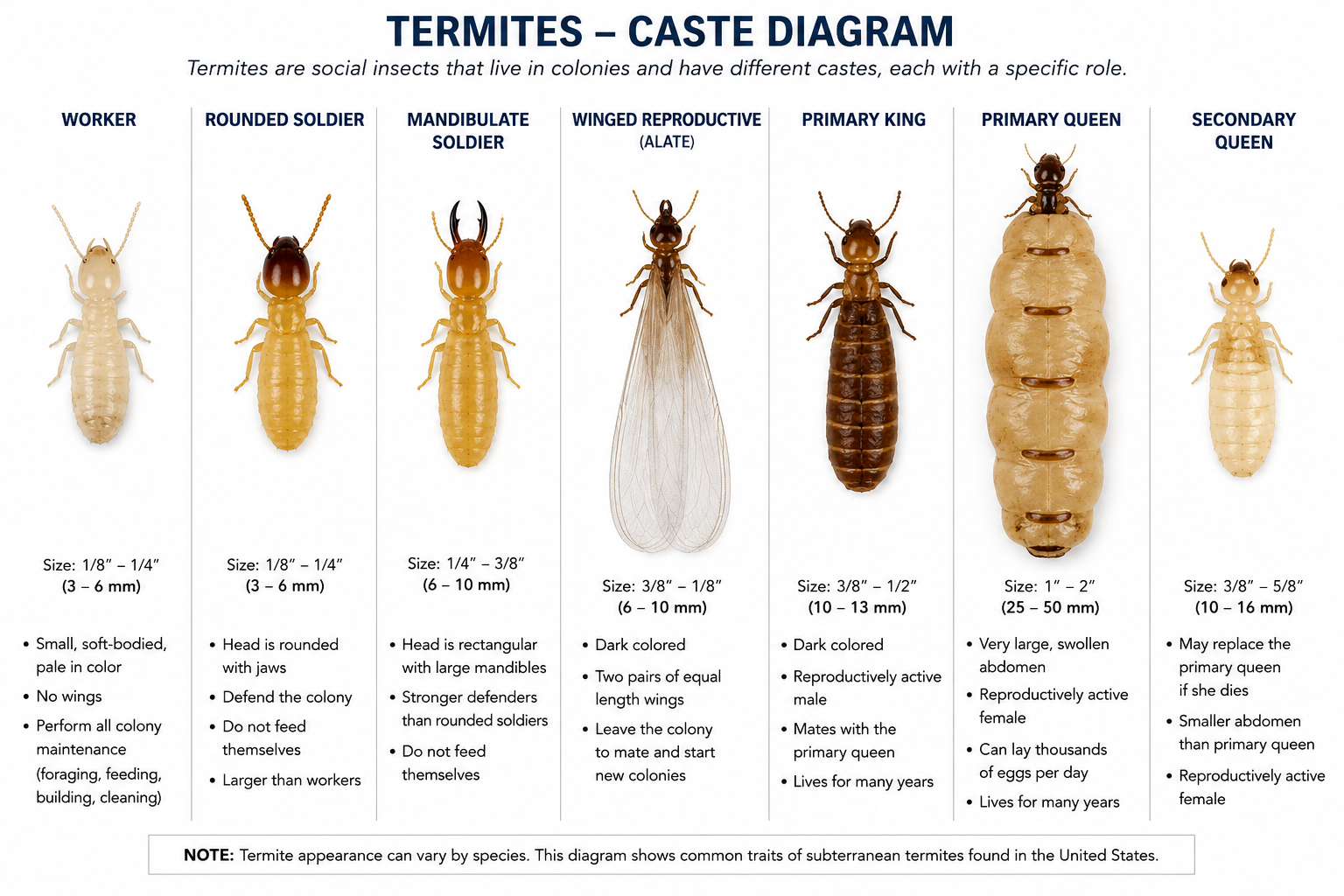
The Three Castes
Workers constitute the vast majority of any termite colony — typically 80 to 90 percent of all individuals. Workers are pale, wingless, and blind. They build and maintain the nest, forage for food, and feed all other castes through a process called trophallaxis (mouth-to-mouth food transfer and pheromone exchange). Workers are responsible for all the structural damage to wood. They are the termites you see when you break open mud tubes or damaged wood. Because workers contact all members of the colony through trophallaxis, they are the key target of bait system technology.
Soldiers defend the colony against predators, primarily ants. They have large, sclerotized (hardened) heads and powerful mandibles or a fontanelle (a pore that produces defensive secretions) used for defense. Soldiers cannot feed themselves and are fed by workers. Soldier morphology — head shape, mandible shape, and the presence or absence of a fontanelle — is the primary feature used to identify termite species in the field. Soldiers are typically present at 1 to 3 percent of the colony population.
Reproductives include the primary king and queen, who are the founders of the colony and the primary egg producers. Mature colonies also produce supplementary (neotenic) reproductives that can take over if the primary reproductives die. Winged reproductive alates (swarmers) are produced seasonally and leave the colony in flight to establish new colonies. Swarmers are the most visible sign of a mature colony to homeowners and are often the first alert that a termite problem exists. Swarmers are poor fliers — most land within 100 to 300 feet of their colony of origin and very few successfully establish new colonies.
Wood as Food
All wood-eating termites share the ability to digest cellulose — the primary structural component of wood — with the help of symbiotic microorganisms (protozoa in lower termites, bacteria in higher termites) living in their hindgut. This digestive relationship is disrupted when termites contact certain insecticides, which is one mechanism of action for non-repellent liquid termiticides like fipronil. Termites cannot distinguish treated wood or soil from untreated material, making non-repellent chemistry especially effective — termites walk through treated zones, pick up the active ingredient, and spread it through trophallaxis to other colony members.
Mud Tubes — The Subterranean Termite Superhighway
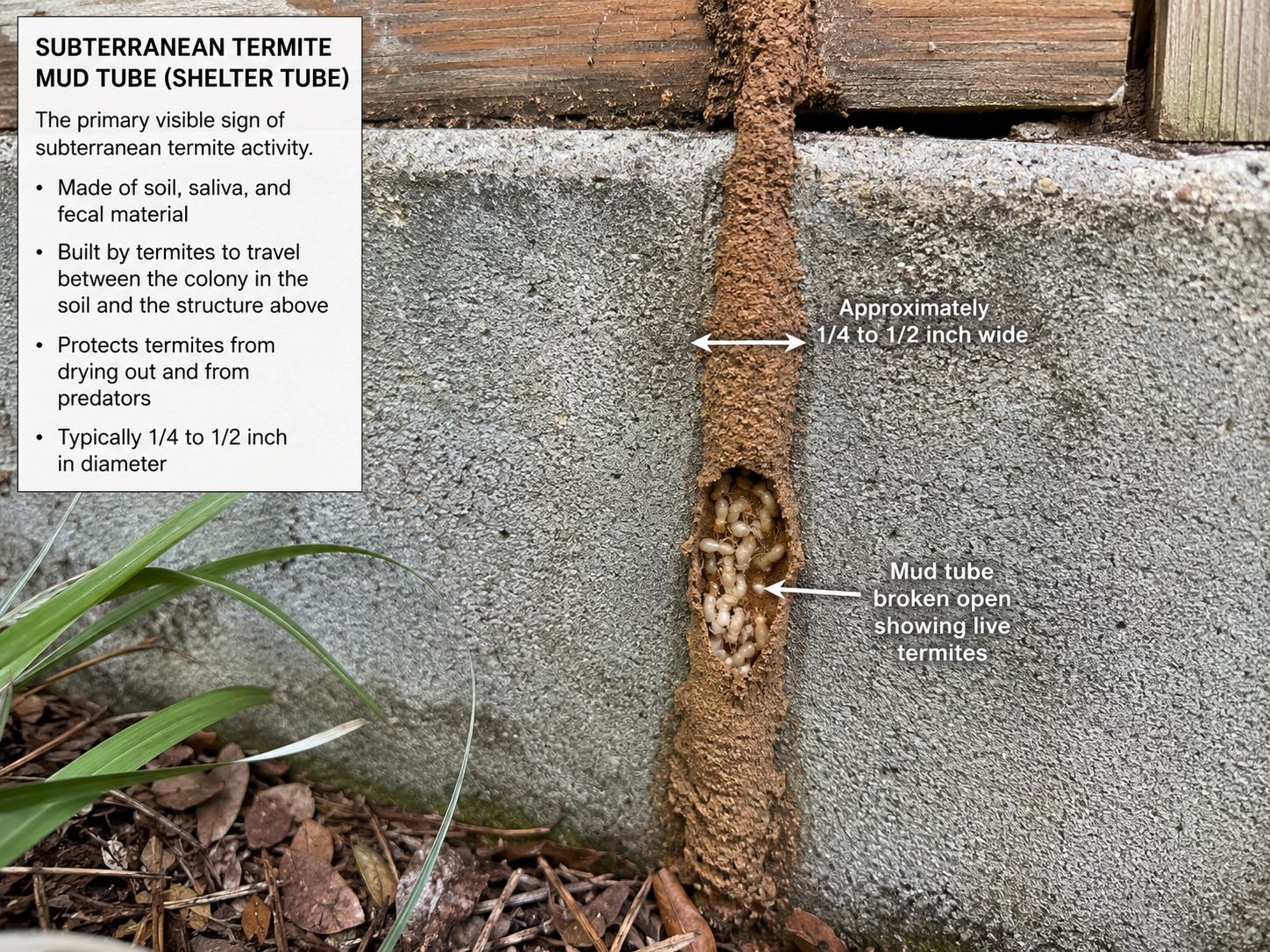
Subterranean termites must maintain contact with the soil to access moisture. They build mud tubes from soil, feces, saliva, and wood particles that protect them from desiccation and predators as they travel from the soil to food sources. Mud tubes are the most reliable visible sign of subterranean termite activity. Active tubes contain live termites and are slightly moist; old, abandoned tubes dry out and crumble easily. Finding a mud tube does not automatically mean active infestation — it means there was an infestation. Probing and breaking open the tube to check for live termites is an essential inspection step.
Four types of mud tubes are encountered during inspections:
- Working tubes — wide, main travel routes from soil to wood
- Exploratory tubes — thin, branching tubes that extend from the ground probing for food sources
- Drop tubes — tubes that descend from infested wood down toward the soil, sometimes visible in crawlspaces
- Swarm tubes — wide tubes built near the soil surface that serve as launch points for alate swarms
Identifying tube type helps assess the status and extent of an infestation.
Soldier morphology is the primary basis for termite species identification in the field. Head shape (rectangular vs. oval/teardrop-shaped), mandible form, body size, and the presence or absence of a fontanelle allow a trained inspector to distinguish between Reticulitermes, Coptotermes, Amitermes, Prorhinotermes, Neotermes, Cryptotermes, and Incisitermes species. When identification is uncertain, collect a sample in alcohol and submit to the University of Florida IFAS Extension for confirmation.