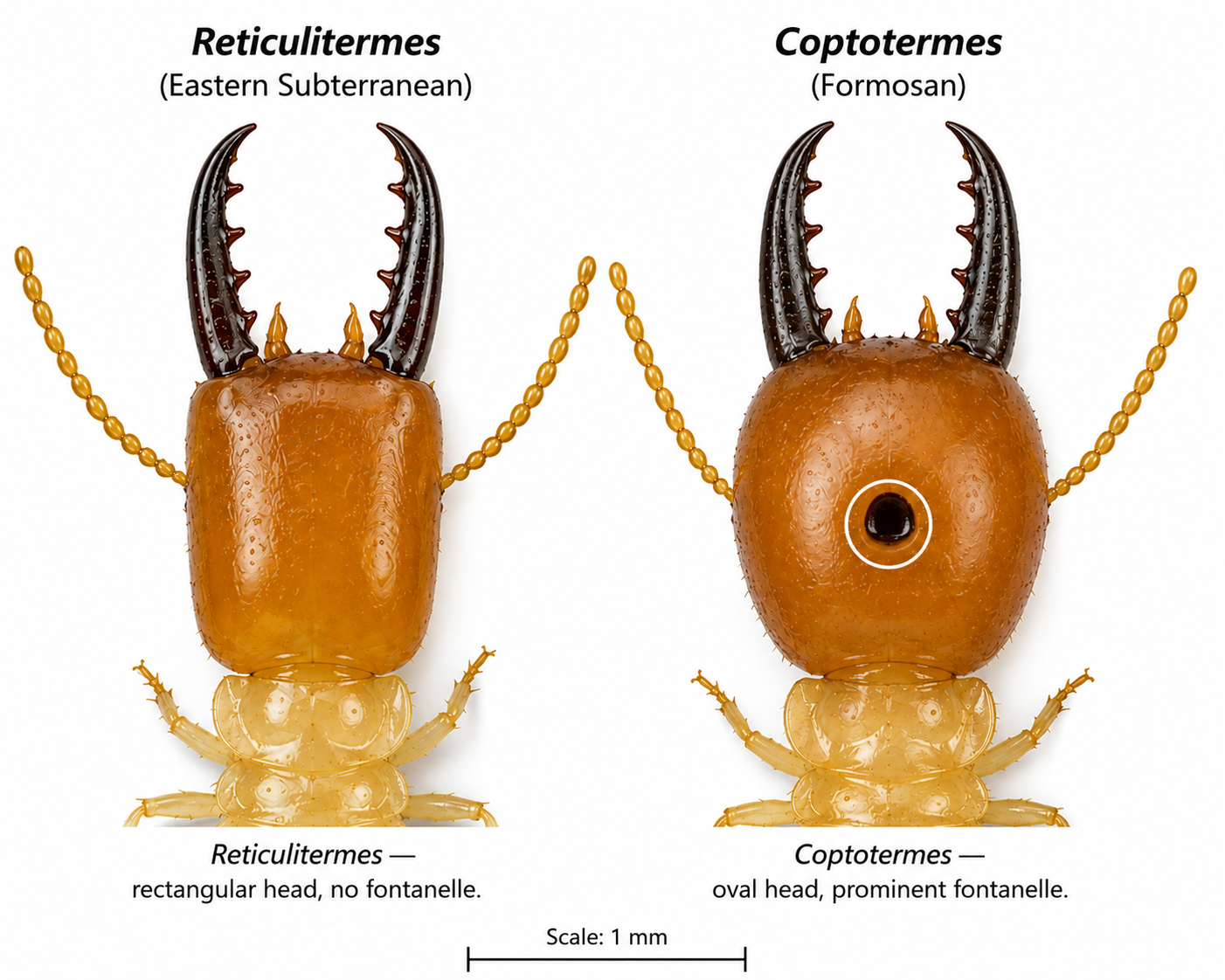
Florida is home to more termite species than any other state in the continental United States. The warm, humid climate and abundant wood in construction creates ideal conditions for both native species and the invasive species that have been introduced through the port of Miami and other entry points. Correct species identification drives correct treatment decisions — a management approach that works for Eastern Subterranean termites may be inadequate for a Formosan infestation.
Eastern Subterranean Termite (Reticulitermes flavipes)
The Eastern Subterranean Termite is the most widely distributed and most frequently encountered termite in Florida and across the eastern United States. Despite being overshadowed in the headlines by the more dramatic Formosan termite, Reticulitermes flavipes is responsible for more total structural damage in Florida annually than any other single species, simply because it is so ubiquitous.
Identification
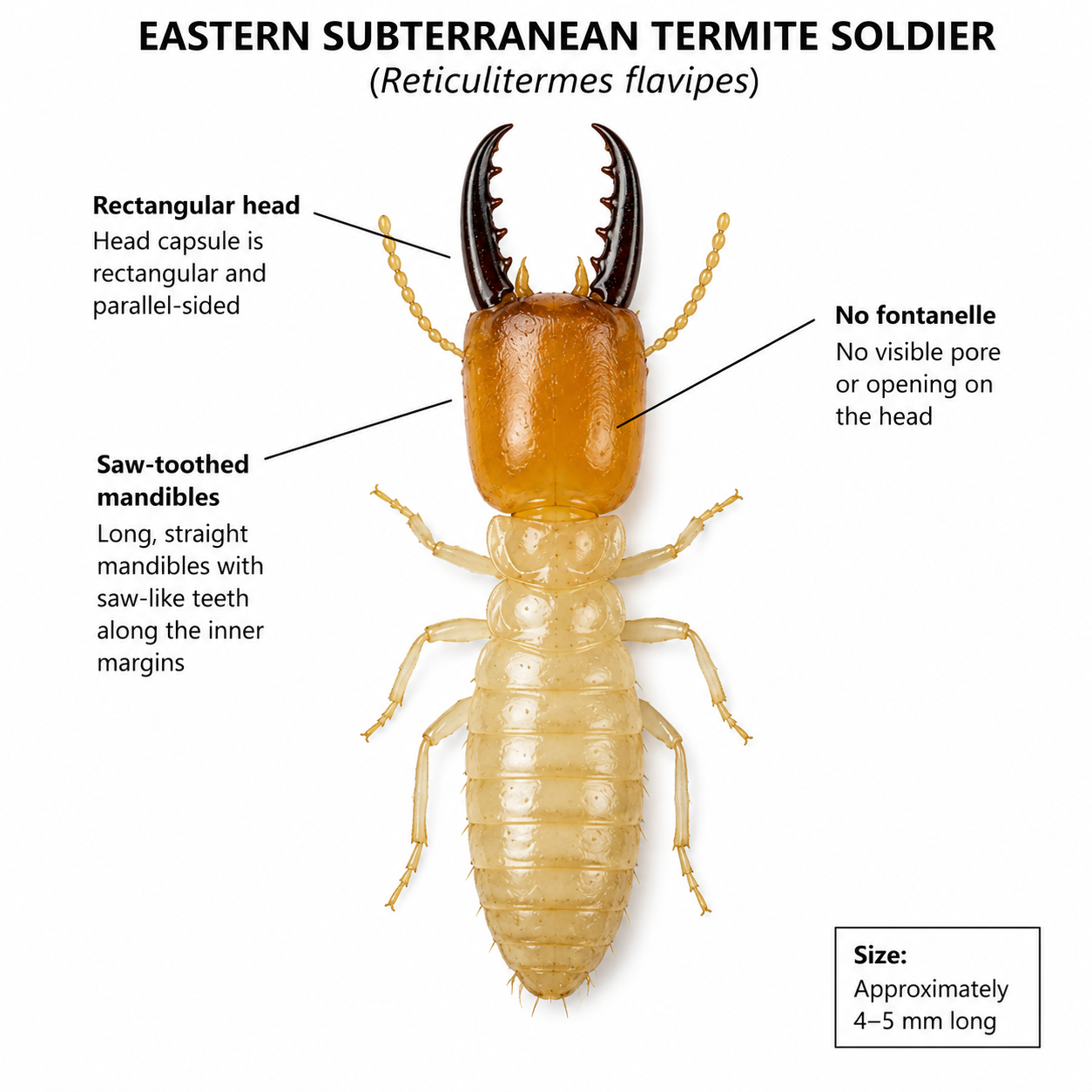
Eastern Subterranean soldiers have a rectangular head (longer than wide) with curved mandibles that lack teeth along their inner edges. The head is pale yellow to light brown. Workers are white to cream-colored. Swarmers (alates) are dark brown to black with two pairs of equal-length wings — a key distinction from flying ants, whose wings are unequal in length and have a visible "pinched" waist. Alate wings break off readily after landing, and finding shed wings near a window sill or light fixture is a common first indicator of a swarm event.
Biology and Behavior
Eastern Subterranean colonies typically contain 100,000 to 1,000,000 workers and can include multiple satellite colonies connected by foraging tunnels. The colony king and queen are long-lived — queens can survive 15 to 25 years. Colonies grow slowly; a colony from a single pair of swarmers takes 3 to 5 years to reach the size needed to produce its own swarmers. Swarming occurs primarily from February through April in Florida, typically after warm rain events.
Eastern Subterranean termites forage in soil and construct the classic mud tube structures when crossing exposed surfaces. They prefer soft, moisture-damaged wood and typically consume wood following the grain, leaving behind a honeycombed gallery pattern packed with soil and fecal material. This "dirty" gallery appearance distinguishes subterranean termite damage from drywood termite damage, which is cleaner with no soil contamination.
Management
Liquid soil treatment and bait systems are both effective management options. Termidor (fipronil) applied as a continuous treated zone in the soil around and under the structure is highly effective — workers contact the fipronil as they forage, pick up a lethal dose, and transfer it to nestmates through trophallaxis, eventually eliminating the colony. Altriset (chlorantraniliprole) is a newer option with a favorable environmental and non-target safety profile. Bait systems (Sentricon Always Active, Advance Termite Bait System) target the worker caste directly through attractive cellulose bait laced with an insect growth regulator or non-repellent active ingredient.
Formosan Subterranean Termite (Coptotermes formosanus)
The Formosan Subterranean Termite is the most destructive termite species in the world and one of the most serious structural pest threats in Florida. Originally from southern China and Taiwan, it was introduced to the United States via port activity following World War II and was first confirmed in Florida in the 1980s. Today it is established throughout South and Central Florida and is spreading northward.
Why Formosan Termites Are Different
Colony size is the defining characteristic that separates Formosan termites from Eastern Subterranean termites. Mature Formosan colonies can contain 2 to 10 million workers — five to ten times the size of a mature Eastern Subterranean colony. This matters enormously for two reasons: the foraging pressure on any given structure is dramatically higher, and the total damage a Formosan colony can cause before it is discovered is proportionally greater. A large, undiscovered Formosan infestation can cause structural damage that would take an Eastern Subterranean colony a decade to produce, in a fraction of the time.
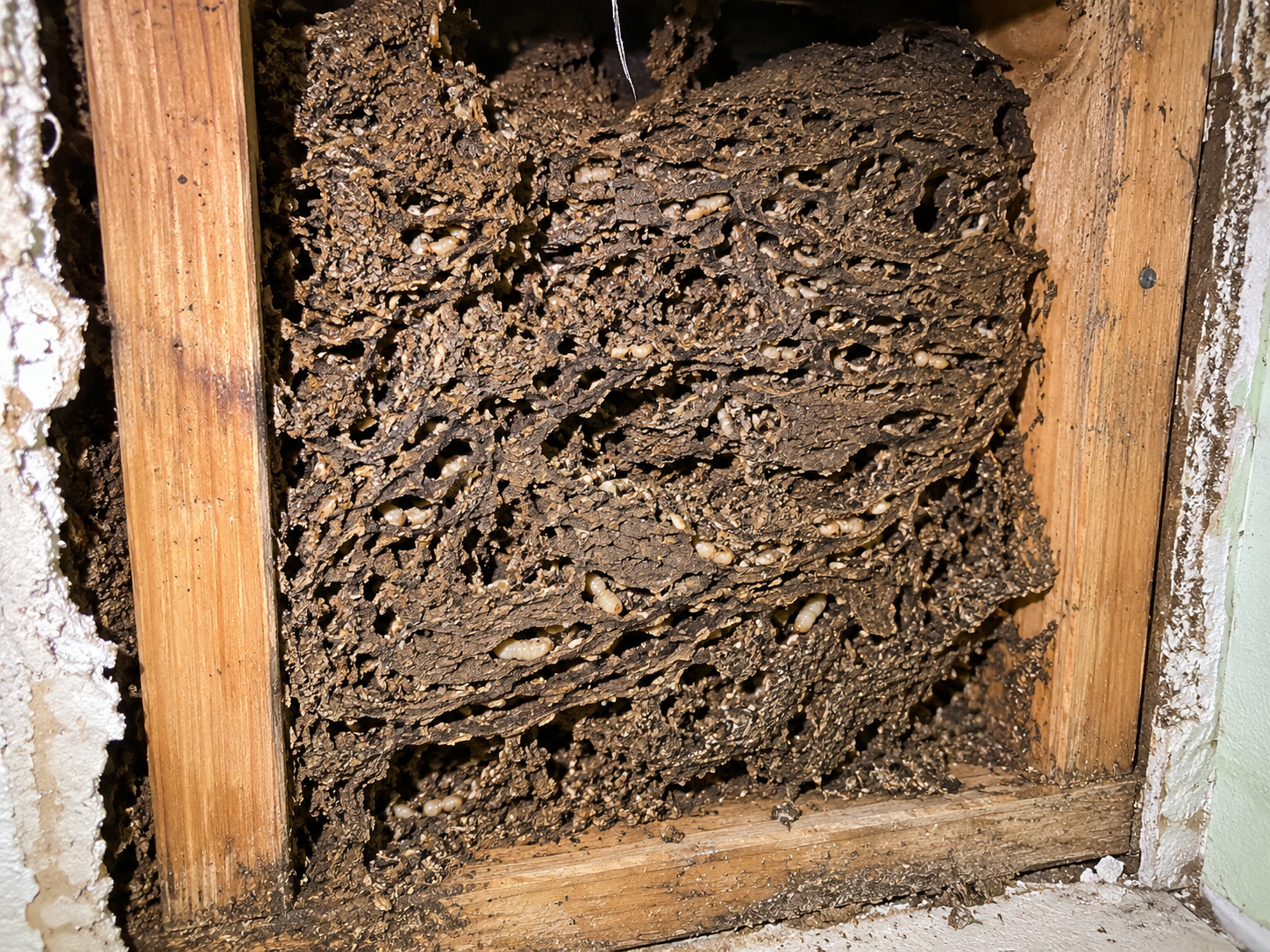
Formosan termites also construct carton nests — above-ground nest structures built from chewed wood, soil, fecal material, and saliva inside wall voids, attic spaces, or even within large trees. This capability to establish a self-contained above-ground moisture source means Formosan colonies can survive soil treatment barriers that would eliminate an Eastern Subterranean colony. This is why bait systems or comprehensive treatment approaches are strongly recommended for confirmed Formosan infestations.
Identification
Formosan soldiers have an oval (teardrop-shaped) head wider than it is long — distinct from the longer, more rectangular head of Eastern Subterranean soldiers. The head has a pore (fontanelle) near the front that exudes a white defensive secretion when the soldier is disturbed. Soldiers are highly aggressive and will bite vigorously when a colony is disrupted. Swarmers are pale yellow to yellowish-brown, larger than Eastern Subterranean swarmers, and swarm from April through June — later in the season than Eastern Subterranean swarmers.
Management
Bait systems are the preferred management approach for Formosan infestations because they target the colony rather than just creating a chemical barrier. The slow-acting insect growth regulator or non-repellent active ingredient in bait is picked up by workers and spread throughout the colony through trophallaxis, eventually eliminating the queen and collapsing the colony. Liquid treatment alone is significantly less reliable for large Formosan colonies because the sheer foraging pressure may find gaps or breaches in a treated zone.
If a Formosan colony has established an above-ground carton nest, a soil liquid treatment alone will not eliminate the infestation. The carton nest provides the colony with its own moisture source, making soil contact unnecessary. Any confirmed or suspected Formosan infestation with structural evidence of above-ground nesting must be treated with a comprehensive approach that includes bait installation. Inform the customer that suppression of a large Formosan colony may take several months.
Asian Subterranean Termite (Coptotermes gestroi)
The Asian Subterranean Termite is an invasive species introduced to Florida through the port of Miami and was first confirmed in the state in 1996. It is now established in Miami-Dade, Broward, and Palm Beach counties and is spreading northward along the Atlantic coast — including into Indian River County and the broader Treasure Coast area. In areas where both Coptotermes gestroi and Coptotermes formosanus are established, they have been documented to hybridize, raising concerns about the production of offspring with characteristics of both species.
Identification
Distinguishing Asian Subterranean termites from Formosan termites requires careful examination of soldier morphology. Asian Subterranean soldiers have an oval to pear-shaped head that is proportionally larger relative to body size compared to Formosan soldiers. The fontanelle is prominent. Soldier mandibles curve more distinctly inward at the tip in Coptotermes gestroi compared to Coptotermes formosanus. Swarmers are dark brown to black and swarm from February through April — overlapping with and earlier than Formosan swarm season.
Biology and Management
Asian Subterranean Termite colonies can reach 1 million or more workers — smaller than a mature Formosan colony but dramatically larger than an Eastern Subterranean colony. Like Formosan termites, Coptotermes gestroi can build above-ground carton nests inside wall voids and other protected spaces, complicating soil treatment approaches. The species shows a strong preference for attacking the structural wood of buildings and is considered particularly aggressive in comparison to native Florida species.
Management approaches mirror those for Formosan termites: bait systems are preferred for colony elimination, supplemented by liquid non-repellent treatment where appropriate. Any property in South or Central Florida with confirmed or suspected Coptotermes infestation — whether formosanus or gestroi — should be evaluated for above-ground carton nesting before a treatment method is finalized.
Section 4: Native and Less Common Florida Termite Species
Florida Darkwing Termite (Amitermes floridensis)
The Florida Darkwing Termite is a native Florida species in the genus Amitermes, first formally described by scientists in 1934. Unlike the highly destructive Coptotermes and Reticulitermes species, Amitermes floridensis is considered a secondary pest — it generally attacks wood that is already in an advanced state of decay or directly in soil contact, rather than sound structural lumber. Its economic importance as a structural pest is significantly lower than that of the subterranean species discussed above.
Identification
Amitermes soldiers are distinctive: they have a narrow, elongated head with mandibles that curve sharply upward in a sickle shape, appearing almost hook-like when viewed from the side. Workers and soldiers are pale to cream-colored. The species builds its colony in soil, rotting stumps, or logs, and may extend into structural wood that is moisture-damaged or in direct soil contact.
Field Significance
Florida Darkwing Termite infestations in structural wood should be interpreted as a strong indicator of a pre-existing moisture problem or wood-to-soil contact issue. When you find Amitermes floridensis in a WDO inspection, your primary recommendation to the property owner should address the moisture or soil contact conducive condition causing the deterioration. Standard subterranean termite liquid treatments or bait systems are effective if the conducive conditions are also corrected.
Cuban Subterranean Termite (Prorhinotermes simplex)
The Cuban Subterranean Termite is a tropical species naturally distributed throughout the Caribbean and was introduced to Florida primarily through the Florida Keys and the Miami-Dade area, where it is established in coastal communities. It was first documented in Florida in 1956. Prorhinotermes simplex is a structural pest but is generally considered less economically damaging than Reticulitermes flavipes and significantly less destructive than Coptotermes species.
Identification
Cuban Subterranean soldiers are medium-sized with a slightly rectangular to rounded head profile. A distinctive feature is the fontanelle (a frontal pore), which produces a milky defensive secretion — this fontanelle distinguishes Prorhinotermes from Reticulitermes soldiers, which lack a functional fontanelle. Soldiers and workers are pale to yellowish-white. The species is most commonly encountered in coastal areas of South Florida, particularly in the Keys and in Miami-Dade County.
Biology and Management
Cuban Subterranean Termite colonies are relatively small, typically in the range of several thousand to a few hundred thousand workers. The species nests in soil and in wood in contact with soil, building traditional mud tube structures. Standard liquid soil treatment with non-repellent termiticides (fipronil, chlorantraniliprole) and bait systems are effective management options. The primary practical challenge with this species is its geographic concentration in coastal areas where soil conditions, environmental sensitivity, and proximity to salt water can complicate treatment logistics.
Florida Dampwood Termites (Neotermes spp.)
Dampwood termites in Florida belong primarily to the genus Neotermes and represent a distinct ecological group from subterranean or drywood termites. As the name implies, they have a fundamental biological requirement for high-moisture wood — they cannot survive in sound, dry lumber. In structural settings, a dampwood termite infestation is always a symptom of a moisture problem, not the primary cause of structural risk.
Identification
Dampwood termite soldiers and workers are noticeably larger than those of most subterranean species. Soldiers have large heads with powerful mandibles and lack a fontanelle. The absence of a fontanelle, the larger body size, and the requirement for moist wood distinguish dampwood termites from subterranean and drywood species. Swarmers are large and often have a reddish-brown coloration.
The Critical Management Principle
Eliminating a dampwood termite infestation without correcting the underlying moisture problem will result in re-infestation. The moisture source must always be identified and eliminated first. Common sources include: roof leaks infiltrating wall cavities, plumbing leaks behind walls, inadequate ventilation in crawlspaces causing condensation, improper drainage that keeps soil wet against the structure's wood components, and wood embedded in concrete or masonry that wicks ground moisture. Once the moisture source is eliminated, the remaining termites in the affected wood can be treated with borate-based wood treatments (Tim-bor, Boracare) or by replacing damaged structural components.
| Species | Soldier Head | Fontanelle | Colony Size | Swarm Season (FL) |
|---|---|---|---|---|
| Reticulitermes flavipes | Rectangular (long) | Absent | 100K–1M | Feb–Apr |
| Coptotermes formosanus | Oval/teardrop (wide) | Present | 2M–10M | Apr–Jun |
| Coptotermes gestroi | Oval/pear-shaped | Present | 1M+ | Feb–Apr |
| Amitermes floridensis | Narrow, elongated | Absent | Secondary pest | Variable |
| Prorhinotermes simplex | Rectangular–rounded | Present | Thousands–100K | Variable |
| Neotermes spp. | Large, powerful | Absent | Moderate | Variable |