
Drywood termites are fundamentally different from subterranean termites in one critical way: they do not require soil contact or a soil-based moisture source to survive. They extract all the moisture they need from the wood they consume, allowing them to infest any dry structural lumber, furniture, or wood product — even in locations with no soil contact whatsoever. This characteristic makes drywood termites the primary termite concern for wooden furniture, wooden structural elements in upper stories, and pre-built structures moved between locations.
West Indian Drywood Termite (Cryptotermes brevis)
The West Indian Drywood Termite is the most economically damaging drywood termite in Florida and is considered by many entomologists to be the most destructive drywood termite species in the world. It is an invasive species, introduced to Florida and other Gulf and Atlantic coastal states through shipping trade with the Caribbean. It is established throughout South and Central Florida.
Identification — The Fecal Pellet is the Key
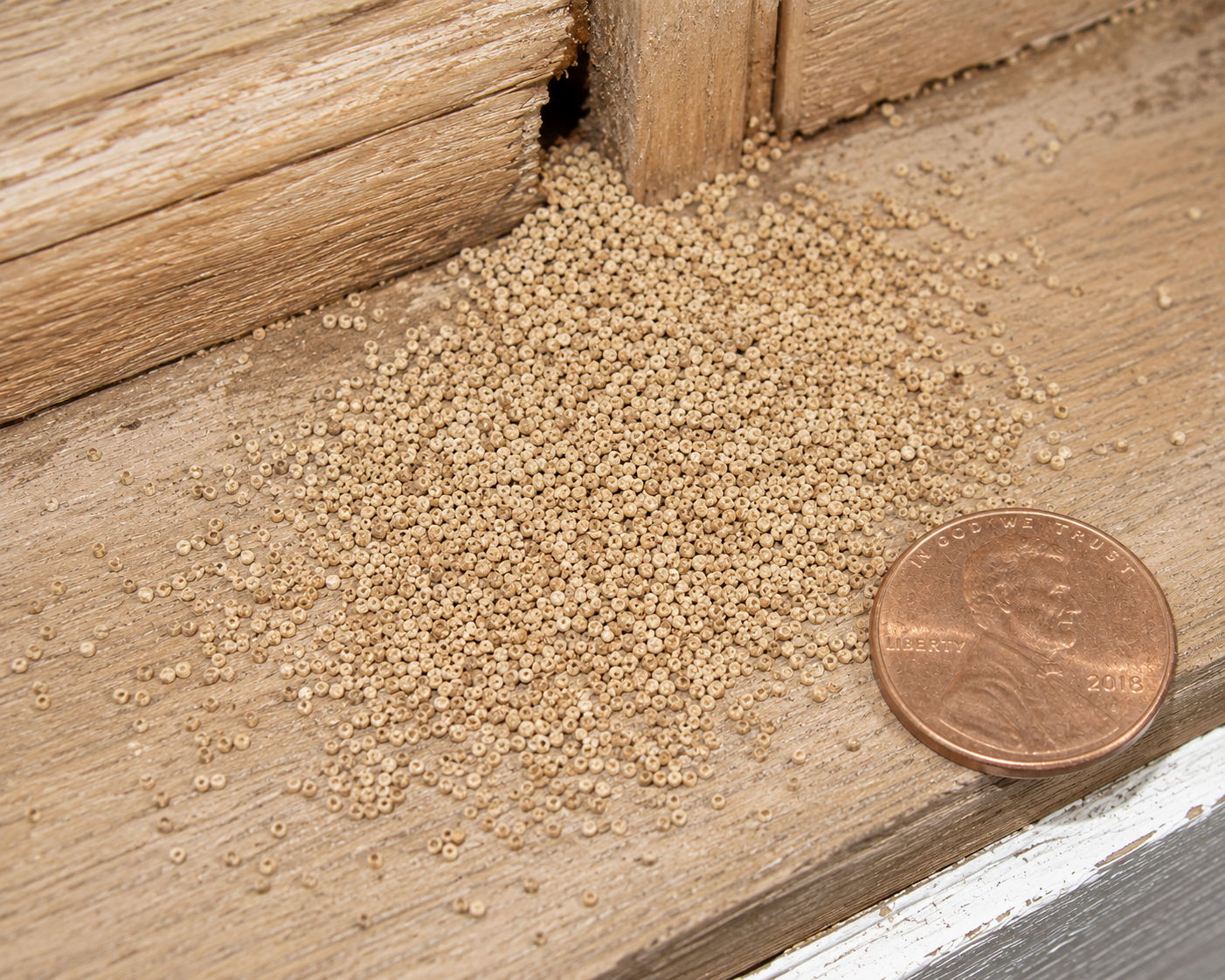
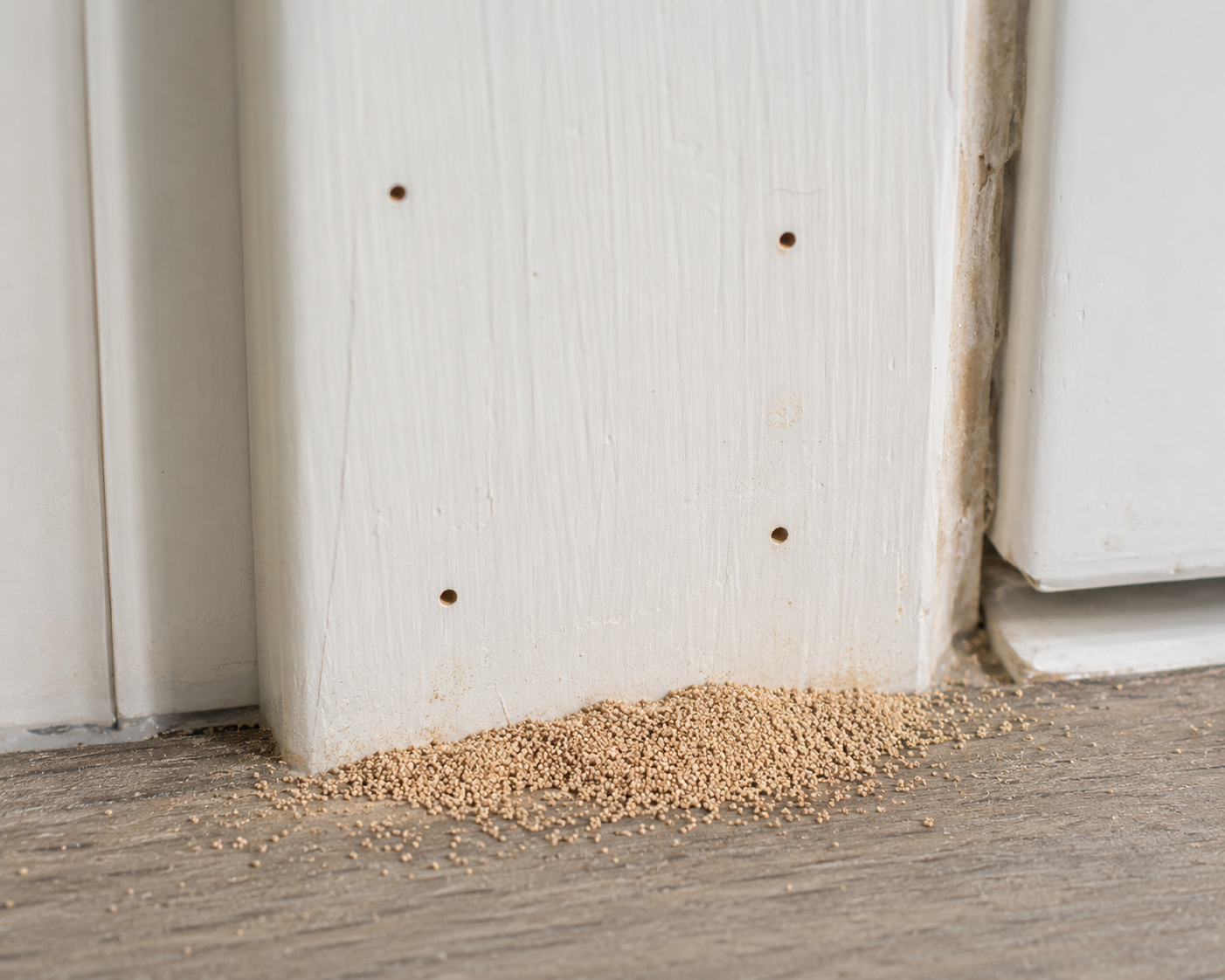
Drywood termites push their fecal pellets (frass) out of small "kickout holes" in infested wood. The pellets are the single most reliable field identification feature for drywood termites and distinguish them from subterranean termites immediately. Drywood termite pellets are hard, dry, and six-sided (hexagonal) with six concave surfaces. They are typically 1 mm or less in length and resemble tiny grains of sand or coffee grounds. Finding piles or accumulations of these pellets below or around wooden items is essentially diagnostic of drywood termite activity.
Cryptotermes brevis soldiers have a distinctive "phragmotic" (plug-shaped) head — the front of the head is heavily sclerotized and roughly rectangular, used to physically block the gallery entrance against invaders. This blocky, armored head shape distinguishes Cryptotermes soldiers from the more elongated heads of other drywood termite soldiers. Workers are pale cream. Colony size is small relative to subterranean species: mature Cryptotermes brevis colonies typically contain 500 to 2,000 individuals.
Colony Behavior and Structural Risk
Cryptotermes brevis colonies are small but structures can harbor multiple simultaneous infestations in different areas. Because colonies do not require soil contact, they can infest attic framing, second-floor structural elements, door frames, window frames, furniture, and any other dry wood product. Infestations begin when a swarm event results in alates (swarmers) entering a structure through attic vents, gaps around windows, or other small openings.
Treatment Options
Treatment decisions for drywood termites depend on the extent of infestation. Localized infestations with confirmed, limited extent can be treated with direct wood injection of approved termiticides (Termidor foam, Tim-bor, Boracare), electrocution devices, microwave treatment, or orange oil (d-limonene) for accessible galleries. These spot treatments are cost-effective when the infestation is truly limited. The definitive treatment for widespread or unknown-extent drywood termite infestation is whole-structure fumigation.
- Fumigation with sulfuryl fluoride (Vikane) is the only treatment method that guarantees control of all drywood termites throughout the entire structure, including inaccessible areas
- Fumigation requires a licensed fumigant applicator — a separate FDACS licensing category from standard structural pest control
- Clearance levels must be confirmed with a gas detection device before reoccupancy is permitted
- All food, medications, and certain household products must be removed or double-bagged in NYLOFUME bags per label requirements
- Secondary locks (Fumigators Only locks) must be placed on all entry points during fumigation
- A certified fumigant applicator must be on site throughout the fumigation process
- Fumigation does not provide residual protection — it kills termites present at the time but does not prevent future infestations
Southeastern Drywood Termite (Incisitermes snyderi)
The Southeastern Drywood Termite is a native Florida and southeastern U.S. species. It is less commonly encountered in urban structures than Cryptotermes brevis but is found throughout Florida, particularly in older wooden structures, dead trees, and utility poles. Incisitermes snyderi colonies are larger than Cryptotermes brevis colonies and can produce more extensive galleries within structural wood.
Identification
Incisitermes snyderi soldiers have a large orange-brown head with prominent curved mandibles that have a series of small teeth along the inner edge — distinguishing them from the plug-headed Cryptotermes soldiers. The head is elongated rather than blocky. Fecal pellets are similar in shape to those of Cryptotermes — hexagonal with six concave surfaces — but tend to be slightly larger.
Significance and Management
Incisitermes snyderi is more likely to be found infesting structural wood in direct contact with or embedded in soil, or in areas with slightly elevated moisture content, compared to Cryptotermes brevis which thrives in completely dry wood. Management approaches parallel those for Cryptotermes brevis: localized wood treatment for limited infestations, whole-structure fumigation for widespread infestations.
Localized drywood termite spot treatments address only the portion of the colony that occupies the treated area. If the infestation has spread to inaccessible areas of the structure — wall cavities, attic framing, or structural members behind finished walls — spot treatment will leave portions of the colony untreated. Whole-structure fumigation is the only method that guarantees treatment of the entire structure regardless of accessibility. Any time the full extent of a drywood termite infestation cannot be confirmed, fumigation should be strongly recommended.
Section 6: Wood-Decaying Fungi
Wood-decaying fungi are included in Florida's WDO inspection and reporting requirements — and for good reason. In many cases, fungal wood decay is a more immediate structural threat than the termite infestation a customer is most concerned about. Fungal decay weakens wood by digesting its structural components, often to the point of complete failure, and creates the moisture-damaged, weakened wood that is preferentially attacked by subterranean and dampwood termites.
How Wood-Decaying Fungi Work
Wood-decaying fungi require four elements to grow: wood (food), moisture, oxygen, and appropriate temperature. The most critical of these for structural pest management is moisture: wood must have a moisture content above approximately 19 to 20 percent to support fungal growth. In Florida's climate, maintaining structural wood below this moisture threshold through proper construction, maintenance, and drainage is the foundation of fungal decay prevention.
Brown Rot Fungi
Brown rot fungi digest the cellulose component of wood while leaving the lignin (the brown structural polymer) largely intact. This gives brown-rot-decayed wood its characteristic dark brown color and a distinctive cracked, cubical appearance — the decayed wood breaks into small cube-like pieces along cracks running both with and across the grain. Brown rot is the most common type of wood decay in structural settings in Florida.
Despite the name "dry rot" for some brown rot species, all wood-decaying fungi require moisture to establish. "Dry rot" refers to the dry, crumbled appearance of the wood after fungal consumption, not to the conditions under which the decay began. A structure with dry-rot-affected wood had a moisture problem — whether or not that problem is still active when discovered.
White Rot Fungi
White rot fungi digest both the cellulose and the lignin components of wood, leaving the wood bleached, soft, and stringy or spongy in texture — a whitish to light yellow color that contrasts with the dark brown appearance of brown rot. White rot species are common on hardwood species and are frequently encountered on exterior trim, decking, and landscape timbers in Florida. Affected wood feels spongy and may compress easily under probe pressure even when it appears relatively intact on the surface.
Documenting Fungal Decay in WDO Inspections
Any visible evidence of wood-decaying fungi must be documented on the WDO Inspection Report. This includes visible fungal fruiting bodies (mushrooms or bracket fungi emerging from wood), discolored or stained wood suggesting active or previous decay, and wood that is soft, spongy, or crumbles under probe pressure. The WDO inspector should probe suspect wood with a screwdriver or pick to assess structural integrity and document the findings.
Conducive conditions for fungal decay — wood-to-soil contact, inadequate clearance between structural wood and grade, plumbing leaks, roof leaks, inadequate crawlspace ventilation, and poor drainage — should all be noted in the WDO report as recommendations for correction.
| Type | What Gets Digested | Appearance | Texture |
|---|---|---|---|
| Brown Rot ("Dry Rot") | Cellulose only | Dark brown, cubical cracks | Crumbles into cubes |
| White Rot | Cellulose + lignin | Bleached white to yellow | Spongy, stringy |
A moisture meter is one of the most valuable tools a WDO inspector can carry. Readings above 19–20% in structural wood indicate elevated moisture sufficient to support fungal growth. Readings above 28% indicate wood wet enough for active fungal decay. Target any discolored, stained, or visually suspect wood with the moisture meter and document readings in your inspection notes. Elevated moisture readings in areas where no visible damage is present are an important early warning to document as a conducive condition.